
Commuting from San Antonio for eating disorder treatment: a planning guide
Austin is close enough that San Antonio families ask whether treatment can fit around a daily drive. Sometimes it can. Here is how to tell, and how to plan the weeks either way.

Can you commute from San Antonio for treatment in Austin?
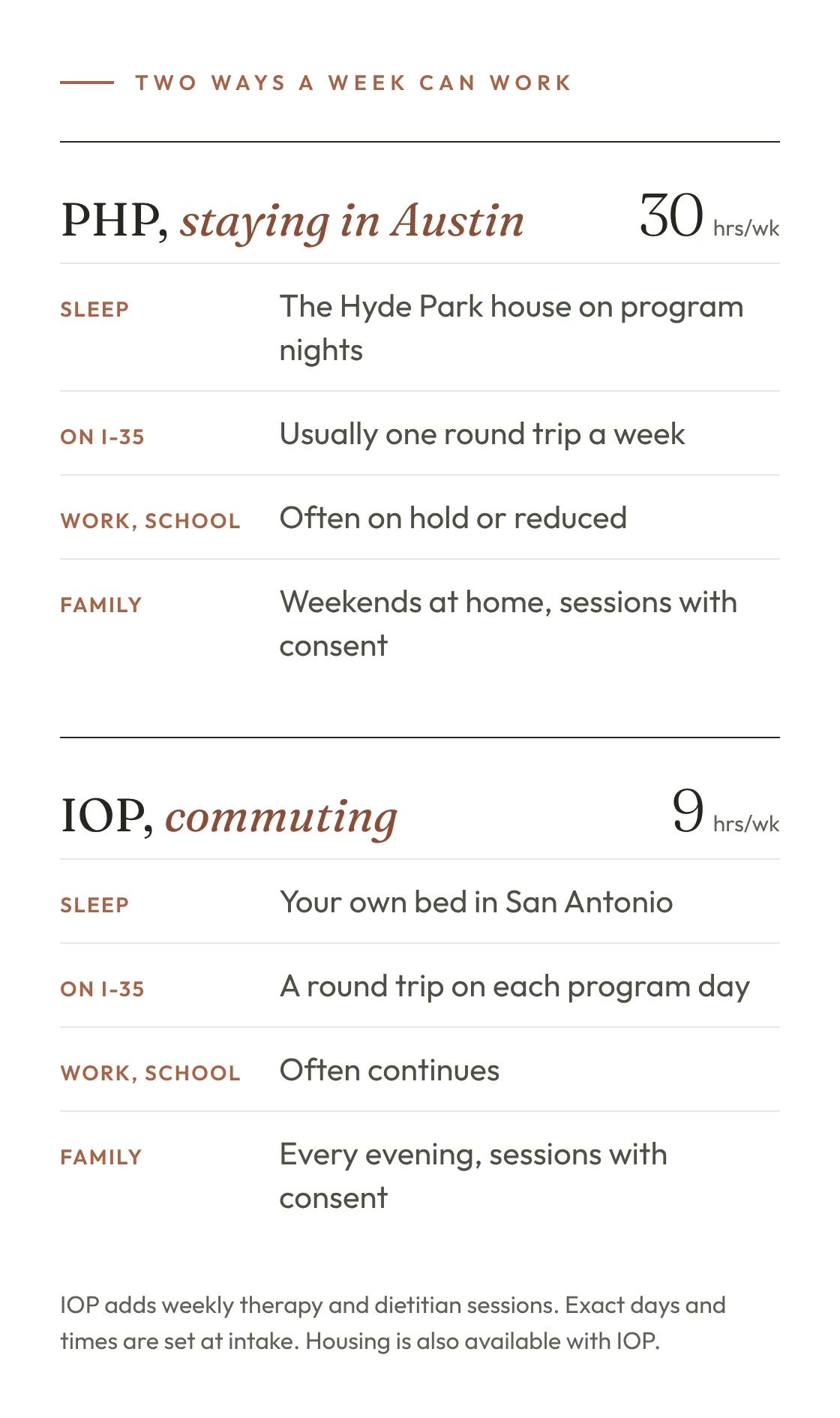
For IOP, often yes. Our intensive outpatient program runs about 9 hours a week, and many people from San Antonio fit the drive around it. Partial hospitalization is different. At about 30 hours a week, a daily round trip of roughly 160 miles on I-35 tends to cost more than it saves, so many San Antonio clients stay in our Austin transitional housing during PHP and go home on weekends.
- The level of care decides the plan. IOP and a commute can coexist. PHP and a daily commute usually wear each other down.
- The drive is real. About 80 miles each way, through stretches of I-35 that state data ranks among the most congested in Texas, with major construction on both ends.
- The plan changes as care changes. A common path is PHP with housing in Austin, then IOP, then home to San Antonio with local aftercare.
- Family can stay close. San Antonio is near enough for weekend time, planned visits and family sessions, with your consent.
Our San Antonio page covers the basics of who we treat and how to reach us. This guide goes further into the logistics: the road, the week, the step-down and the people at home.
What the I-35 drive actually involves
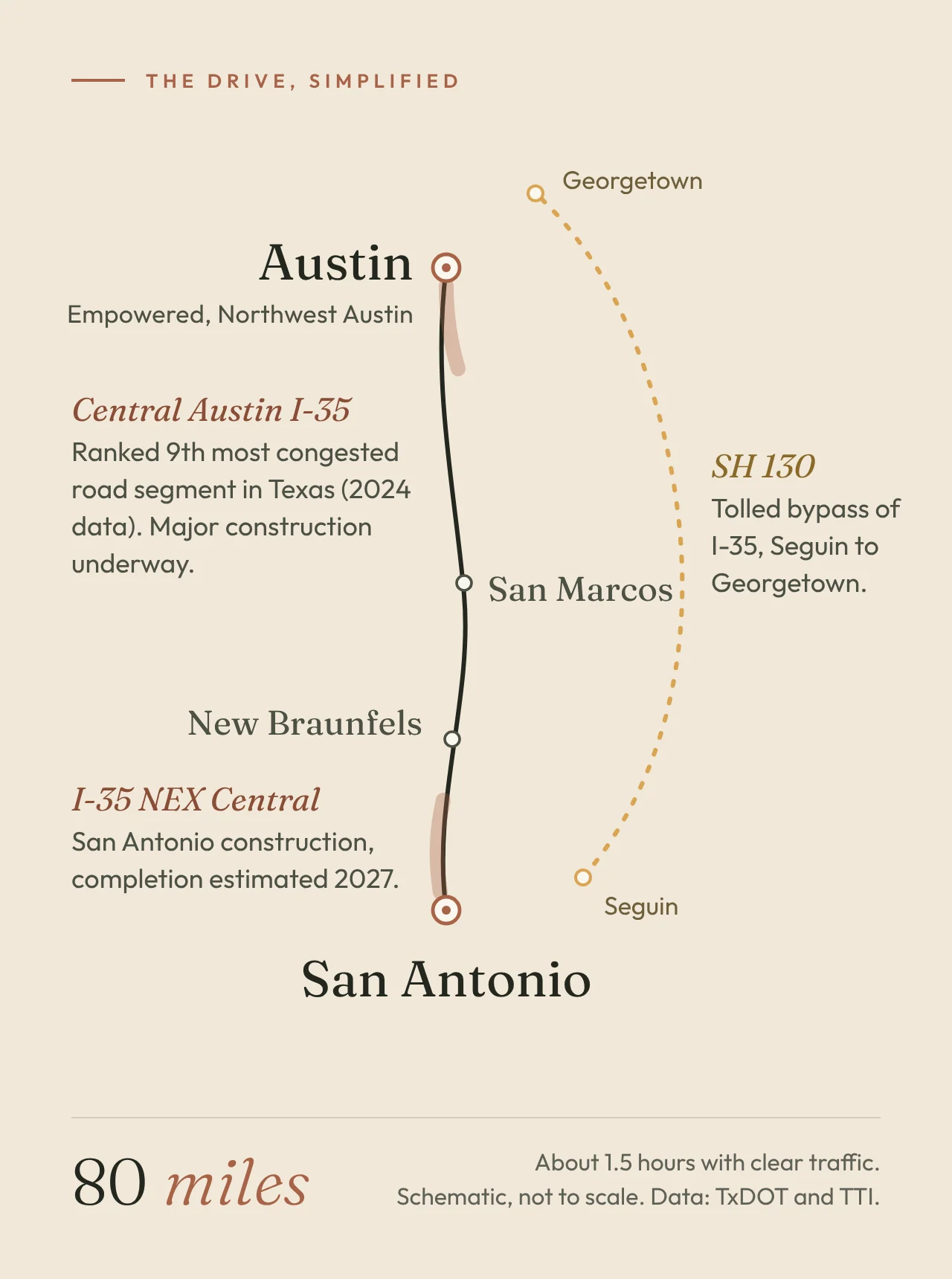
Our center sits on Spicewood Springs Road in Northwest Austin, about 80 miles from San Antonio. With clear roads that is roughly an hour and a half. Clear roads are not something to count on.
Each year the Texas Department of Transportation and the Texas A&M Transportation Institute rank the state's most congested road segments. In the 2025 report, which uses 2024 data, I-35 through central Austin, from US 290 North to Ben White Boulevard, ranked ninth out of roughly 2,100 segments statewide. For truck traffic, the two stretches a San Antonio driver crosses on the way into south Austin, Ben White to Slaughter Lane and Slaughter Lane to SH 45, ranked ninth and tenth. If you share the road with freight at rush hour, you will feel it.
Construction adds to the picture at both ends. In San Antonio, TxDOT's I-35 NEX Central project is building elevated lanes along 9.5 miles of I-35 between Loop 410 North and FM 3009, with completion estimated for 2027. In Austin, TxDOT says the Capital Express Central project through the heart of the city is expected to take six to eight years to build.
Ways to make the drive easier
- Check conditions before you leave. TxDOT's DriveTexas site and app show closures, crashes, construction and live traffic cameras across the state.
- Know the toll option. SH 130 lets drivers bypass I-35 between Seguin and Georgetown. It is tolled, and whether it saves time depends on where in San Antonio you start.
- Plan food for the road. A long drive after a program day is exactly when a planned snack gets skipped. Your dietitian can build the drive into your meal plan, so it is part of the plan rather than a gap in it.
- Share the driving when you can. A family member behind the wheel turns two hours of solo time into two hours of company, and takes one task off a tired person's plate.
Matching the plan to the level of care
The honest answer to "can I commute?" depends far more on the level of care than on the distance.
IOP: a commute can work
Our intensive outpatient program is about 9 hours a week of groups, supported meals and skills work, plus a weekly session with your therapist and one with your dietitian. It is built to sit alongside work, school and family life. For a San Antonio client, that means a handful of round trips a week, which many people manage, especially once the schedule settles into a routine. Exact days and times are set at intake.
PHP: staying in Austin usually works better
Our partial hospitalization program is about 30 hours a week of structured days: several supported meals and snacks, daily groups, individual therapy, dietitian care and medical and psychiatric oversight. If your program days run Monday through Friday, a three-hour round trip each day would add about 15 hours of driving to that week. That is time taken from rest, from evening meals and from the quiet hours when the work of the day settles in.
This is why our transitional housing exists. The houses are in Hyde Park, a residential neighborhood in central Austin a short drive from the center, with separate houses for men and women. Each is a real house with a shared kitchen and dining table and a private bedroom, not a facility. Housing is an optional addition to PHP or IOP, not a separate program.
Brittni Pogue, Co-Founder and Director of Admissions and Business Development, Empowered Treatment
What the weeks can look like
During PHP, with housing
Many people drive up from San Antonio at the start of the week, spend program days at the center and evenings at the house, and head home for the weekend. Weekends become practice. A meal plan for Saturday and Sunday is made before you leave, and what happened at home is part of the next week's work. The point is not to keep you away from San Antonio. It is to give you a stable base on the days that ask the most of you.
During IOP, commuting
On program days the rhythm is drive, groups and a supported meal or snack, then the drive home. On the other days you are at work, in class or at home, practicing with real meals in your own kitchen. Our post on day-to-day life in IOP walks through a program day in more detail. Early fatigue is common, and it usually eases as the routine settles.
Some people mix the two
Housing is available with IOP too. Some San Antonio clients keep their room in Austin for the first weeks after stepping down from PHP, then move home and commute once the new schedule feels steady. Others stay in Austin for all of IOP because home is part of what has been hard. Both are reasonable, and the plan can change as you do.
From PHP to IOP, and back home
Length of stay in PHP is not a fixed number of weeks. It depends on medical stability, nutrition and behavior change, and the plan is reviewed as you go. When the team agrees you are ready, the step down to IOP is planned rather than abrupt. Our guide to levels of care explains how each one works.
For San Antonio clients, the step-down often happens in two moves rather than one: first the drop in program hours, then the move home. Separating them means you are not adjusting to fewer hours of support and a new kitchen, a new schedule and a commute all in the same week.
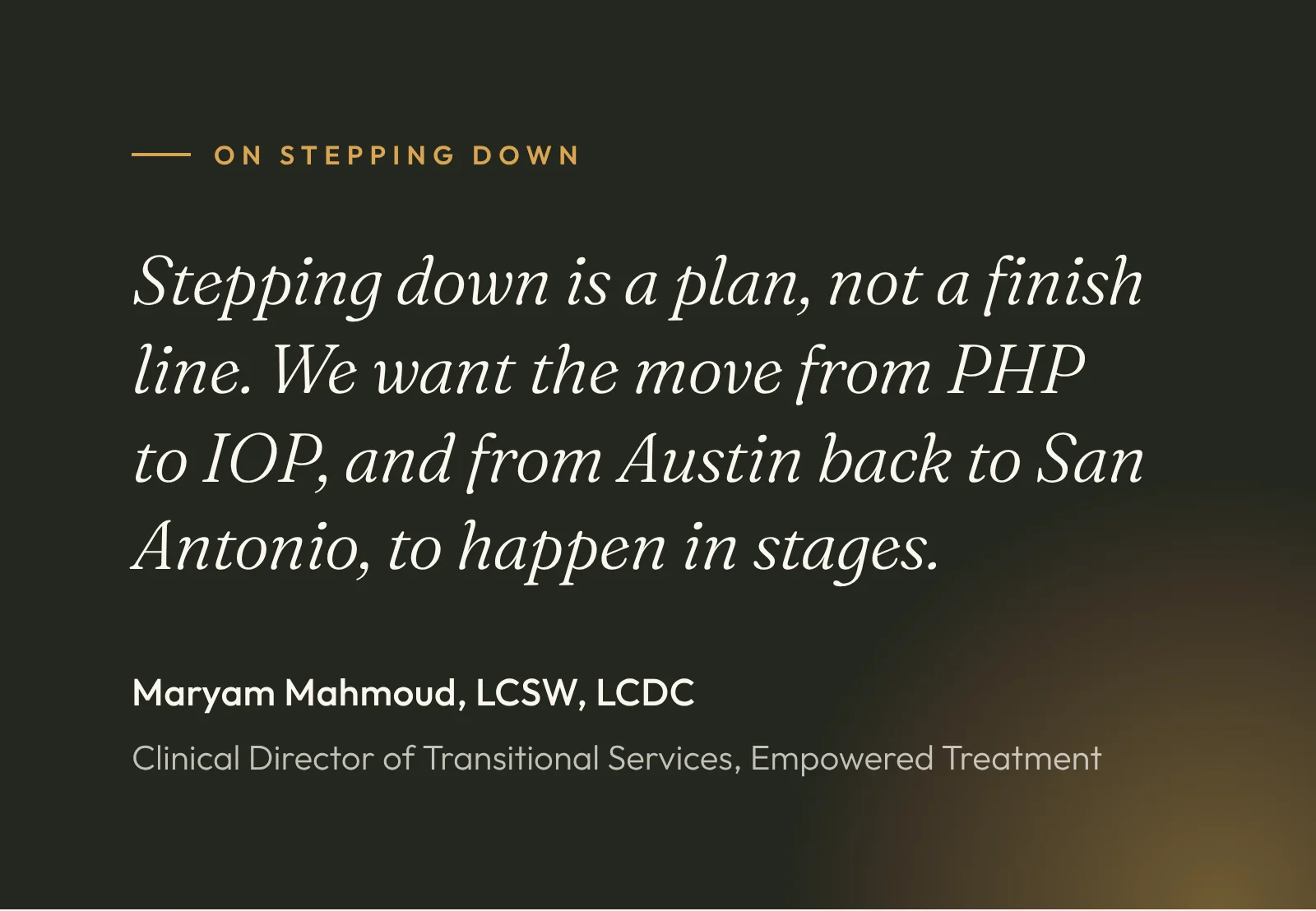
"Nobody should be handed a whole week of meals on their own all at once," says Maryam Mahmoud, LCSW, LCDC, our Clinical Director of Transitional Services.
Before discharge, transition planning includes aftercare connections in the San Antonio area, so the support you leave with is close to where you live. Our guide to relapse prevention covers what that plan usually includes.
Keeping work or school going
PHP is close to a full-time commitment, so most people pause or reduce work or classes while they are in it. Stepping down to IOP is often the point where work and school come back, which is one more reason to plan the step-down carefully.
- Remote or hybrid work makes IOP from San Antonio easier, and can make a few weeks in Austin housing workable too. Our post on working while in treatment covers schedules, energy and boundaries.
- What to tell an employer is your decision. Our guide to telling your employer about treatment covers how much to share and how to ask for schedule changes.
- College and graduate students in San Antonio can often coordinate with their school's disability or counseling office on reduced loads or flexible deadlines. Our page for college students in treatment goes into that.
How family can stay involved
Our clients are adults, so who is involved is their decision. With consent, family education and sessions with our family therapist are part of treatment, and distance does not have to keep families out. A few things tend to help San Antonio families most:
- Make weekends calm. Ask what the weekend meal plan is and how you can support it, rather than watching plates. Our guide to meal support at home has practical language.
- Keep contact routine. Regular calls about ordinary life do more than check-ins about food. Our post on long-distance support covers how to do this well.
- Offer the logistics. Driving on a hard week, handling an insurance call or cooking a planned meal are concrete help.
- Get support of your own. NAMI San Antonio offers Family-to-Family, a free peer-taught course for adults with a loved one living with a mental health condition. The ANAD Eating Disorders Helpline is free at 1-888-375-7767, weekdays from 9 a.m. to 9 p.m. Central.
Questions worth asking us
- Which level of care fits right now, and how would that change the plan for the drive?
- What days and times would I be at the center?
- Is a room open in transitional housing, and what does it cost with my coverage?
- How will meals and snacks fit around the drive?
- How will my family be involved, and can sessions happen when they are in Austin?
- What aftercare options exist near my home in San Antonio?
Our post on questions to ask before starting treatment has more.
Planning care from San Antonio
Empowered Treatment offers adult PHP, IOP and transitional housing in Austin for people from across Texas. A pre-assessment can happen in person or remotely, so the first step does not require the drive. You can check your insurance benefits online, or call (512) 882-4599 to talk through the plan with our admissions team.
San Antonio to Austin treatment: FAQs
How far is Empowered Treatment from San Antonio?
Our center in Northwest Austin is about 80 miles from San Antonio, roughly an hour and a half by car on I-35 with clear traffic. Construction and congestion in both cities can add a lot to that.
Can I do PHP and drive home every night?
Some people try it, but PHP is about 30 hours a week, and a daily round trip of roughly 160 miles leaves little time for rest and evening meals. Many San Antonio clients stay in our Austin transitional housing during PHP and go home on weekends.
Can I keep working during treatment?
Usually during IOP, which is about 9 hours a week and designed around work and school. PHP is close to full time, so most people pause or reduce work while in it and return as they step down.
What happens when I move back to San Antonio?
Before discharge we build a transition plan that includes aftercare connections in the San Antonio area. Many people step down in stages, moving from PHP to IOP first and then home, so changes do not all land at once.
This article is for general education and is not medical advice. If you are in crisis, call or text 988.
Sources
- Texas Department of Transportation and Texas A&M Transportation Institute. 2025 Texas Top 100 Congested Road Segments (2024 data). November 24, 2025.
- Texas Department of Transportation. I-35 NEX Central: project overview.
- Texas Department of Transportation, Mobility35. Frequently asked questions: I-35 Capital Express Central.
- Texas Department of Transportation. SH 130 extension opens. October 24, 2012.
- Texas Department of Transportation. Download the new DriveTexas app. August 11, 2026.
- NAMI San Antonio. Family support.
- ANAD. Eating Disorders Helpline.
Eating disorders are not a choice. Recovery can be.
One confidential conversation is all it takes to start. No pressure. We'll help you find the right next step, even if it isn't with us.