
When food runs short: food insecurity and binge eating in Texas
Texas SNAP enrollment just fell to its lowest level since 2009. For many families that means emptier pantries. For some, it also means a harder relationship with food that can outlast the shortage itself.

Does food insecurity cause binge eating?
Food insecurity does not cause binge eating on its own, but it is a real and well-documented risk factor. In a study of more than 500 food pantry clients in San Antonio, people facing the most severe food shortages reported more binge eating, more dietary restraint and more purging. When food is unpredictable, the body learns to eat as much as it can, while it can.
- Texas is facing a food squeeze. SNAP enrollment fell to 2.8 million in September 2026, down 20.8% in a year, while roughly one in five Texans already lived with food insecurity.
- Scarcity and binge eating are linked. Restriction, whether chosen or forced by an empty pantry, is one of the strongest known triggers for bingeing.
- It is not a willpower problem. Eating urgently after going without is a protective response, and it is treatable.
- Recovery has to fit real life. Good eating disorder care builds meal plans around a person's actual budget, kitchen and schedule.
What is happening to food access in Texas
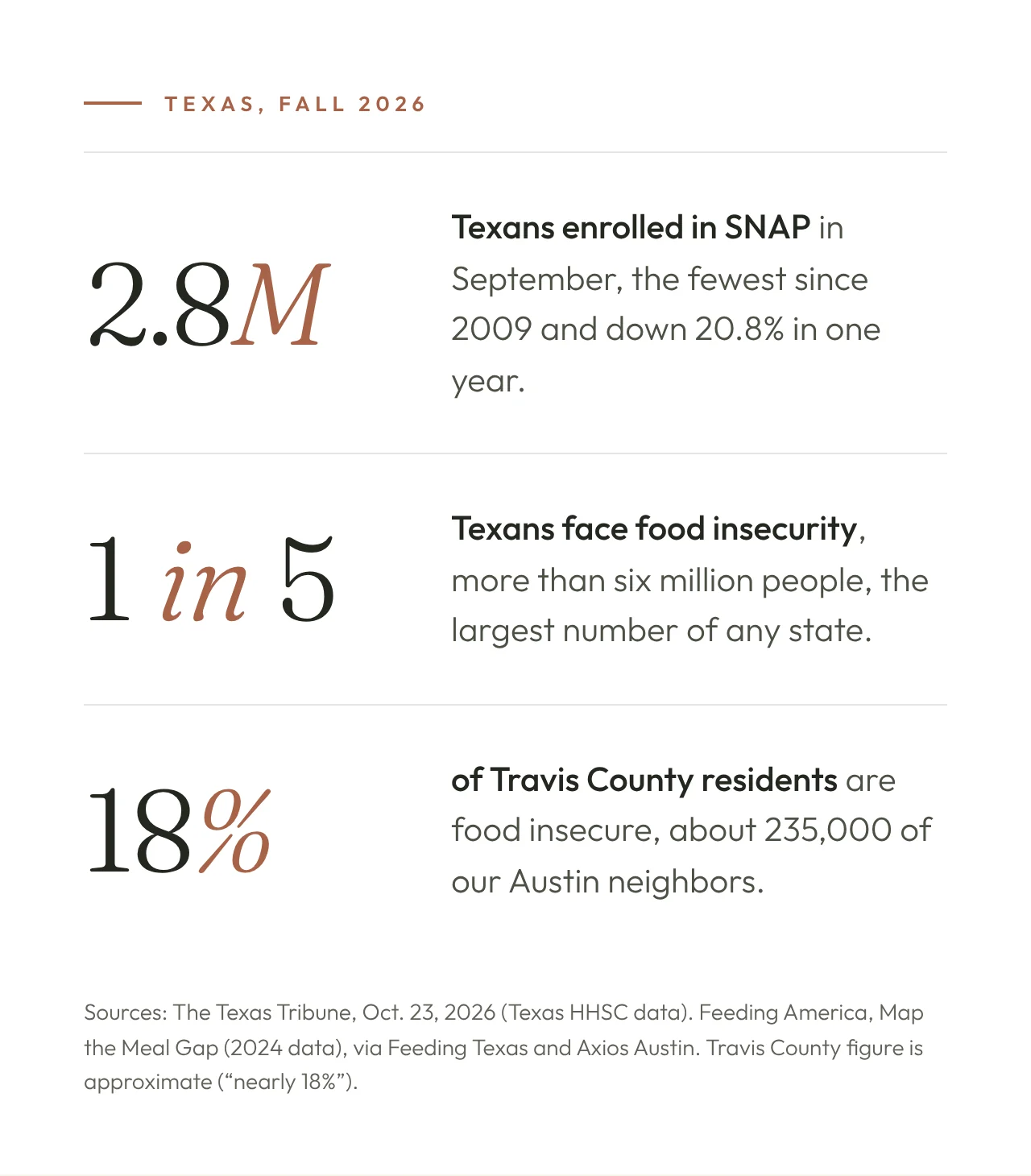
On October 23, The Texas Tribune reported that 2.8 million Texans were enrolled in SNAP in September, the fewest since August 2009 according to Texas Health and Human Services Commission data. Enrollment fell 20.8% from September 2025, the steepest annual drop in two decades. Children account for more than half of those losses, and only 64% of applications were processed within 30 days, down from 91% a year earlier.
The drop does not reflect a drop in need. "The declines aren't the result of people leaving the program because they no longer need it, or because they found work," Feeding Texas CEO Celia Cole told the Tribune.
The need was already large. Feeding America's latest Map the Meal Gap study, which uses 2024 data, found that nearly one in five Texans experiences food insecurity, more than six million people and the largest food-insecure population of any state. Closer to home, nearly 18% of Travis County residents, about 235,000 people, were food insecure in the same report.
Most coverage of these numbers is about groceries, budgets and policy, as it should be. Eating disorder clinicians watch them for another reason. Much of the research connecting food insecurity to disordered eating was done right here in Texas.
What a San Antonio food bank taught the field
In 2017, Trinity University psychologist Carolyn Black Becker and colleagues published a study of 503 people seeking food from pantries in the International Journal of Eating Disorders. The work was done with clients of the San Antonio Food Bank, a population eating disorder research had largely ignored.
The results were hard to dismiss. People with the most severe food insecurity, defined as adults whose children were going hungry, reported significantly higher binge eating, overall eating disorder symptoms, dietary restraint, weight self-stigma and worry. Compensatory behaviors such as purging also rose as food insecurity worsened. In that highest-need group, 17% reported clinically significant eating disorder symptoms.
A later replication at the same food bank, with a larger sample, reported nearly identical results. The work continues: UT Health San Antonio and Trinity University are running a four-year, $2.2 million study funded by the National Institutes of Health, following 250 Hispanic women aged 50 and older who live with food insecurity, half of them with chronic binge eating disorder.
None of this means scarcity is the only cause. Eating disorders grow from many roots, including genetics, trauma and long-term stress. What the Texas research makes clear is that an unpredictable food supply belongs on that list, and that the people affected rarely look like the stereotype. Our post on why you cannot see an eating disorder goes further into that.
How scarcity becomes a binge-restrict cycle
Picture a stretched month. Meals get skipped near the end of it so the kids can eat. Then benefits arrive, or a pantry visit goes well, and suddenly there is more food than usual. A body that has been running low responds the way bodies are built to respond: it wants to eat, quickly and a lot. Shame follows, then a promise to do better, then another stretch of going without.
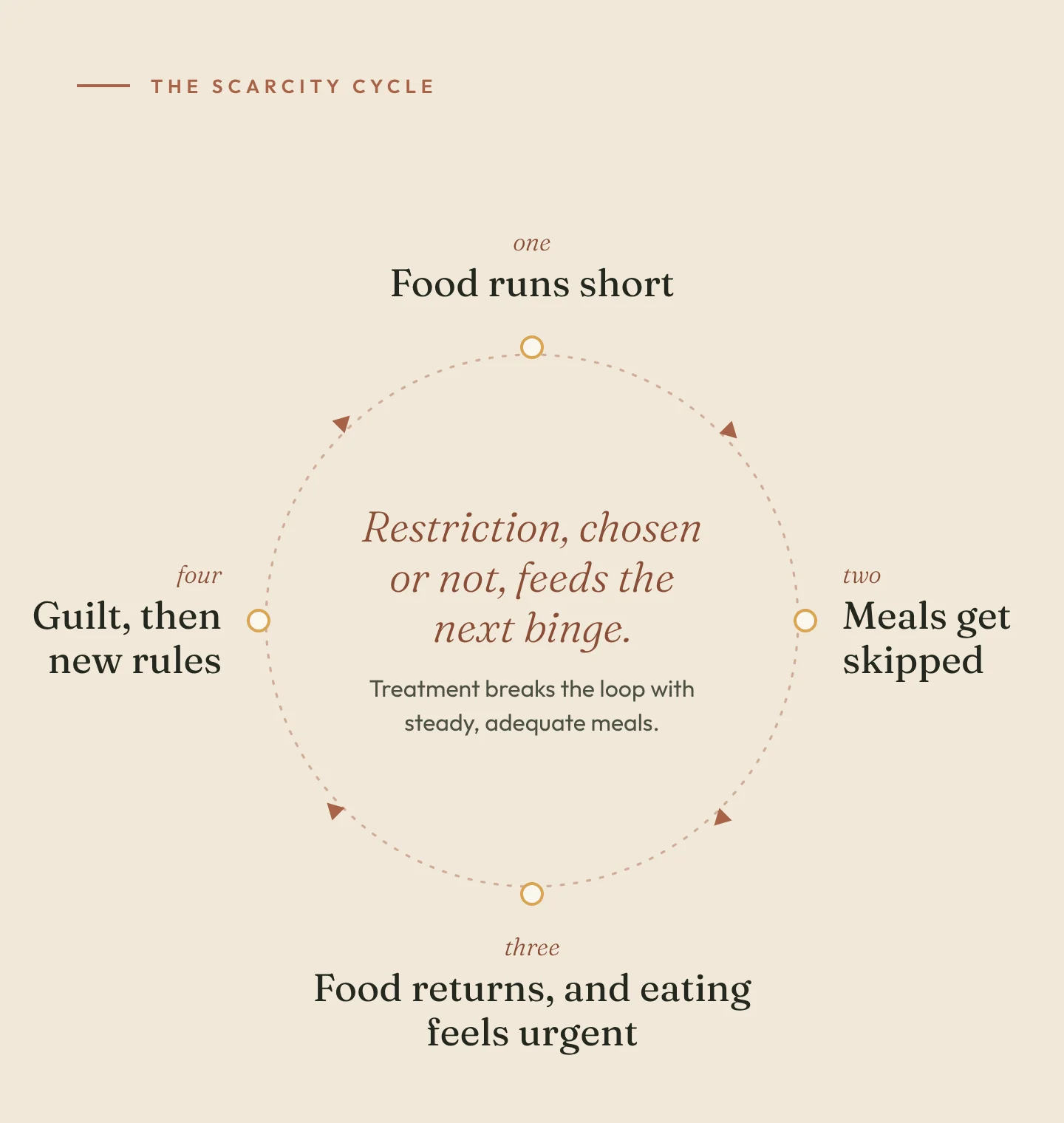
That loop looks almost exactly like the binge-restrict cycle we treat every week, except the restriction was never a diet. Over time the pattern can take on a life of its own and keep running even after the pantry is full again. The same cycle can start by choice, too, as when people skip meals to “save up” for a holiday dinner.
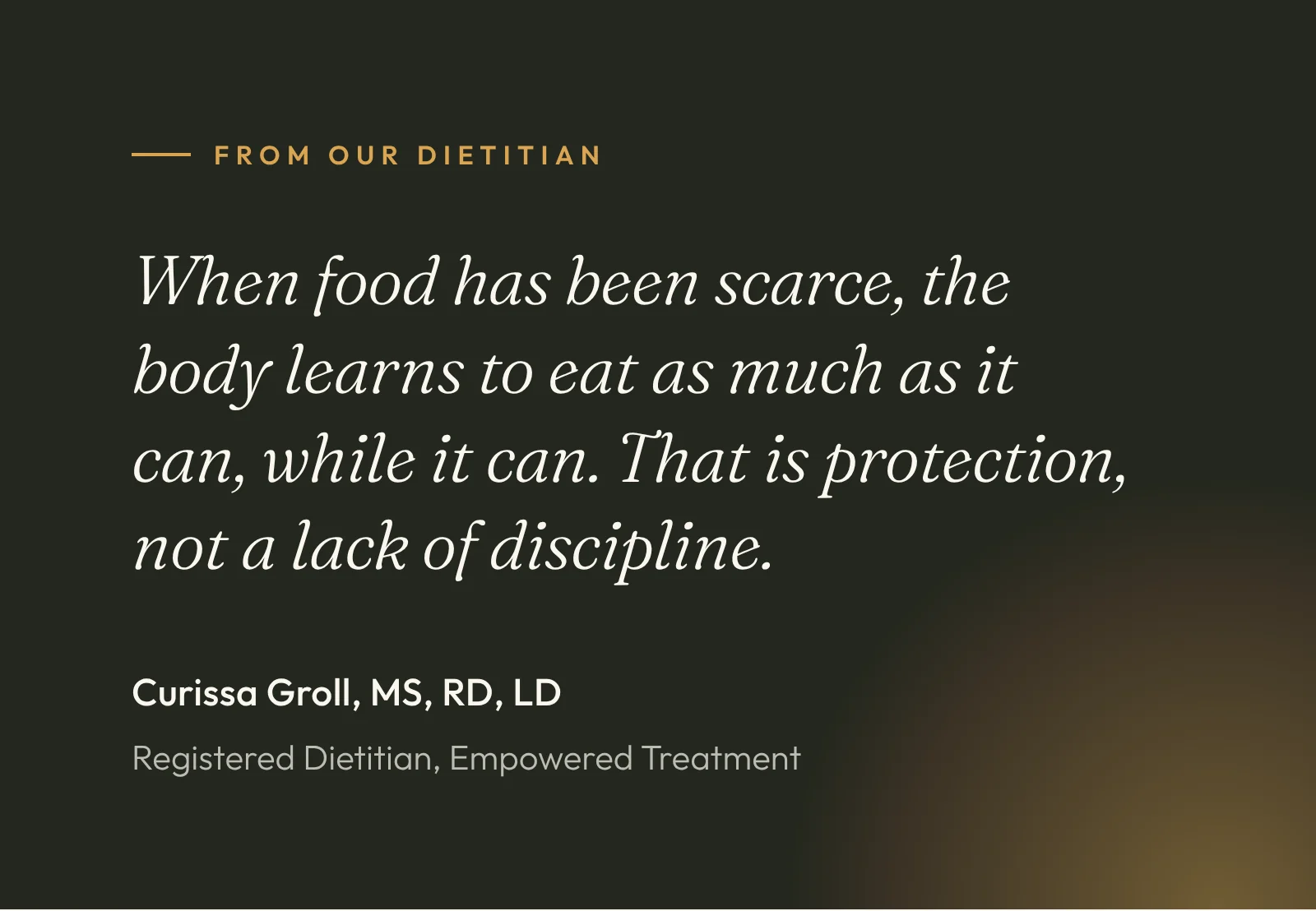
"Part of my work is helping someone's body learn, meal by meal, that food will keep coming," says Curissa Groll, MS, RD, LD, one of our registered dietitians.
Signs worth paying attention to
If money for food has been tight, now or in the past, these patterns are worth noticing and worth mentioning to a provider:
- Eating large amounts quickly when food is available, with a sense of losing control
- Strong guilt or shame after eating, or eating in secret
- Skipping meals beyond what the budget actually requires, or unease when eating regularly
- Hiding or hoarding food long after supplies have steadied
- Vomiting, laxatives or exercise used to make up for eating
- Worry about food that crowds out most other thoughts
One sign alone does not confirm an eating disorder. A pattern that keeps tightening deserves a conversation with a specialist. Our binge eating disorder page explains how the condition is diagnosed and treated.
Steffani Roller, LPC, IEDS, Co-Founder and Clinical Director, Empowered Treatment
Recovery that fits a real budget
Recovery from an eating disorder that grew out of scarcity starts with steadiness: regular, adequate meals, eaten without judgment about what is on the plate. That principle sits at the center of our nutrition rehabilitation and supported meals, where registered dietitians help people rebuild trust with food one meal at a time.
It also has to be practical. A meal plan that assumes an unlimited grocery budget is not a plan anyone can follow.
Curissa Groll, MS, RD, LD, Registered Dietitian, Empowered Treatment
If you need food help right now
- Apply for SNAP at YourTexasBenefits.com, or call 2-1-1 and choose option 2.
- Find a food bank through Feeding Texas. Many food banks can also help with a SNAP application.
- In crisis? Call or text 988, the Suicide and Crisis Lifeline, any time.
When outpatient support makes sense
Reach out if binges are recurring, if the cycle keeps tightening even when food is steady, or if shame about eating is shaping your days. You do not need to be certain something is wrong to ask.
Empowered Treatment offers an adult intensive outpatient program and a partial hospitalization program in Austin, with registered dietitians, therapists and psychiatric care on one team. Adults from across Texas attend, and our transitional housing makes care possible for people who live outside Austin. You can check your insurance benefits in a few minutes, or read how insurance coverage for eating disorder treatment usually works.
Food insecurity and eating disorders: FAQs
Can food insecurity cause an eating disorder?
Food insecurity is a risk factor rather than a single cause. Research with San Antonio food bank clients found that the most severe food insecurity was linked to higher binge eating, restraint and purging. Genetics, trauma and stress also play a part.
Why do I binge when food finally becomes available?
After a stretch of going without, the body pushes hard to take in food while it can. That urgency is a survival response, not a character flaw. Regular, adequate meals over time help the urge settle.
Is binge eating disorder treatment a diet program?
No. Restriction drives binge eating, so treatment focuses on consistent nourishment, skills for handling urges and emotions, and healing shame. Weight loss is not the goal of care at Empowered.
Can a meal plan work on a tight budget?
Yes. Our dietitians build plans around what a person can actually buy and prepare, including pantry staples, canned and frozen foods, and food bank items.
This article is for general education and is not medical advice. If you are in crisis, call or text 988.
Sources
- Huff J. Texas SNAP participation drops to a 17-year low as the feds tighten eligibility. The Texas Tribune. October 23, 2026.
- HPPR / Texas Standard. Report shows nearly 1 in 5 Texans are experiencing food insecurity. July 31, 2026.
- Axios Austin. Report: Over 1 in 6 Central Texans face food insecurity. August 12, 2026.
- Becker CB, Middlemass K, Taylor B, Johnson C, Gomez F. Food insecurity and eating disorder pathology. International Journal of Eating Disorders. 2017;50(9):1031-1040. doi:10.1002/eat.22735.
- STAT. Eating disorders and food insecurity. June 25, 2020.
- UT Health San Antonio. Collaborative research on binge eating disorder in older Hispanic women. January 2, 2025.
- Feeding Texas. Supplemental Nutrition Assistance Program (SNAP).
Eating disorders are not a choice. Recovery can be.
One confidential conversation is all it takes to start. No pressure. We'll help you find the right next step, even if it isn't with us.