
When the clocks fall back: shorter days and eating disorder recovery
Texas set its clocks back an hour on November 1. In Austin, sunset jumped from about 6:44 p.m. to 5:43 p.m. overnight. For most people that is a small annoyance. For someone in eating disorder recovery, a sudden shift in light, sleep and evening routine can loosen the structure that keeps meals on track. Here is what the research suggests, and how to steady the season.
Can the end of daylight saving time affect eating disorder recovery?
The end of daylight saving time can affect eating disorder recovery. The one-hour change is small, but it shifts sleep, light and the timing of meals, and regular, predictable eating is a foundation of recovery. Older research also links binge eating and appetite to seasonal changes in daylight, so plan meals and evenings on purpose for the next few weeks.
- Texas still changes its clocks. A 2025 state law would keep Texas on daylight saving time year-round, but only if Congress allows it, so clocks fell back on November 1.
- Some eating disorder symptoms appear to follow the seasons. Studies have linked binge frequency to day length and found high seasonality scores among people with eating disorders.
- Seasonal depression is less common in Texas than farther north, but routine disruption from the time change affects people everywhere.
- Structure is protective. Anchoring meals to the clock, not the light, and planning the first hour after dark can help.
Is Texas still changing its clocks?
Yes, for now. In June 2025, Gov. Greg Abbott signed House Bill 1393, which would put Texas on permanent daylight saving time, sometimes called “Texas Time.” As FOX 7 Austin reported, the change cannot take effect unless Congress passes a law allowing states to do it. Until then, Texans keep switching twice a year, and the November change is the one that moves daylight out of the evening.
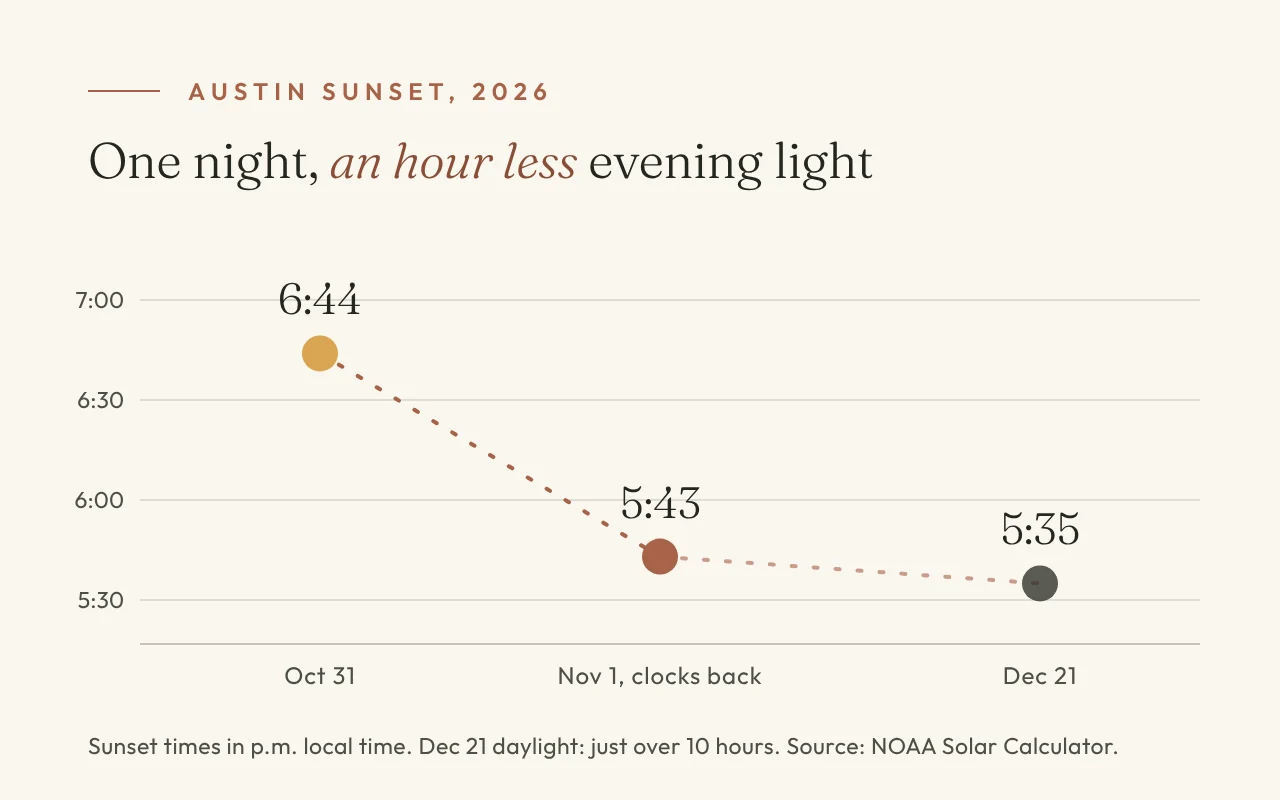
Based on the NOAA solar calculator, Austin now loses its light around the time many people are heading home, and by the winter solstice on December 21 the day lasts just over 10 hours. Houston, Dallas-Fort Worth and San Antonio saw the same one-hour jump, with sunsets now between about 5:35 and 5:47 p.m. Dinner, the evening commute and the walk that used to happen after work now take place in the dark.
Why do light and routine matter in recovery?
Light and routine matter because they set the rhythm that regular eating depends on. The link between seasons and eating is not new. A 1991 study in the Journal of Psychiatric Research compared seasonal patterns across several clinical and general populations and found that people with eating disorders had unexpectedly high seasonality scores. Across every group studied, people tended to eat more, sleep more and gain weight in winter.
A 1992 study in the American Journal of Psychiatry looked specifically at bulimia nervosa. Binge behavior was highly associated with photoperiod, the number of daylight hours, and the authors concluded that food-related symptoms may be influenced by seasonal changes in light. These studies are older and relied partly on people recalling their own patterns, so they point to a tendency rather than a rule. They do match what clinicians often see when the days get short.
The National Institute of Mental Health (NIMH) lists overeating, especially craving carbohydrates, along with oversleeping and social withdrawal among the symptoms of winter-pattern seasonal affective disorder. NIMH also notes that people in Texas or Florida are less likely to develop seasonal depression than people in Alaska or New England. For most Texans, the bigger issue is not darkness itself. It is what the time change does to the shape of the day.
Three shifts are worth watching for over the next few weeks:
- Meals drifting. Dinner moves earlier because it feels late, or gets skipped because the evening blurs together. Long gaps between meals can feed the binge-restrict cycle.
- Sleep changing. An earlier wake-up or a later bedtime can throw off hunger cues and make the evening feel longer and emptier.
- Evenings opening up. Without daylight for a walk or errands, the hours after work can become the time when urges to restrict, binge or overexercise feel strongest.
How can you protect your routine after the time change?
Protect the structure of your day and let the light change around it. None of this needs a perfect plan.
Set meal times by the clock
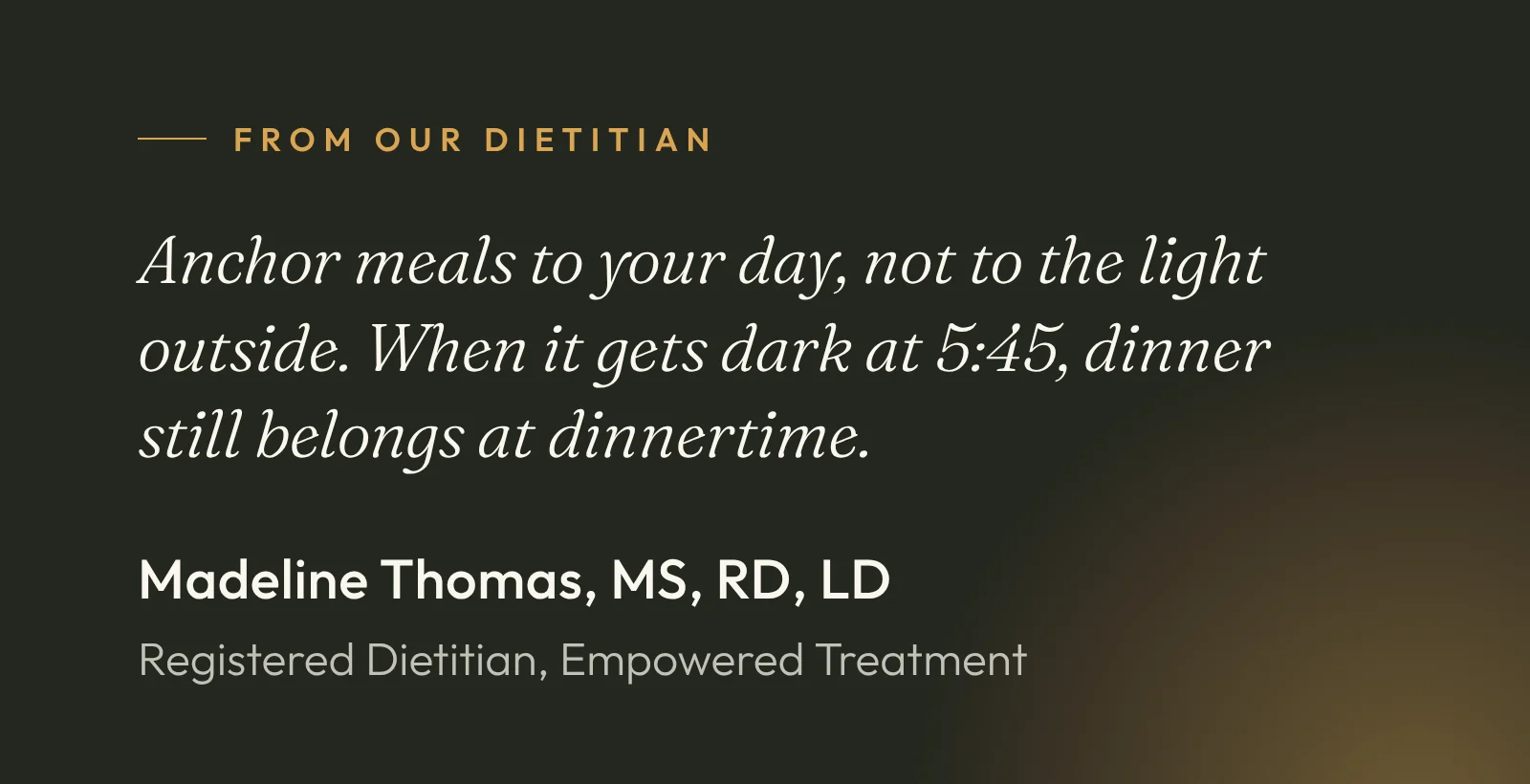
Keep breakfast, lunch, dinner and planned snacks at the times that were working before the change. If early darkness makes dinner feel late, a planned afternoon snack can bridge the gap so you are not arriving at the evening overly hungry.
Madeline Thomas, MS, RD, LD, Registered Dietitian, Empowered Treatment
Get morning light
Daylight early in the day helps set your internal clock. A few minutes outside after breakfast, or coffee by a bright window, is an easy place to start. If you think you may have seasonal depression, talk with a medical provider before trying a light box.
Plan the first hour after dark
The stretch right after sunset is often when the day feels most unstructured. Decide ahead what goes there: a call with a friend, a class, cooking with someone, or a support group.
Megan Swiderski, MS, LCSW, Therapist, Empowered Treatment
Keep movement flexible
If you lose your usual evening walk, resist the urge to make it up with harder or longer workouts. Movement should stay something you enjoy, not a way to earn or cancel out food.
Tell your treatment team
If you see a therapist or dietitian, mention the time change at your next session. Small adjustments to a meal plan or schedule are easier to make early than after a few hard weeks. Our guide to common recovery situations covers more ways to navigate changes like this one, and the holidays bring their own version of the same problem, which we cover in why “saving up” for Thanksgiving backfires.
When is it more than the winter blues?
It is more than the winter blues when eating, mood or behavior changes start to run your days. Feeling a little sluggish after the time change is common. It is worth reaching out for an assessment if any of these sound familiar:
- You are skipping meals, eating much less, or eating large amounts and feeling unable to stop.
- You are vomiting, using laxatives or exercising hard to make up for food.
- Low mood, oversleeping or pulling away from people has lasted more than a couple of weeks.
- Thoughts about food, weight or your body take up much of your day.
- You feel dizzy or faint, or people close to you have said they are worried.
The National Institute of Mental Health describes eating disorders as serious and potentially life-threatening, and also treatable, with early detection and treatment important for a full recovery. You do not need to be certain before you ask. If you are not sure whether what you are noticing is disordered eating or an eating disorder, an assessment can help sort it out.
Support for adults across Texas
Empowered Treatment offers an adult intensive outpatient program and a partial hospitalization program in Northwest Austin, with therapists, registered dietitians and psychiatric providers on one team. Programming gives the day a steady shape, which can be especially useful in a season when the light keeps changing. Adults come to us from across Texas, including San Antonio, Houston and Dallas-Fort Worth, and our transitional housing supports people traveling from other cities.
You can check your insurance benefits online, or call our admissions team during business hours at (512) 882-4599.
Daylight saving time and eating disorders: FAQs
Can shorter days make binge eating worse?
For some people, yes. Older studies found that binge frequency in bulimia nervosa tracked the number of daylight hours, and that people with eating disorders reported strong seasonal swings in appetite and mood. The research is dated and relies partly on recall, so it shows a tendency, not a certainty. Regular meals and planned evenings are the most practical protection.
Is seasonal affective disorder common in Texas?
Seasonal affective disorder is less common in Texas than in northern places such as Alaska or New England, according to the National Institute of Mental Health, but it does occur here. Overeating, carbohydrate cravings, oversleeping and social withdrawal are among the winter-pattern symptoms. If low mood lasts more than a couple of weeks, talk with a medical or mental health provider.
Is Texas getting rid of the time change?
Not yet. House Bill 1393, signed in June 2025, would keep Texas on daylight saving time year-round, but it only takes effect if Congress passes a law allowing states to do that. Until then, Texas clocks still fall back in November and spring forward in March, and each change is worth planning around in recovery.
When should I get help for eating changes in winter?
Reach out if you are skipping meals, bingeing, compensating for food with vomiting, laxatives or exercise, or if low mood has lasted more than a couple of weeks. A doctor, therapist or eating disorder program can help you sort out what is going on. An eating disorder assessment is a conversation, not a commitment to any program.
This article is for general education and is not medical advice. In a medical emergency, call 911. If you are in crisis, call or text 988. The ANAD Eating Disorders Helpline is free at (888) 375-7767, weekdays.
Sources
- FOX 7 Austin. Gov. Abbott signs bill to create “Texas Time,” but Congress needs to act. June 23, 2025.
- NOAA Global Monitoring Laboratory. Solar Calculator, Austin, Texas, 2026.
- Hardin TA, Wehr TA, Brewerton T, Kasper S, Berrettini W, Rabkin J, Rosenthal NE. Evaluation of seasonality in six clinical populations and two normal populations. Journal of Psychiatric Research, 1991;25(3):75-87.
- Seasonal patterns of bulimia nervosa. American Journal of Psychiatry, January 1992;149(1):73-81.
- National Institute of Mental Health. Seasonal Affective Disorder. Revised 2023.
- National Institute of Mental Health. Eating Disorders.
- 988 Suicide and Crisis Lifeline. 988lifeline.org.
Eating disorders are not a choice. Recovery can be.
One confidential conversation is all it takes to start. No pressure. We'll help you find the right next step, even if it isn't with us.