
Houston marathon season: when training becomes compulsive exercise
The Chevron Houston Marathon is on Sunday, January 17, 2027, and both the marathon and the half are sold out. For thousands of adult runners, the next eleven weeks are the heart of the build. For some, the miles quietly start doing a different job.

When does marathon training become compulsive exercise?
Marathon training becomes compulsive when the plan stops serving you and starts running you. Warning signs include guilt or panic over a missed run, miles used to earn or cancel out food, training through injury or illness, and skipping fuel on long runs. Chronic underfueling can also lead to RED-S, which affects bones, hormones, mood and performance.
- Recreational runners are not exempt. Studies of everyday runners find eating disorder symptoms and low energy availability in roughly one in five, sometimes more.
- The Houston calendar adds pressure. Peak long runs land on the holidays, the taper lands in early January, and race day is January 17.
- Underfueling is a training error and a health risk. The International Olympic Committee describes it as a syndrome that affects both women and men.
- Flexibility is the clearest test. A healthy plan can bend for illness, injury or life. A compulsion cannot.
The Houston season, week by week
Houston's marathon calendar is unusual. Many runners start their build in late-summer heat, reach peak mileage between Thanksgiving and New Year's, taper through the first weeks of January and race on January 17. According to the race's registration page, 2027 is the 54th running of the marathon, and every registration tier for the marathon and half has sold out.
That calendar creates a few predictable pressure points. None of them mean something is wrong. They are simply the moments when a rigid relationship with food and exercise tends to show itself.
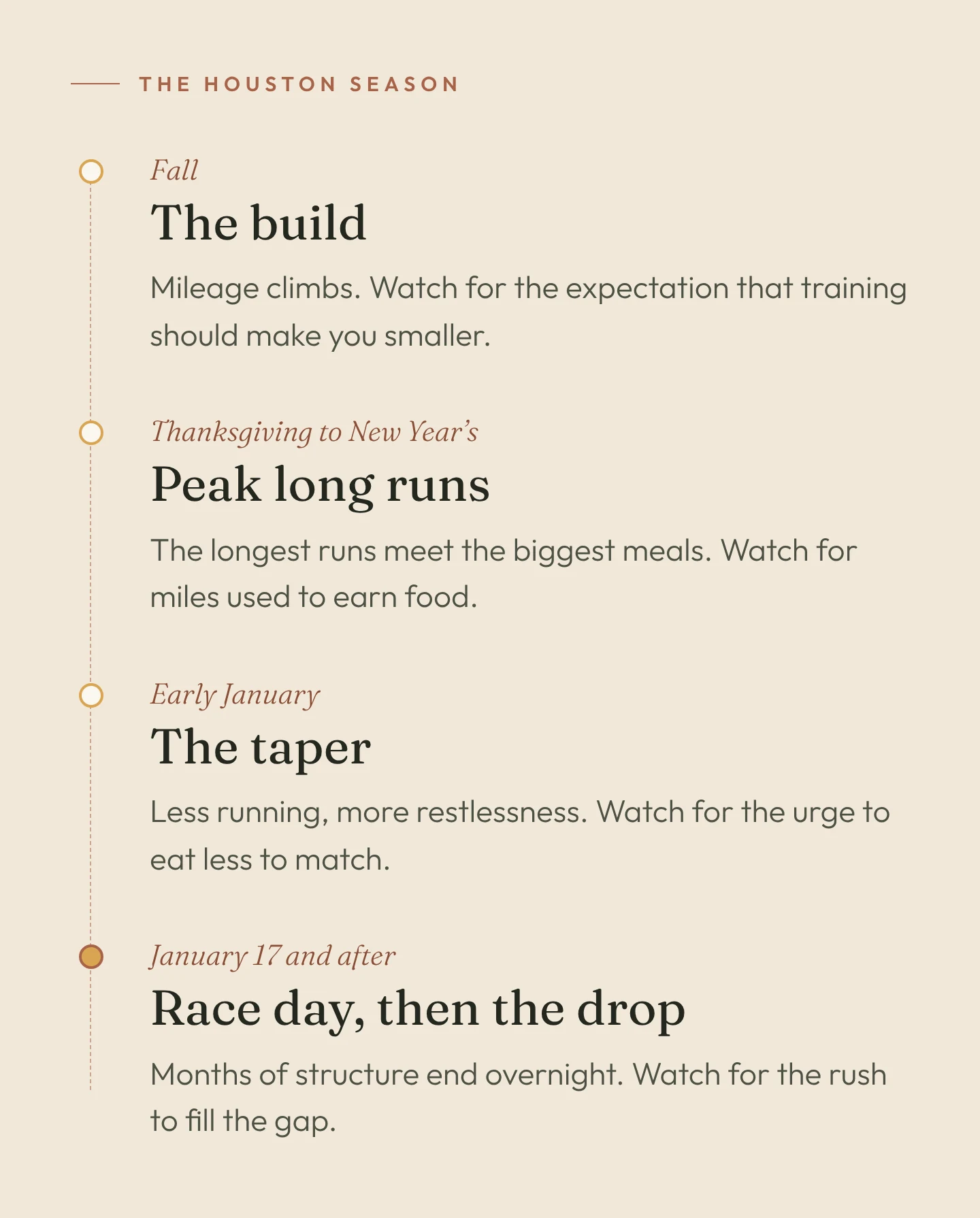
The build
Mileage climbs, and so do expectations. Many runners assume marathon training should make them leaner, then feel betrayed when the body holds steady or gains as it adapts. That frustration is a common doorway into cutting food while adding miles.
Holiday peak
The longest runs often fall on the same weekends as Thanksgiving dinner, office parties and family gatherings. Watch for the logic of "earning" a holiday meal with an extra loop, or skipping the meal before a long run to "make room." Our guide to eating disorder recovery during the holidays has more on food-centered gatherings.
The taper
Volume drops in early January, and many runners feel restless or anxious. A taper is when the body finishes absorbing months of work, and it needs steady food to do it. "I'm not running as much, so I shouldn't eat as much" is one of the most common taper thoughts, and one of the least helpful.
After January 17
Race day ends months of structure overnight. Some runners feel flat or lost for weeks. If the urge is to register for the next race immediately, or to keep running hard to manage the feeling, that is worth noticing.
Everyday runners, real risk
Eating disorders in sport are often discussed as a problem for elite or college athletes. The research on adults who run for health and enjoyment tells a broader story:
- In a 2023 study of 85 recreational female runners aged 18 to 39, 18% had symptoms of an eating disorder and 19% had symptoms of low energy availability. Higher dietary restraint was linked to more stomach and gut problems.
- A survey of 524 female endurance runners, competitive and recreational, found about 47% at risk of low energy availability, 40% at risk of disordered eating and 9.4% at risk of an eating disorder.
- Men are affected too. In a study of 899 athletes, most of them in endurance sports, 22% of men and 24% of women were at risk of disordered eating, and recreational athletes were more likely to be at risk than those competing internationally.
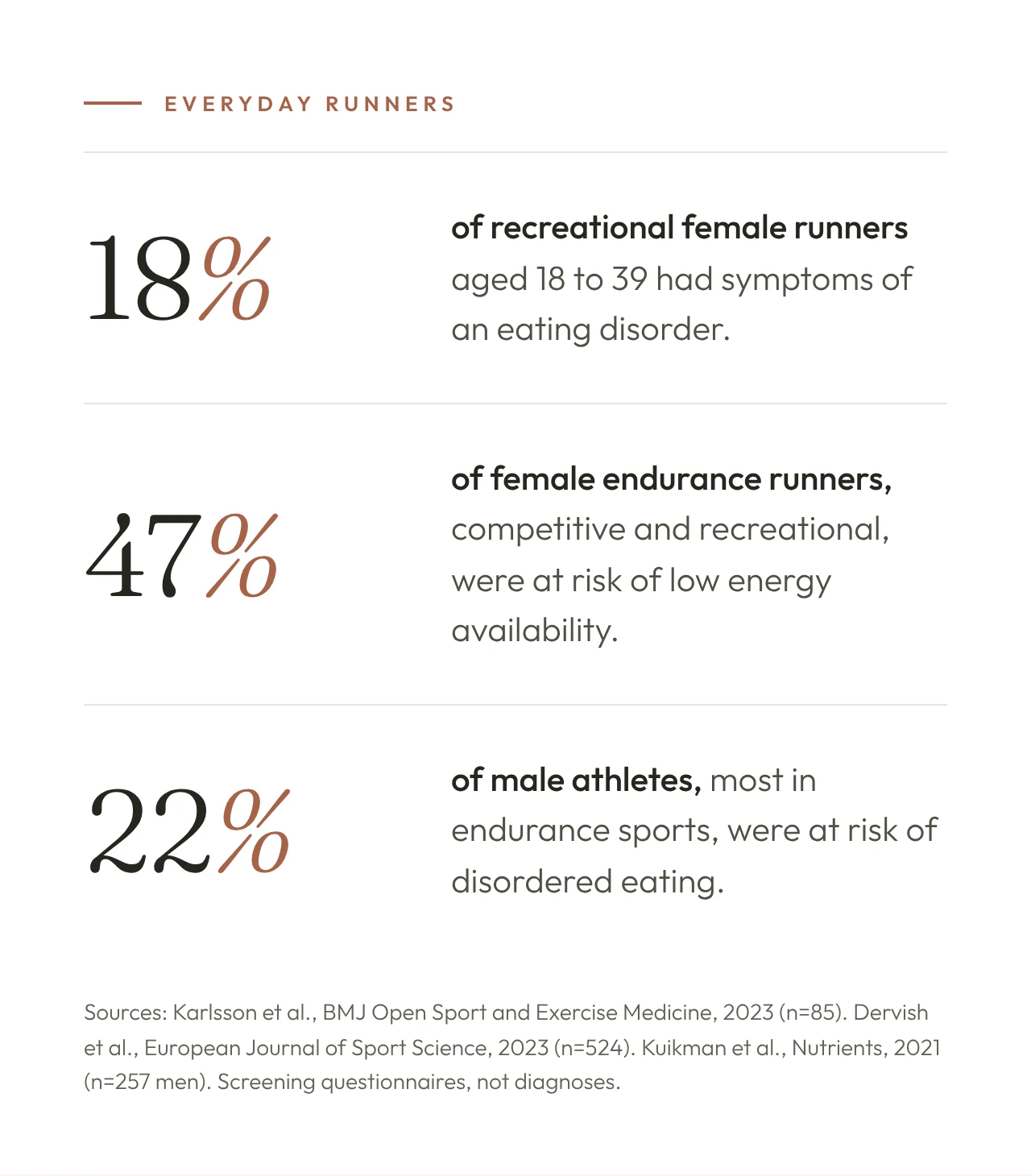
These are screening studies, not diagnoses, and they used volunteers who chose to take part. Still, the pattern is consistent: being a weekend runner rather than an elite one is not protective. In some samples it may be the opposite.
What underfueling does to a runner's body
The 2023 International Olympic Committee consensus statement defines Relative Energy Deficiency in Sport (REDs) as a syndrome of harmful health and performance effects caused by low energy availability: too little fuel for both training and the body's everyday work. It affects female and male athletes, and it can happen with or without an eating disorder. Our page on athletes and eating disorders covers the full picture. For a recreational marathoner, it often shows up like this:
- Paces that stall or slip even as training volume rises
- Bone stress injuries, or aches that keep returning in the same place
- Catching every cold that goes around the office
- Poor sleep, irritability, low mood or trouble concentrating
- Missed or irregular periods, or low libido in men and women
- Ongoing stomach trouble on runs and off them
Any of these deserves a conversation with a sports medicine physician or primary care doctor. A missed period is a medical signal at any age, not a badge of hard training.
Dedicated training or compulsive exercise?
Hours and miles do not tell you much on their own. Two runners can follow the same plan for very different reasons. A few honest comparisons:
| Training is serving you | Training is running you |
|---|---|
| You skip a run for a sick child or a sore tendon and move on | A missed run brings guilt, panic or a plan to make it up |
| You eat more on big training days without thinking twice | Food has to be earned by miles, or cancelled out by them |
| Rest days feel like part of the plan | Rest days feel like failure, so extra cross-training creeps in |
| Pain or illness changes the plan | You run through injury, illness or exhaustion |
| Your running group knows roughly what you do | You hide extra runs, or log them somewhere private |
If the right-hand column sounds familiar, our self-check on whether your exercise is still healthy walks through the questions in more depth.
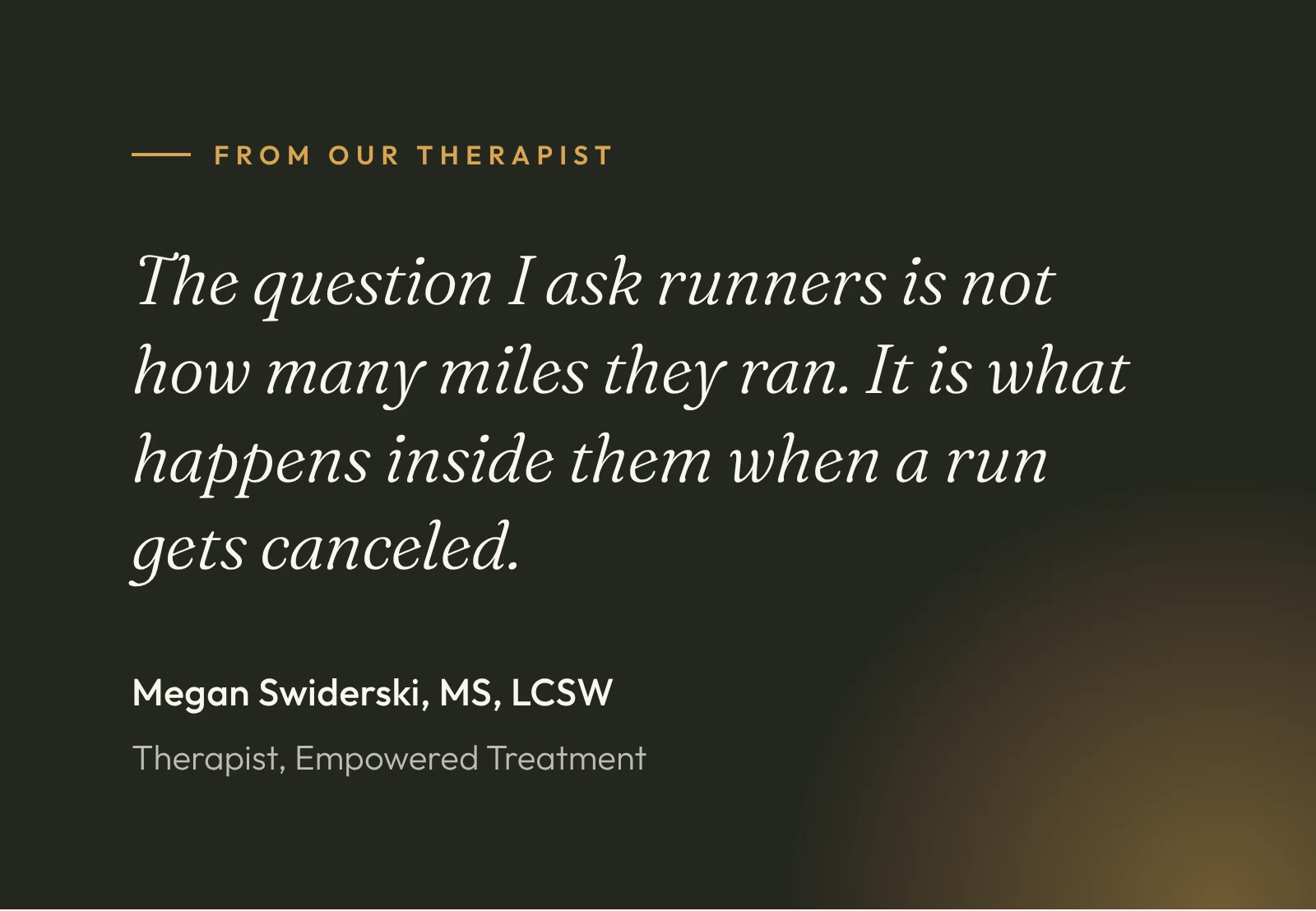
"If the answer is panic or shame, the training has taken on a job it was never meant to do," says Megan Swiderski, MS, LCSW, one of our therapists.
Eating for the build, not against it
Fueling for a marathon is individual, and a sports dietitian can tailor it to you. A few principles hold for nearly every adult runner:
- Eat before you run long. Running a long run on an empty stomach is a habit, not a strategy.
- Fuel during long runs. Practice with the foods and drinks you plan to use on race day, and account for Houston humidity with fluids and electrolytes.
- Eat after, even when you are not hungry. Appetite often lags behind need after hard efforts.
- Keep eating through the taper. Less running does not mean the body needs much less food during those weeks.
- Leave weight out of the plan. Chasing a lower number during a build is one of the most reliable ways to get injured or sick.
Emily Van Eck, MS, RDN, Dietitian, Empowered Treatment
"Rest days need food too," Van Eck adds. "Your body does most of its rebuilding on the days you are not running."
When to get help
Reach out if training rules are shaping what you eat, if you have physical warning signs like the ones above, or if the thought of missing a run feels unbearable. You do not have to give up running to get help, and you do not have to wait until after race day. If your health means it is wiser not to race this January, that decision belongs with your medical team, and the race's own policies will tell you your options.
Empowered Treatment offers an adult intensive outpatient program (about 9 hours a week) and a partial hospitalization program (about 30 hours a week) in Northwest Austin, with registered dietitians, therapists and psychiatric care on one team. Movement is part of the conversation, not something we ignore, and our page on athletes and eating disorder recovery explains how a return to sport is planned in steps.
Houston runners can attend in person, with transitional housing in Austin available during treatment. Our page for Houston residents covers travel and family involvement, and adults come to us from across Texas. You can check your insurance benefits in a few minutes, or call (512) 882-4599.
Marathon training and eating disorders: FAQs
Is it normal to lose weight while training for a marathon?
Many runners find their weight holds steady or even rises a little during a build as the body adapts to the work. Steady weight loss while mileage climbs can be a sign of underfueling, and it is worth discussing with a doctor or sports dietitian.
Can recreational runners get RED-S?
Yes. Low energy availability depends on fuel relative to training, not on competitive level. Studies of recreational runners find symptoms of low energy availability in a meaningful share of participants, in both women and men.
Can I keep running during eating disorder treatment?
It depends on your medical status and your relationship with running. Some people need a break while their body recovers, and others continue with adjusted, supervised movement. Your treatment team makes that call with you and revisits it as you progress.
What if I only notice these patterns during training season?
Seasonal patterns still count. If rigid rules about food and exercise show up every time you train for a race, that is useful information to bring to a professional, ideally before the next build begins.
This article is for general education and is not medical advice. Empowered Treatment is not affiliated with the Chevron Houston Marathon. If you are in crisis, call or text 988.
Sources
- Chevron Houston Marathon. 2027 Registration. Accessed October 29, 2026.
- Mountjoy M, Ackerman KE, Bailey DM, et al. 2023 International Olympic Committee's (IOC) consensus statement on Relative Energy Deficiency in Sport (REDs). British Journal of Sports Medicine. 2023;57(17):1073-1097. doi:10.1136/bjsports-2023-106994.
- Karlsson E, et al. Symptoms of eating disorders and low energy availability in recreational active female runners. BMJ Open Sport and Exercise Medicine. 2023;9(3):e001623. doi:10.1136/bmjsem-2023-001623.
- Dervish RA, Wilson LJ, Curtis C. Investigating the prevalence of low energy availability, disordered eating and eating disorders in competitive and recreational female endurance runners. European Journal of Sport Science. 2023;23(5):869-876. doi:10.1080/17461391.2022.2079423.
- Kuikman MA, Mountjoy M, Burr JF. Examining the relationship between exercise dependence, disordered eating, and low energy availability. Nutrients. 2021;13(8):2601. doi:10.3390/nu13082601.
If training has become something you cannot stop, read about eating disorder treatment for Houston adults, including where you would stay in Austin.
Eating disorders are not a choice. Recovery can be.
One confidential conversation is all it takes to start. No pressure. We'll help you find the right next step, even if it isn't with us.