
For people struggling with eating disorders in Wisconsin, and for every family wondering how to help.
Empowered Treatment is an Austin, Texas program where adults with eating disorders can receive partial hospitalization or intensive outpatient care, with transitional housing for anyone who needs to stay nearby. Reading about options is a reasonable place to begin.
It may not feel like a crisis. It can still be serious.
Eating disorders in Wisconsin take many shapes. A UW–Madison student may run every morning on almost nothing. A shift worker in Green Bay may eat one meal a day and binge at night. A dental hygienist in Eau Claire may purge in secret, and a grandmother in the Northwoods may still be following the diet she started forty years ago. Each of them might seem perfectly fine from the outside.
Because eating disorders can look ordinary, people often minimize them, even to themselves. Yet the effects add up: fatigue, dizziness, isolation, constant anxiety about food or weight, and a sense that life is happening somewhere else. If that resonates, it is a signal worth taking seriously. You deserve care from people who see past the surface and understand what you are dealing with.

You can want help and still feel unsure.
Ambivalence is part of almost every eating disorder. You may want relief and also feel attached to the habits that have helped you cope. That mix does not disqualify you from treatment. Our clinicians are used to meeting people right in the middle of it.
Calling us is a low-pressure first step. We will learn about your experience, explain how our partial hospitalization and intensive outpatient programs are structured, and help you consider what level of support makes sense. If you are working, our article on working while in treatment may answer some early questions.
Supporting someone starts with understanding.
It is painful to watch an adult you love become consumed by food, weight, or exercise, especially when they push back on your concern. You are not alone in that frustration. Our page on what to expect when a loved one is in treatment explains how you can help without taking over.
If your family member comes to Austin for care, you can stay involved from Milwaukee, Madison, La Crosse, or Door County. Our family education offers relatives a clear explanation of eating disorders, what each phase of treatment involves, and how to handle mealtimes and difficult conversations.
Settled in, so treatment can come first.
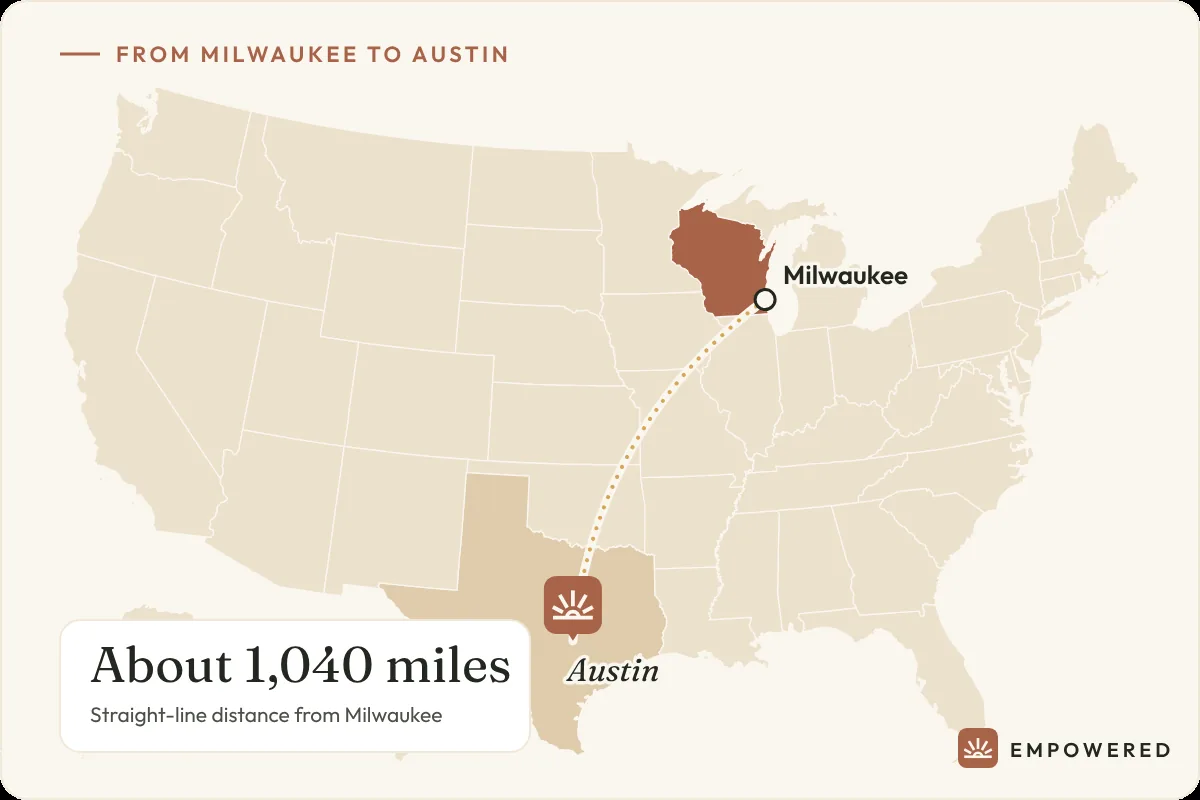
Arranging treatment more than a thousand miles from Lake Michigan raises an obvious question: where will you live? Our transitional housing answers it. The house sits in Hyde Park, one of Austin’s older neighborhoods, and you share it with others attending PHP or IOP. The environment is structured and supportive, so time outside programming feels steady instead of lonely.
 Shared living spaces
 A room of your own
A coordinated plan, built around you.
Our therapists help with the emotions and beliefs underneath disordered eating, while dietitians guide meal planning and exposure to feared foods. A family therapist brings loved ones into the process, and psychiatric providers address mood, anxiety, sleep, and medical stability. Everyone works from one shared plan, and when it is time to go home to Wisconsin, aftercare is arranged before you leave.
Partial hospitalization (PHP)
Full treatment days at our Austin center: supported meals, daily groups, individual therapy, dietitian care, and medical and psychiatric monitoring.
About PHP →Intensive outpatient (IOP)
Group programming plus weekly individual and dietitian sessions, built to fit around work, school, and family once more structure is not needed.
About IOP →
“My hope is that people leave our sessions feeling more confident with food and less ruled by numbers, labels, or the idea of eating perfectly. We focus on flexibility, practicing meals and snacks that fit real life so nourishment can become steady and familiar again.”Curissa Groll, MS, RD, LDDietitian, Empowered Treatment
Planning for travel and for costs.
Coming to Austin from Wisconsin
Flying is the usual choice from Wisconsin. Our team can help you map out arrival plans and what to expect your first week.
- Distance: about 1,040 miles from Milwaukee as the crow flies
- Airports: Milwaukee Mitchell International Airport (MKE) and Dane County Regional Airport (MSN) in Madison connect to Austin-Bergstrom International Airport (AUS)
- Final leg: our center is roughly 30 minutes by car from AUS, depending on traffic
- Housing: our transitional house can be arranged with PHP or IOP
Navigating insurance
Insurance for treatment in another state can involve extra steps. We can confirm your benefits for partial hospitalization and intensive outpatient care and help make sense of the details.
- Complete our verify insurance form, or call and someone will reach out to your plan for you
- With a plan based in Wisconsin, ask how it covers care at a Texas program, including out-of-network benefits and authorization; we help you ask the right questions
- The Wisconsin Office of the Commissioner of Insurance answers insurance questions and helps consumers with complaints
- Read does insurance cover eating disorder treatment? for background
Continuing care in the Badger State.
Treatment is a starting point, not the finish line. These statewide resources in Wisconsin can help you and your family stay connected to care, information, and support after you return.
- Wisconsin DHS: Mental Health Care and CoverageDepartment of Health Services guidance on accessing mental health care, signs of quality treatment, county agencies, and the 211 helpline.
- NAMI WisconsinFamily support groups, Family-to-Family education, and presentations for relatives and friends of people living with mental illness.
- Wisconsin Office of the Commissioner of InsuranceConsumer help with insurance questions, problems, and complaints, along with contact information for the Consumer Affairs team.
- 988 Suicide & Crisis LifelineCall or text 988, any time, from anywhere in the United States. In an emergency, call 911.
Questions from across Wisconsin.
How long would I need to be away from Wisconsin?
That depends on your needs and progress. Some people attend PHP and then IOP over a period of weeks to months. We will give you a realistic estimate after your assessment. Read how long does eating disorder treatment take?
Can I continue with my Wisconsin dietitian or therapist afterward?
Ideally, yes. With your permission, we coordinate with your existing providers during treatment and before discharge, so they understand what you worked on and can continue the plan when you are back home.
Is your program appropriate for people in midlife or older?
Yes. Eating disorders can begin or resurface at any age, and our adult programs welcome people in their thirties, forties, fifties, and beyond. Read more about eating disorders in midlife and beyond.
What does the first week look like?
Your first days include getting to know your care team, completing assessments, and beginning groups and supported meals. Staff will help you settle into your schedule and, if you are staying in our housing, into the house routine as well.
More for Wisconsin
Articles and guides for readers in Wisconsin.
Start with a conversation, not a commitment.
Call our team to share what is happening and ask anything on your mind about treatment. There is no charge for the call.