
For people struggling with eating disorders in Tennessee, you do not have to keep carrying this alone.
Empowered Treatment is an Austin, Texas, program for adults that combines partial hospitalization, intensive outpatient therapy, and transitional housing, with nutrition care woven through every level.
Plenty of people look fine while barely eating.
Tennessee stretches from the Mississippi River bluffs in Memphis to the ridges of the Smokies, and eating disorders turn up all along the way. A songwriter in Nashville keeping her body 'camera ready,' a Vanderbilt resident too busy to sit down for lunch, a Chattanooga dad who binges late at night, a University of Tennessee student who counts everything. None of them may look sick to anyone else.
That is what makes these illnesses so isolating. From the outside, things seem manageable, while on the inside food has become a constant source of worry, shame, or control. If your days are shaped more by eating rules than by what you actually want, that is a meaningful sign. Exploring help is a reasonable, even brave, thing to do.

Wanting help is enough of a reason to call.
You may not be sure what to call what you are experiencing, or whether it rises to the level of treatment. You do not need a label first. If food and body image are costing you more than you want them to, a conversation is a sensible next step.
When you reach us, a member of our team will listen to what has been happening and help you understand the options. We can explain how intensive outpatient care differs from partial hospitalization, and our guide to levels of care lays it out in more detail.
It is normal not to know where to begin.
Many parents, spouses, and siblings spend months wondering whether they are imagining things. If you have noticed changes around meals, weight, or mood, trust that. Approaching the subject gently, with specific observations rather than judgments, tends to go better. Our article on how to help someone with an eating disorder offers practical steps.
If someone you love comes to Austin for care, there is still a place for you from Tennessee. Our family education teaches relatives about the illness, how to respond to hard conversations, and how to look after their own wellbeing while supporting recovery.
A home base for the weeks of treatment.
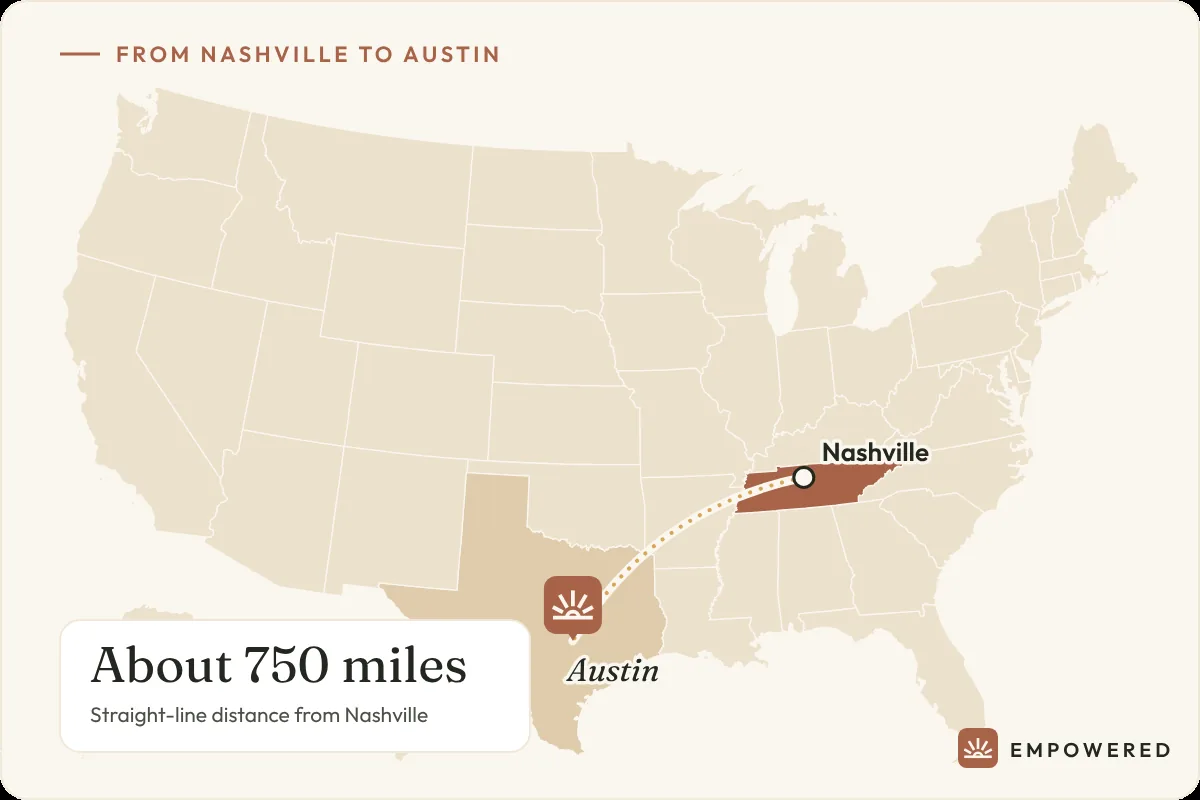
Living about 750 miles away from Austin can make treatment feel unreachable until housing is part of the plan. Our transitional housing in the Hyde Park neighborhood is a real house that works alongside PHP or IOP. You share it with others in recovery, have support around meals and evenings, and return each day to a place designed for healing.
 Shared living spaces
 A room of your own
Nourishment and therapy moving in step.
Registered dietitians, therapists, a family therapist, and psychiatric providers coordinate each person's care, meeting regularly to look at progress from every angle. Meal support happens in real time, and therapy addresses the thoughts and feelings that come up around food. As you near discharge, we help you connect with providers in Tennessee to keep momentum going.
Partial hospitalization (PHP)
Full treatment days at our Austin center: supported meals, daily groups, individual therapy, dietitian care, and medical and psychiatric monitoring.
About PHP →Intensive outpatient (IOP)
Group programming plus weekly individual and dietitian sessions, built to fit around work, school, and family once more structure is not needed.
About IOP →
“A lot of my work is helping people notice hunger and fullness again after years of tuning them out, and that takes patience on both our parts. We go one meal at a time, and I try to make the nutrition side of recovery feel collaborative rather than like a list of rules.”Emily Van Eck, MS, RDNDietitian, Empowered Treatment
Planning the trip and the paperwork.
Getting to Austin from Tennessee
People from Tennessee generally fly to Austin and stay for their program, attending in person on Spicewood Springs Road.
- Distance: about 750 miles from Nashville as the crow flies
- Flights: Nashville International Airport (BNA), Memphis International Airport (MEM), McGhee Tyson Airport (TYS) near Knoxville, and Chattanooga Metropolitan Airport (CHA) offer service to Austin-Bergstrom International Airport (AUS), some routes with a connection
- Into the city: AUS is about a 30-minute drive from our center, longer in heavy traffic
- Housing: ask about transitional housing so we can plan it around your start date
Checking your benefits
Our team can help you understand your coverage before you travel, including benefits for partial hospitalization, intensive outpatient programming, and care received outside Tennessee.
- Verify your insurance online, or call and we will walk you through it
- With a plan based in Tennessee, it helps to ask about out-of-network benefits and how Texas providers are covered; we help you get clear answers
- The Tennessee Department of Commerce and Insurance has a consumer insurance services team that mediates claim disputes and answers health insurance questions
- Read does insurance cover eating disorder treatment? to get familiar with the terms
Ongoing help from Memphis to the mountains.
Support after treatment matters as much as the treatment itself. These statewide organizations in Tennessee can help you and your family continue care and find community once you are home.
- Tennessee Department of Mental Health and Substance Abuse ServicesThe state mental health agency, with a helpline for questions, crisis services, and support for people without insurance.
- NAMI TennesseeFamily Support Groups, Family-to-Family courses, and resources for caregivers through affiliates across the state.
- Tennessee Department of Commerce and InsuranceConsumer insurance services that look into claim disputes and help with health coverage questions.
- 988 Suicide & Crisis LifelineCall or text 988, any time, from anywhere in the United States. In an emergency, call 911.
Questions from across Tennessee.
Is Austin a manageable distance from Tennessee?
For many people, yes. Flights from Nashville, Memphis, Knoxville, and Chattanooga reach Austin in a few hours, and some people choose to drive. Once here, most stay in our transitional housing or nearby lodging for the length of their program.
Can a Tennessee therapist stay in the loop while I am in Austin?
Yes, with your permission. We can coordinate with your current therapist, dietitian, or doctor in Tennessee about your history and progress, which helps avoid gaps in care and makes returning home smoother.
Do you help with eating disorders other than anorexia?
Yes. We treat adults with bulimia, binge eating disorder, ARFID, OSFED, and anorexia. Many people do not fit one category neatly, and that is fine; treatment is based on what you are actually experiencing.
More for Tennessee
Articles and guides for readers in Tennessee.
One call can make the next step clearer.
Talk with our team about what is going on and what level of support might help. It is confidential and costs nothing to ask.