
For people struggling with eating disorders in Nebraska, along I-80 and well beyond it.
Empowered Treatment helps adults with eating disorders through partial hospitalization and intensive outpatient programs in Austin, Texas, with transitional housing for those who need a place to stay. You can start by simply asking questions.
Wide open spaces, and a very narrow world inside.
Nebraska covers a lot of ground, from Omaha and Lincoln to Kearney, Grand Island, the Sandhills, and the Panhandle around Scottsbluff. An eating disorder can take hold anywhere along that map: in a Husker student juggling practice and classes, a nurse working twelve-hour shifts, a farmer who stops eating during harvest and never quite starts again, or a retiree who has quietly restricted for decades.
However big the world outside, an eating disorder tends to make the inner one smaller. Thoughts circle the same foods, numbers, and mirrors. Days get planned around avoiding meals or making up for them. If you have been living in that shrinking space, you are not weak for wanting out. Recognizing it is a real first step, and you do not have to take the next ones by yourself.

You do not have to wait for a breaking point.
Plenty of people keep going until their body, their job, or a loved one forces the issue. It does not have to work that way. If you are worn out by the rituals, worried about your health, or simply tired of pretending things are fine, you can reach out now.
A first conversation with us is confidential and practical. We will ask about what you are experiencing, explain how our intensive outpatient program and partial hospitalization program differ, and talk through timing. If you have struggled for a long time, our article on starting treatment after years of struggling may help.
You are allowed to need support too.
Caring about someone with an eating disorder can wear you down, especially when you live hours from specialists and feel like the only person who sees what is happening. Your own wellbeing matters in this. Our page on caregiver burnout offers ways to keep going without running on empty.
When your adult child, spouse, or sibling starts care in Austin, you can stay involved from Omaha, North Platte, or a farmhouse at the end of a gravel road. Through family education, we help relatives understand the illness and learn how to respond in ways that support recovery.
Somewhere steady to call home for now.
When the nearest specialized program is a long way from your town, staying in Austin can make focused care possible. Our transitional housing in the Hyde Park neighborhood gives you a furnished, shared home during PHP or IOP, with structure built into mornings and evenings and housemates who understand exactly why you are there.
 Shared living spaces
 A room of your own
A team that talks to each other.
Eating disorders are medical, psychological, nutritional, and relational all at once. Your therapist, dietitian, family therapist, and psychiatric providers share one treatment plan, meet about your progress, and change course together when needed. That coordination continues through discharge, when we help you connect with providers in Nebraska who can carry the work forward.
Partial hospitalization (PHP)
Full treatment days at our Austin center: supported meals, daily groups, individual therapy, dietitian care, and medical and psychiatric monitoring.
About PHP →Intensive outpatient (IOP)
Group programming plus weekly individual and dietitian sessions, built to fit around work, school, and family once more structure is not needed.
About IOP →
“When someone calls us for the first time, my goal is for them to hang up feeling a little less alone and a lot clearer about their options. We take time to understand each person’s situation, answer the practical questions about travel, housing, and insurance, and make the path into care feel as straightforward as possible.”Brittni PogueCo-Founder & Director of Admissions and Business Development, Empowered Treatment
From Nebraska to Austin, one detail at a time.
Making the trip from Nebraska
Most people traveling from Nebraska fly. We can help you think through timing and settling in, so your first days in Austin feel less rushed.
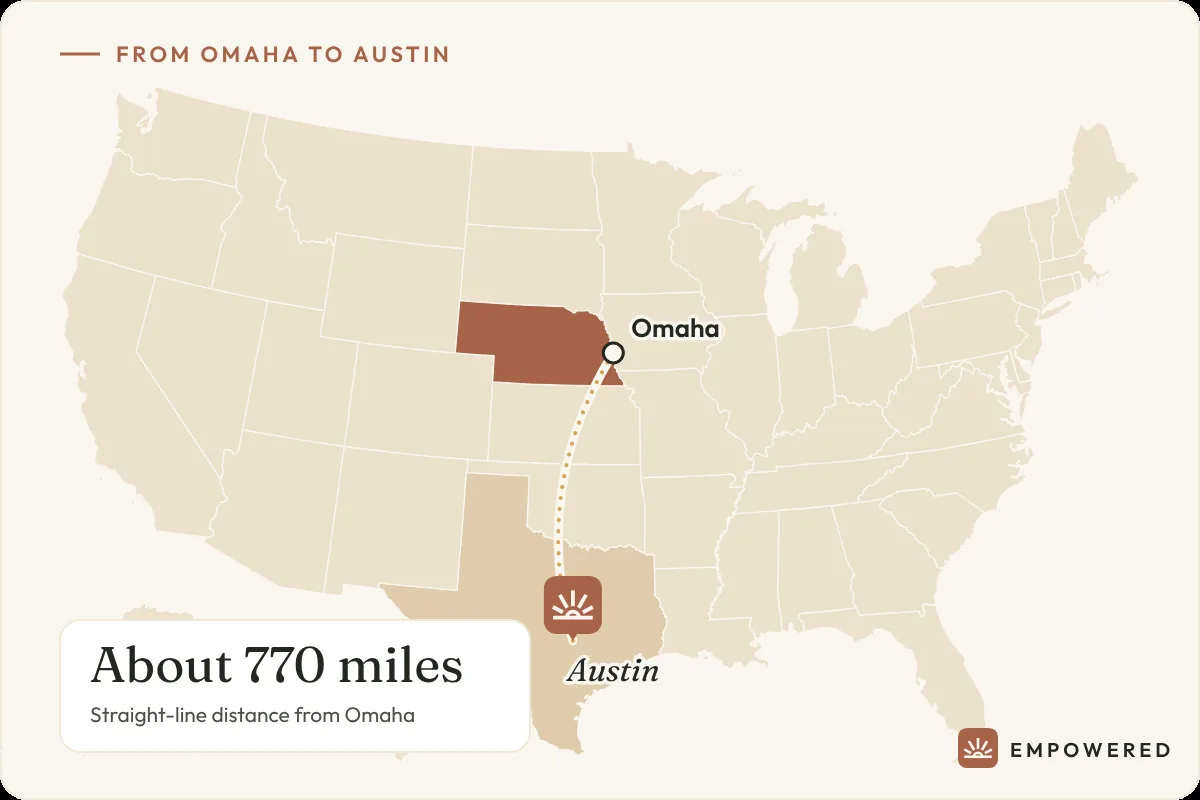
- Distance: about 770 miles from Omaha as the crow flies
- Airports: Eppley Airfield (OMA) in Omaha and Lincoln Airport (LNK) offer flights to Austin-Bergstrom International Airport (AUS)
- Once you land: AUS is roughly 30 minutes by car from our center, longer in heavy traffic
- Lodging: our transitional housing is available with PHP or IOP
Coverage and costs
Each plan handles out-of-state treatment differently. We can review your benefits for partial hospitalization and intensive outpatient care and help you understand your choices before you plan anything.
- Fill out our verify your insurance form, or call and we will check your benefits together
- Coverage through a Nebraska plan may work differently for a Texas program; ask about out-of-network benefits and prior authorization, and we help you ask the right questions
- The Nebraska Department of Insurance takes consumer complaints and explains what to do before filing
- If you have Medicaid, coverage for care outside your home state is usually limited, so call and we will help you understand what applies
Resources across the Cornhusker State.
Support after treatment helps recovery hold. These statewide resources in Nebraska can help you and your family find ongoing care and answers once you are home.
- Nebraska DHHS Division of Behavioral HealthThe state mental health authority, with information on crisis lines, walk-in access, the Nebraska Family Helpline, and a directory of services.
- NAMI NebraskaNo-cost family support groups in Lincoln, Omaha, and elsewhere, along with Family-to-Family education.
- Nebraska Department of InsuranceConsumer complaint help, guidance on insurer disputes, and an in-state complaint hotline.
- 988 Suicide & Crisis LifelineCall or text 988, any time, from anywhere in the United States. In an emergency, call 911.
Questions we hear from Nebraskans.
There are few eating disorder specialists where I live in Nebraska. What are my options?
Many people outside large metro areas face long drives or waitlists. Some choose a program like ours and stay in transitional housing, then return home with an aftercare plan. Our guide on levels of care explains what each option involves.
Can I take a leave from work to attend treatment in Austin?
Many people do, and some keep working during IOP. Rules vary by employer, so it helps to ask HR about medical leave. Our article on telling your employer about treatment covers what to share and what you can keep private.
How soon could I start?
Timing depends on your assessment, insurance review, and housing availability. Our admissions team will give you a realistic sense of the next steps and help you plan travel once a start date is confirmed.
Is your program only for women?
No. We treat adults of all genders, and men and nonbinary adults are welcome in every part of our programming. Eating disorders affect people of every identity, and our groups are built to make room for that.
More for Nebraska
Articles and guides for readers in Nebraska.
Reach out whenever you’re ready.
A call to our team is a chance to ask questions and learn about options, without any cost or commitment.