
For people struggling with eating disorders in Montana, the distance to good care can shrink.
Empowered Treatment provides adult partial hospitalization, intensive outpatient programming, and transitional housing in Austin, Texas. For Montanans weighing how far to go for specialized help, we can explain what that would really involve.
Big Sky Country, and a struggle few people talk about.
Montana asks a lot of the people who live there: long drives on two-lane highways, hard winters on the Hi-Line, seasonal work in Glacier country, and towns where everyone knows your truck. Eating disorders fit uneasily into that picture, so they are often kept private. They show up in college students in Missoula and Bozeman, in parents on ranches outside Miles City, and in professionals in Billings and Helena who keep everything looking fine.
An eating disorder is a medical and psychiatric illness, and it can affect the heart, bones, hormones, sleep, and concentration long before anyone notices a change. If you have been pushing through on your own, that grit is real, and it can be pointed toward recovery. The next step does not need to be dramatic. It can be as simple as finding out what kind of care fits.

You can keep your independence and still accept help.
People who grew up fixing their own fences or working through bad weather often carry the belief that needing help is the same as failing. Eating disorders thrive on that belief. Reaching out to a specialized team is not giving in. It is choosing the right tool for a hard job.
If you call, a real person on our team will listen to what has been going on, explain the difference between PHP and IOP, and talk through the practical side of coming to Austin. You can also read what happens when you call a treatment center.
For the people who notice first.
Maybe your husband has stopped eating with the crew, your adult daughter in Great Falls seems to live on coffee, or your sister's running has started to look more like punishment than pleasure. Saying something can feel risky. Our guide on how to help someone with an eating disorder offers practical, respectful ways to begin.
If your loved one enters treatment in Austin, you can still play an active role. Our family education explains what recovery involves and how families can support it, even from hundreds of miles away.
Housing that makes a long trip workable.
Coming from Billings, Kalispell, or a small town on the eastern plains, attending a day program in Austin only works if you have somewhere stable to live. Our transitional housing is a real house in Austin's Hyde Park neighborhood, used alongside PHP or IOP. It gives you a predictable routine, housemates who understand, and support during the hours outside of programming.
 Shared living spaces
 A room of your own
Medical, psychiatric, and nutrition care in one plan.
Eating disorders often travel with anxiety, depression, trauma, or other conditions, and the body needs attention alongside the mind. Our psychiatric providers, therapists, registered dietitians, and family therapist build one coordinated plan and revisit it as you progress. When it is time to return to Montana, we help connect you with outpatient providers so the care you started can continue.
Partial hospitalization (PHP)
Full treatment days at our Austin center: supported meals, daily groups, individual therapy, dietitian care, and medical and psychiatric monitoring.
About PHP →Intensive outpatient (IOP)
Group programming plus weekly individual and dietitian sessions, built to fit around work, school, and family once more structure is not needed.
About IOP →
“Eating disorders affect both brain and body, so part of my role is making sure medical safety and psychiatric care are addressed together rather than one at a time. I want patients to feel that their questions about medications and symptoms are welcome, because informed patients tend to feel more in control of their own recovery.”Dr. Yahya SaeedMedical Director, Psychiatrist, Empowered Treatment
The practical side of coming from Montana.
Traveling to Austin from Montana
Most Montanans fly, often with a connection, and arrive a day or two before their program begins.
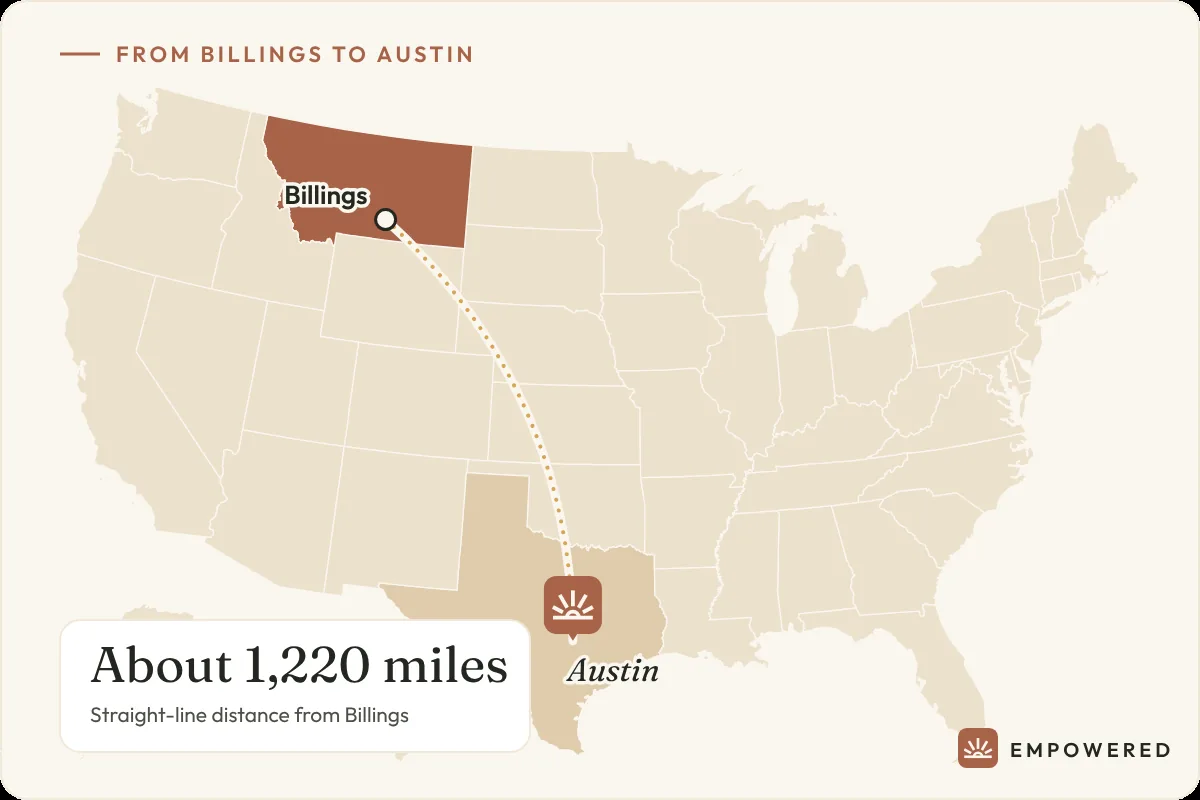
- Distance: about 1,220 miles from Billings as the crow flies
- Departing Montana: Billings Logan International (BIL), Bozeman Yellowstone International (BZN), Missoula Montana Airport (MSO), and Glacier Park International (FCA) all offer connections to Austin-Bergstrom International Airport (AUS)
- Getting to the center: AUS is roughly a 30-minute drive from our Northwest Austin location, depending on traffic
- Lodging: our transitional housing is available alongside PHP or IOP
Checking coverage from Montana
With plans and premiums shifting, it is worth confirming your benefits before you make travel plans. We will help you understand what your plan covers.
- Verify your insurance with our admissions team
- If your plan is based in Montana, ask how it covers out-of-network or out-of-state programs in Texas; we help you prepare the right questions
- The Montana Commissioner of Securities and Insurance offers health insurance guidance and help if you have a problem with your insurer
- Read whether insurance covers eating disorder treatment
Statewide support for the road home.
Lasting recovery depends on support where you live. These resources across Montana can help you and your family stay connected to care after treatment.
- Montana DPHHS: Behavioral Health and Developmental DisabilitiesThe state division overseeing publicly funded adult mental health services and behavioral health programs.
- NAMI MontanaFree peer-led support groups, education, and workshops for Montanans with mental health conditions and their families.
- Montana Commissioner of Securities and InsurancePlain-language help choosing and using health coverage, plus a phone line for problems with an insurer.
- 988 Suicide & Crisis LifelineCall or text 988, any time, from anywhere in the United States. In an emergency, call 911.
Answers for Montanans weighing the trip.
Is it worth traveling from Montana for eating disorder care?
It depends on your needs and what is available closer to home. When someone needs more structure than weekly appointments, a dedicated program can provide it. We can talk through the tradeoffs, including time away, cost, and support at home, so you can decide with clear information.
Can I bring my own vehicle, or do I need one in Austin?
Some people drive down, but most fly. You do not need a car to attend if you stay in our transitional housing; ask us how residents get to and from programming.
Does Empowered treat co-occurring conditions?
Yes. Many people have anxiety, depression, trauma, or OCD alongside an eating disorder, and our team addresses them together. Learn more about co-occurring disorders.
Does Empowered treat teenagers?
No, our programs are for adults only. If you are seeking help for a teenager, you are still welcome to call, and we can share what to look for in a program that serves younger people.
More for Montana
Articles and guides for readers in Montana.
Let's figure out what fits you.
Talk with our team about what you are facing and which level of care makes sense. Calling is free and does not commit you to anything.