
For people struggling with eating disorders in Michigan, you do not have to keep fighting alone.
Empowered Treatment in Austin, Texas, helps adults loosen the grip of an eating disorder through partial hospitalization, intensive outpatient care, and transitional housing. Our team includes therapists, dietitians, and psychiatric providers who work side by side.
An eating disorder can feel like the only steady thing.
Michigan stretches from Detroit neighborhoods and auto plants to Ann Arbor lecture halls, Grand Rapids hospitals, East Lansing apartments, and small towns across the Upper Peninsula. Eating disorders reach into all of those places. They can look like strict meal plans before a race, a habit of grazing in the car after a long shift, or a private ritual that no one at home knows about.
When the snow stays and schedules get heavy, food can become the one thing that feels predictable. That is part of what makes an eating disorder so hard to put down. It may have helped you cope for a while. Now it might be costing more than it gives. Talking with a specialist can help you see your options without pressure.

Your relationship with food can change.
It may be hard to imagine meals without counting, bargaining, or guilt. Many people we work with felt the same at first. Recovery does not mean pretending food is simple. It means learning, with support, to eat in a way that sustains your body and gives your mind room for other things.
If you have been struggling for years, our article on starting treatment after years of struggling may help. When you are ready, a call with our team can clarify whether partial hospitalization or intensive outpatient care fits your situation.
For parents, partners, and siblings back home.
Families often feel stuck between saying too much and saying nothing. If you are worried about an adult son or daughter, our page on talking to your adult child about their eating offers language that keeps the door open and keeps the focus on care, not appearance.
Once treatment begins, family education helps you understand what your loved one is working on and how to support meals, routines, and setbacks. You can take part from Michigan, and many families also plan a visit to Austin when the timing is right.
Your recovery needs a home base.
Flying in from Michigan means stepping away from your usual routines, which can be helpful and unsettling at once. Our transitional housing, located in Austin’s Hyde Park neighborhood, gives clients in PHP or IOP a shared, supportive house to return to each evening. You are not left to figure out dinner, weekends, or a new city on your own.
 Shared living spaces
 A room of your own
Nutrition, therapy, and medicine in the same room.
Our dietitians do not hand you a meal plan and disappear. They work alongside therapists, psychiatric providers, and a family therapist so nutrition goals and emotional work move forward together. Medical concerns are monitored as part of the plan. As you prepare to go home, we help you find a Michigan-based team to continue what you started.
Partial hospitalization (PHP)
Full treatment days at our Austin center: supported meals, daily groups, individual therapy, dietitian care, and medical and psychiatric monitoring.
About PHP →Intensive outpatient (IOP)
Group programming plus weekly individual and dietitian sessions, built to fit around work, school, and family once more structure is not needed.
About IOP →
“My goal is to help people feel less afraid of food, one meal at a time, by rebuilding trust with hunger and fullness rather than relying on rigid rules. We work at a pace that feels manageable, and I want every client to know there is no such thing as a perfect eater in recovery.”Curissa Groll, MS, RD, LDDietitian, Empowered Treatment
Travel and coverage without the guesswork.
Coming to Austin from Michigan
Michigan’s two largest airports have flights to Austin, and our team can help you plan around winter weather and your program start date.
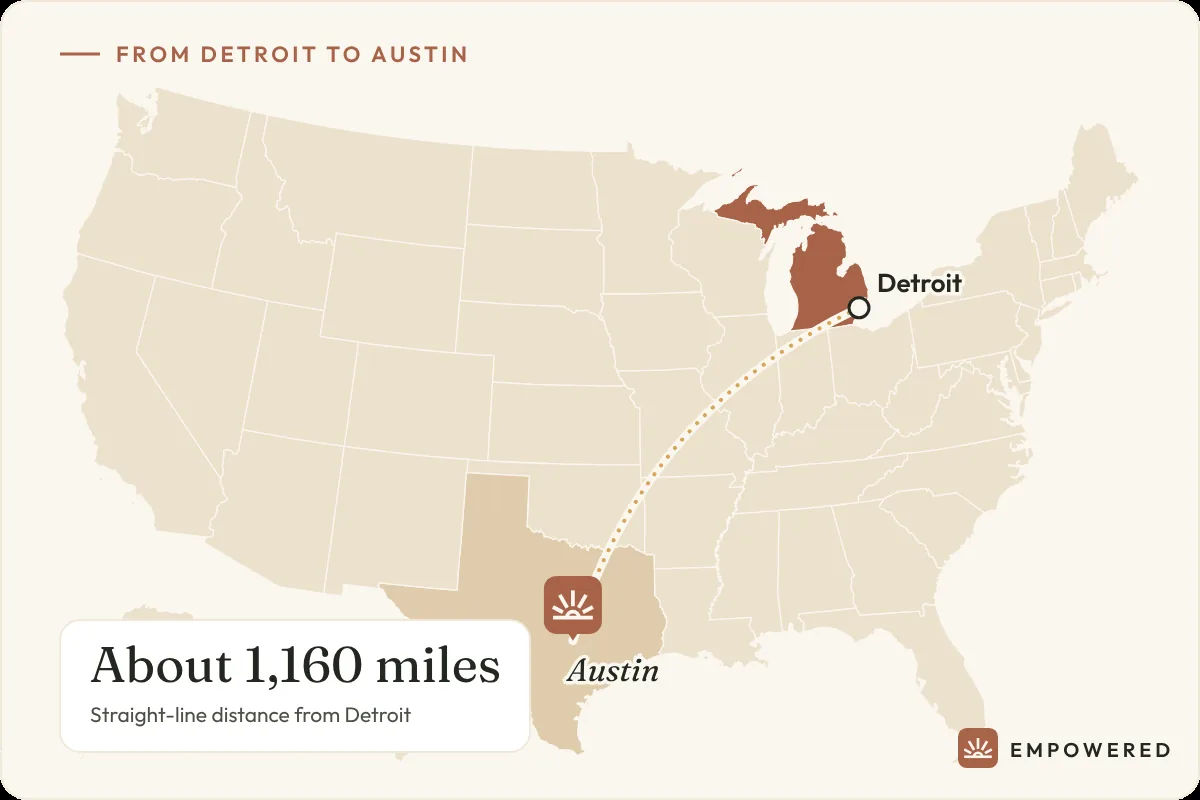
- Distance: about 1,160 miles from Detroit as the crow flies
- Air travel: Detroit Metropolitan Wayne County Airport (DTW) and Gerald R. Ford International Airport (GRR) in Grand Rapids both connect to Austin-Bergstrom International Airport (AUS)
- Arrival: Empowered is roughly a 30-minute car trip from AUS, depending on the time of day
- Place to stay: transitional housing is offered alongside PHP or IOP
Insurance questions, answered early
Our team can verify your benefits and explain how your plan handles partial hospitalization, intensive outpatient care, and out-of-network services before you decide.
- Request a benefits check at verify insurance, or call and we will start it with you
- Michigan-based plans vary in how they handle providers in Texas, so ask whether out-of-network benefits apply; we can help you prepare the right questions
- The Michigan Department of Insurance and Financial Services answers consumer questions and investigates complaints about insurers
- Read about eating disorder treatment costs and how to plan for them
Staying supported across Michigan.
As you look toward life after treatment, these statewide resources in Michigan can help you and the people who love you keep care going.
- MDHHS: Adult Behavioral HealthState information on adult mental health services, including the Michigan Crisis and Access Line and community behavioral health clinics.
- NAMI MichiganFamily-to-Family classes, family support groups, and other programs for people affected by mental health conditions.
- Michigan Department of Insurance and Financial ServicesConsumer help with insurance questions and complaints, with call center specialists available on weekdays.
- 988 Suicide & Crisis LifelineCall or text 988, any time, from anywhere in the United States. In an emergency, call 911.
Questions Michiganders ask us most.
Why would someone from Michigan choose a program in Texas?
People choose programs for many reasons: a specific level of care, a team approach that fits them, housing availability, or simply a fresh setting. We are happy to talk honestly about whether Empowered matches what you need, and to point you elsewhere if it does not.
How do I plan time away from work?
Many people use medical leave during PHP and return to work while in IOP. We can provide documentation when appropriate. Our article on working while in eating disorder treatment covers what to consider.
What will meals look like in the program?
Meal support is part of the work, guided by our dietitians and clinical staff. The goal is to practice eating in a structured, supportive setting so it gradually feels less frightening. Your meal plan is individualized and adjusted as you progress.
What happens if I relapse after going home to Michigan?
Setbacks are common and do not erase progress. Your aftercare plan includes outpatient providers and warning signs to watch for. Read relapse after eating disorder treatment for guidance on what to do next.
More for Michigan
Articles and guides for readers in Michigan.
Help is one call away from Michigan.
Talk with someone on our team about what you are experiencing and what support might look like. Questions are welcome, and there is no commitment attached.