
For people struggling with eating disorders in Maryland, from the Eastern Shore to the western mountains.
Empowered Treatment is an adult eating disorder program in Austin, Texas, offering partial hospitalization, intensive outpatient care, and a supportive transitional house. This page is for you, and for the people in your corner.
You may have been carrying this longer than anyone knows.
An eating disorder in Maryland might belong to a federal contractor in Montgomery County who works through every lunch, a student in College Park weighing herself between classes, a line cook in Ocean City who binges alone after closing, or a mother in Hagerstown who serves dinner to everyone but herself. Eating disorders reach people of all genders, ages, races, and body sizes, often without anyone noticing.
However it began, it has probably become a way of coping with something: stress, control, grief, loneliness, or simply getting through the day. That is part of why it is so hard to set down. Treatment is not about taking your coping away and leaving you empty. It is about building other ways to manage, with people who understand how frightening that change can feel.

Asking for help is not the same as giving up.
Part of you may be ready for things to change while another part is scared of what change would mean. Both can be true at once. You do not have to resolve that tension before you call; working through it is part of what treatment is for.
When you reach us, you will have a confidential conversation with someone who understands eating disorders. We will talk about your history, what you have already tried, and whether a structured program like PHP or a more flexible IOP might suit where you are. For more on that decision, see when weekly therapy isn’t enough.
It is okay not to have the answers.
Parents, spouses, and siblings often describe feeling helpless, frustrated, and guilty all at the same time. Those feelings make sense. Some of the most well-meant comments can unintentionally make things harder, which is why our article on what not to say to someone with an eating disorder may be a useful place to start.
If someone you love enters treatment in Austin, you will not be shut out. Our family education helps relatives in Annapolis, Frederick, Salisbury, and beyond learn how eating disorders work, what recovery tends to look like, and how to take care of themselves along the way.
Room to focus on getting well.
Coming from the Baltimore area or the Chesapeake shoreline means you will be far from your usual support, but also far from the routines that kept the eating disorder going. Our transitional house in Austin’s Hyde Park offers shared meals, a predictable rhythm, and housemates who are also in treatment, so evenings and weekends feel supported rather than isolating.
 Shared living spaces
 A room of your own
Every part of your care, in conversation.
A therapist helps with the thoughts and emotions beneath the eating disorder. A dietitian helps you rebuild trust with food. A family therapist works with the people closest to you, and psychiatric providers attend to mood, anxiety, and medical concerns. Because they work as one team, your plan stays consistent, and your discharge plan includes connections back in Maryland.
Partial hospitalization (PHP)
Full treatment days at our Austin center: supported meals, daily groups, individual therapy, dietitian care, and medical and psychiatric monitoring.
About PHP →Intensive outpatient (IOP)
Group programming plus weekly individual and dietitian sessions, built to fit around work, school, and family once more structure is not needed.
About IOP →
“In therapy, I try to create a space where people can be honest about the parts of the eating disorder that still feel helpful to them, without worrying about being judged. Once we understand what it has been protecting, we can start building other ways to cope that feel just as safe.”MayLinh Lucio, LMSWTherapist, Empowered Treatment
Travel and coverage, made clearer.
Getting from Maryland to Austin
Flying is the usual route. We can help you choose an arrival day that gives you time to settle in before programming begins.
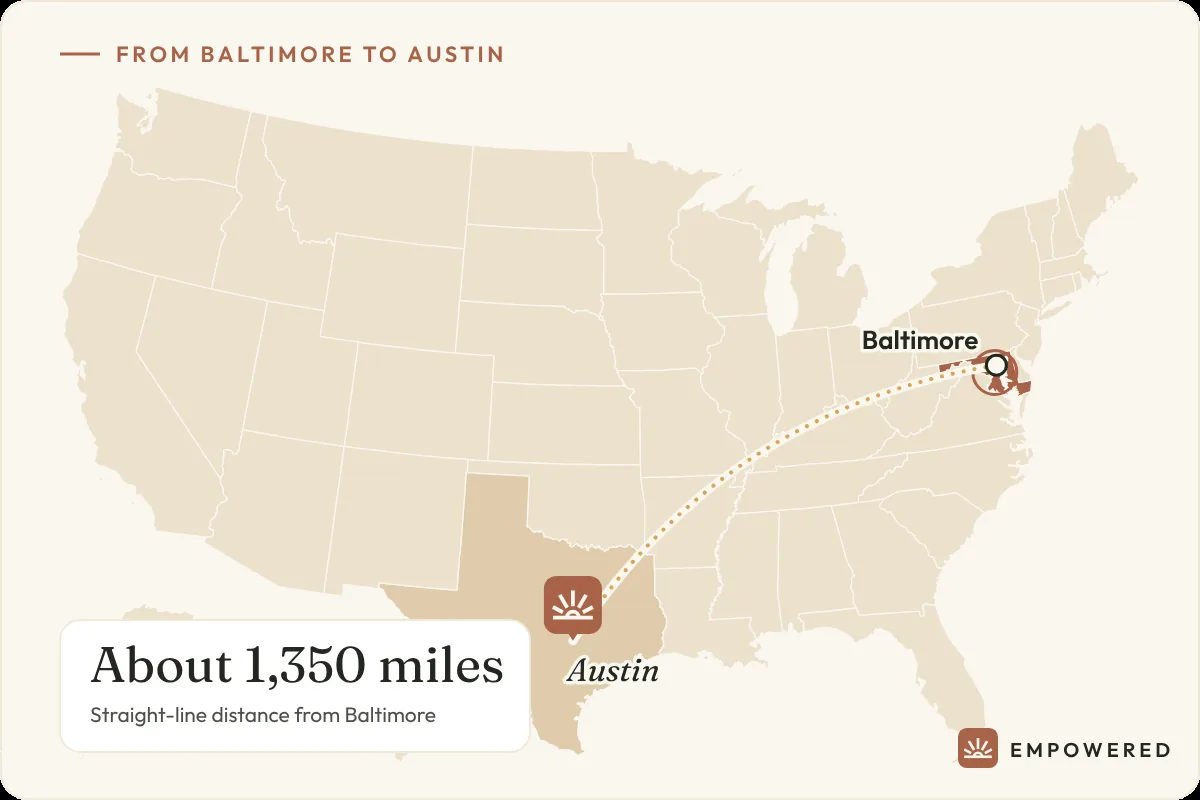
- Distance: about 1,350 miles from Baltimore as the crow flies
- Departing Maryland: Baltimore/Washington International Thurgood Marshall Airport (BWI) has flights to Austin-Bergstrom International Airport (AUS)
- Last stretch: count on about 30 minutes by car from AUS to our center, depending on traffic
- Staying in Austin: our transitional housing pairs with PHP or IOP
Making sense of insurance
We know insurance can feel like a second full-time job. Our team will contact your plan, look at your benefits for partial hospitalization and intensive outpatient care, and explain what we learn.
- Use our insurance verification page, or call to have a team member look up your benefits
- For a plan issued in Maryland, ask how it treats care received in Texas and whether out-of-network coverage applies; we help you ask the right questions
- The Maryland Insurance Administration offers free help with health coverage problems and complaints
- Learn more in does insurance cover eating disorder treatment?
Support that follows you home to Maryland.
Planning for life after treatment starts early. These statewide resources in Maryland can help you and your family find continuing care, education, and help with coverage questions.
- Maryland Behavioral Health AdministrationPart of the Maryland Department of Health, with links to get help, Maryland Behavioral Health Connect, and crisis support.
- NAMI MarylandFamily support groups, Family-to-Family classes, and a weekday HelpLine for relatives and caregivers.
- Maryland Insurance AdministrationConsumer information and free help with health insurance problems, including how to file a complaint.
- 988 Suicide & Crisis LifelineCall or text 988, any time, from anywhere in the United States. In an emergency, call 911.
Answers for Marylanders considering care.
How do people from Maryland handle being so far from home?
Distance is a real adjustment. Many people stay in our transitional housing, keep in touch with family through scheduled calls, and involve loved ones in family education. Our article on long-distance support has more ideas.
What happens to my care when I go back to Maryland?
Before you leave, we build an aftercare plan with you. That can include stepping down from PHP to IOP, then connecting you with a therapist, dietitian, or psychiatric provider closer to home, and sharing records with your permission.
I am a man. Is this program for me?
Yes. Eating disorders affect men too, though they often go unrecognized. Our groups and individual work are open to adults of all genders. Read more about eating disorders in men.
Do I need a diagnosis before I call?
No. Many people call simply because something feels wrong. Part of our process is an assessment that helps clarify what is going on and what level of care fits. Our page on what happens when you call explains the steps.
More for Maryland
Articles and guides for readers in Maryland.
Let’s talk about what comes next.
Call to speak with our team about what you are going through and what kind of support could help. The call is free, private, and carries no obligation.