
For people struggling with eating disorders in Indiana, there is room to slow down and get support.
Empowered Treatment in Austin, Texas, offers adults partial hospitalization, intensive outpatient programming, and transitional housing, so recovery can have your full attention for a while.
It can start small and quietly take over.
It might be the nurse in Fort Wayne who skips meals through a twelve-hour shift, the Purdue senior who runs extra miles after every dinner, or the warehouse supervisor near Indianapolis who binges in the car and then feels ashamed for days. Eating disorders turn up in the Region, along the Ohio River, and in the farm towns in between. They do not depend on size, age, or gender.
Most people do not notice the exact moment it changed. Food becomes a set of rules, then a source of constant calculation, and eventually the main thing your mind returns to when it is quiet. If that is where you are, it is not a personal failing. It is a health condition with real treatment, and you can begin by simply talking about it.

Struggling quietly still counts as struggling.
You might be keeping up at work and showing up for family while privately spending hours on food, guilt, or exercise. Needing help with that does not require a crisis, a certain weight, or a hospital stay first.
Our admissions team takes your call personally. We ask what daily life looks like right now, answer questions about schedules and costs, and explain whether PHP or IOP could fit. Read what happens when you call if you would like to know ahead of time.
You noticed something. That matters.
Parents and partners often pick up on changes first: meals avoided, new rituals, a mood that drops around food. Raising it with an adult can feel risky, especially if they push back. Our page on talking to your adult child about their eating offers words and timing that tend to help.
When someone you love comes to Austin for care, staying involved from Indiana is still possible. Our family education sessions explain what recovery involves, what to expect during the hard weeks, and how home can become a steadier place when they return.
Settling in, a long way from home.
Leaving Indiana for treatment raises practical questions about where to live and how to get through evenings alone. Our transitional housing answers both. It is a furnished house in Austin's Hyde Park neighborhood, used alongside PHP or IOP, where residents share meals, routines, and encouragement, and staff support helps carry the skills from the day into the rest of life.
 Shared living spaces
 A room of your own
Body, mind, and meals treated together.
Eating disorders affect physical health, emotions, and relationships at the same time, so our care brings those threads together. Therapists, registered dietitians, a family therapist, and psychiatric providers collaborate on one plan and adjust it as you change. When it is time to step down, we help line up providers in Indiana who can continue the work with you.
Partial hospitalization (PHP)
Full treatment days at our Austin center: supported meals, daily groups, individual therapy, dietitian care, and medical and psychiatric monitoring.
About PHP →Intensive outpatient (IOP)
Group programming plus weekly individual and dietitian sessions, built to fit around work, school, and family once more structure is not needed.
About IOP →
“Most people who call us are nervous, and that is completely okay, because the first conversation is just about listening and answering questions. Our job in admissions is to make the next step clear, whether that step is with us or somewhere that fits you better.”Brittni PogueCo-Founder & Director of Admissions and Business Development, Empowered Treatment
Plans, flights, and paying for care.
From Indiana to Northwest Austin
Flying is the usual way people from Indiana reach us, and most stay in Austin for the length of their program.
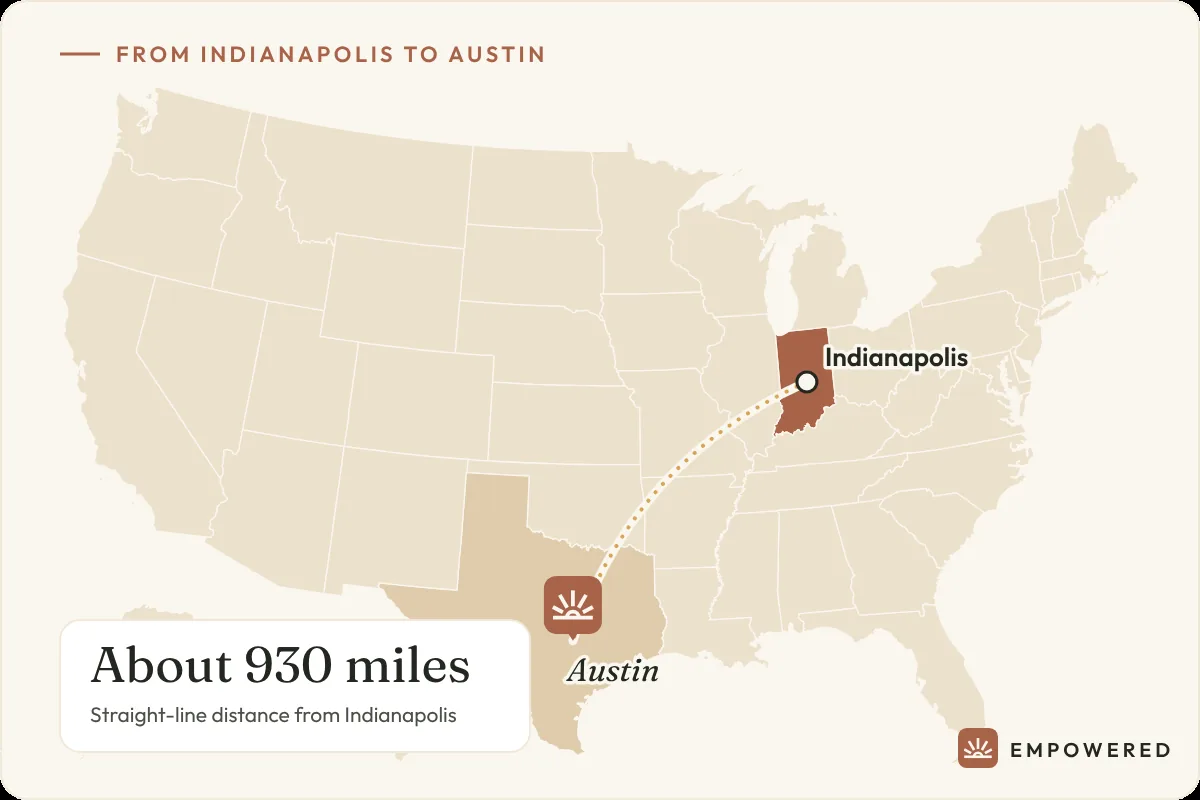
- Distance: about 930 miles from Indianapolis as the crow flies
- Flying in: Indianapolis International Airport (IND), Fort Wayne International Airport (FWA), South Bend International Airport (SBN), and Evansville Regional Airport (EVV) all connect to Austin-Bergstrom International Airport (AUS)
- From the airport: plan on roughly half an hour by car from AUS to our center, more at rush hour
- Where to stay: our transitional housing can be arranged with your program
Benefits and costs
We can check your coverage before you commit, including how your plan handles partial hospitalization, intensive outpatient services, and care delivered in another state.
- Verify your insurance online, or call and we will do it with you
- With a plan based in Indiana, the key questions are whether you have out-of-network benefits and how care in Texas is handled; we help you ask them
- The Indiana Department of Insurance Consumer Services team can help with health insurance questions and complaints
- If you have Indiana Medicaid, coverage for care outside your home state is usually limited, so call and we'll help you understand what applies
Support that continues after Austin.
Lasting recovery depends on the support around you once you are home. These statewide resources in Indiana can help you and your family find care, education, and help with coverage.
- Indiana Division of Mental Health and Addiction (FSSA)The state's mental health division, with a search tool for finding mental health providers in your area.
- NAMI IndianaThe state organization of NAMI, offering support groups and family programs such as Family-to-Family.
- Indiana Department of InsuranceConsumer Services staff who assist with health insurance inquiries and complaints by phone or email.
- 988 Suicide & Crisis LifelineCall or text 988, any time, from anywhere in the United States. In an emergency, call 911.
Questions Hoosiers bring to us.
Why would someone from Indiana choose a program in Austin?
People choose us for different reasons: a specialized adult team, a combination of programming and housing, or simply a fresh setting away from daily triggers. Distance is a real consideration, so we talk honestly about whether relocating for a period makes sense for you.
Can I bring my car or do I need one in Austin?
Some people drive down from Indiana, and others fly and get by without a car. If you stay in our transitional housing, we can explain how residents usually get to and from programming. Ask during your call so we can plan it together.
What if my job does not know I need treatment?
You decide how much to share. Many people use medical leave protections, and some only need to adjust hours for IOP. Our article on telling your employer about treatment walks through common options.
Who will help me find care back in Indiana?
Your team at Empowered starts aftercare planning well before discharge. That can mean identifying a therapist, dietitian, or psychiatric provider in Indiana, sharing records with your permission, and making sure the handoff happens before you leave.
More for Indiana
Articles and guides for readers in Indiana.
A first call is just a conversation.
Talk with our admissions team about what you are noticing and what options exist. There is no cost and no pressure to decide.