
For people struggling with eating disorders in Idaho, help can exist even when it feels far away.
Empowered Treatment offers adult partial hospitalization, intensive outpatient care, and transitional housing in Austin, Texas. For Idahoans who have run out of nearby options, it is one place to start a real conversation.
Wide-open country can still feel very small inside your head.
Idaho is full of space: the Snake River Plain, the Sawtooths, the long drives between Twin Falls and Coeur d'Alene. Yet an eating disorder can shrink a life down to the next meal, the next weigh-in, or the next plan to make up for what you ate. It can happen to a Boise State student, a rancher's spouse in the Magic Valley, or a nurse working nights in Pocatello, and it often stays hidden for a long time.
If you are reading this, part of you may already suspect that food has stopped being simple. That awareness matters. Eating disorders respond to specialized, consistent treatment, and needing more than you can find close to home is not a personal shortcoming. It is often just a reflection of how few dedicated programs exist across large rural regions.

Being self-reliant is a strength. It doesn't have to mean doing this alone.
Many people in rural places are used to handling hard things themselves. That independence can carry you a long way, but eating disorders tend to use it against you, convincing you that asking for help means giving up control. Reaching out is a way of taking control back.
When you call, you will speak with someone on our team who listens first. We can walk through your options, explain levels of care, and help you think about what a stay in Austin would involve, including whether you are sick enough to need this level of support.
When you can see the change from across the dinner table.
Families often notice shifts first: an adult child who no longer eats with everyone, a partner whose exercise has become nonnegotiable, a sibling who seems tired all the time. If your loved one has brushed off your concern, our guide to when a loved one refuses eating disorder help may help you plan what to say next.
Distance does not have to cut you out of their recovery. Through our family education, relatives learn about eating disorders, what treatment looks like day to day, and how to respond in ways that support progress, whether they live in Meridian or the Idaho Panhandle.
A place to live while the work gets done.
Coming from Boise, the Wood River Valley, or a small town along Highway 95 usually means you cannot commute. Our transitional housing solves that: it is a real house in Austin's Hyde Park neighborhood, available alongside PHP or IOP. You share it with others in treatment, practice everyday routines with support, and have a stable place to rest between program days.
 Shared living spaces
 A room of your own
Clinical care that connects mind, body, and daily life.
Recovery is easier to sustain when the pieces fit together. At Empowered, eating disorder therapists, registered dietitians, a family therapist, psychiatric providers, and experiential staff share one treatment plan. Groups, meals, individual sessions, and real-world practice all build on each other, and your team adjusts as you change. Before you leave, we help arrange the outpatient support you will need back home.
Partial hospitalization (PHP)
Full treatment days at our Austin center: supported meals, daily groups, individual therapy, dietitian care, and medical and psychiatric monitoring.
About PHP →Intensive outpatient (IOP)
Group programming plus weekly individual and dietitian sessions, built to fit around work, school, and family once more structure is not needed.
About IOP →
“A lot of recovery happens outside the therapy room, at a grocery store, a restaurant table, or on a walk where movement can feel like something other than punishment. My job is to help people practice those moments with support, so they leave with skills they have actually used and not just talked about.”Chris Ellis, LCDCi, RSPSDirector of Experiential Recovery Services, Empowered Treatment
Planning the trip and the coverage.
Getting from Idaho to Austin
The distance is significant, so most people from Idaho fly and plan to stay in Austin for the length of their program.
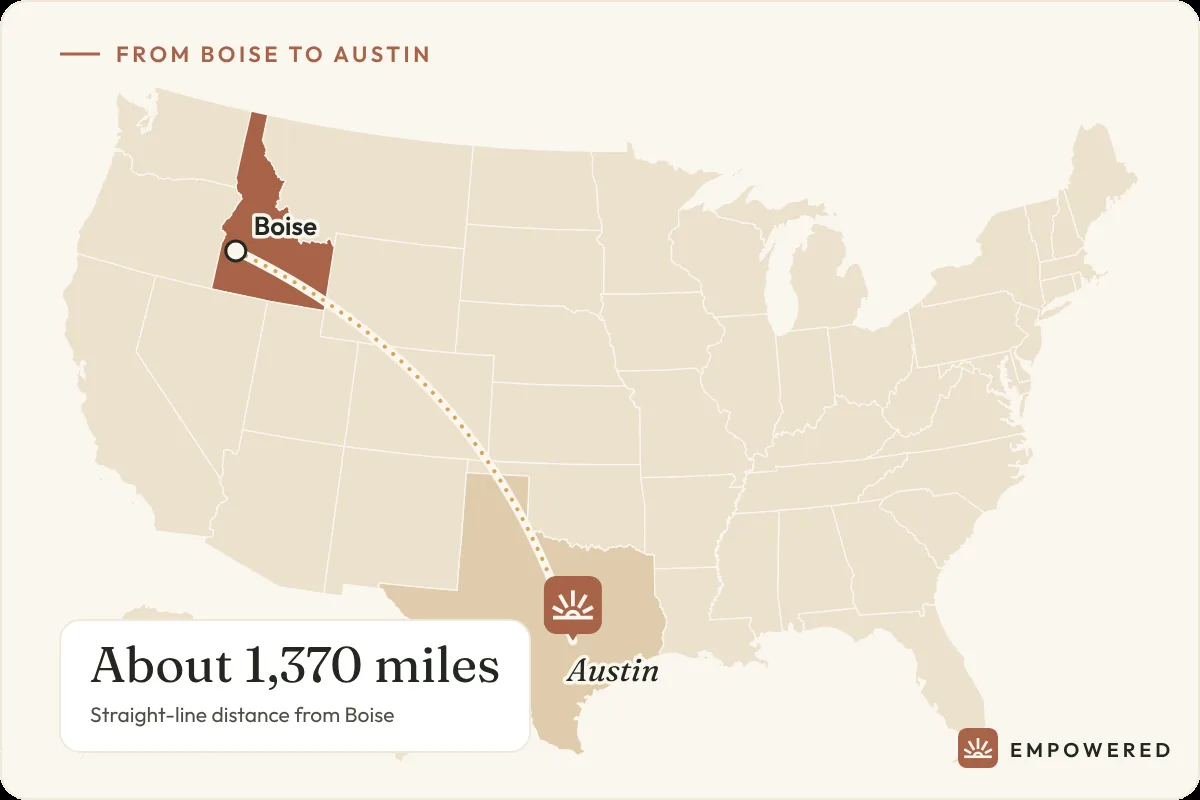
- Distance: about 1,370 miles from Boise as the crow flies
- Flying: most Idahoans fly from Boise Airport (BOI) into Austin-Bergstrom International Airport (AUS), usually with a connection
- Arrival: AUS is roughly a 30-minute drive from our center, depending on traffic
- Housing: transitional housing in Hyde Park can be set up to start alongside PHP or IOP
Insurance questions from Idaho
Before you travel, it helps to know how your plan treats eating disorder care across state lines. We can check your benefits and explain what we find in plain terms.
- Start by asking us to verify your insurance
- Plans based in Idaho may handle care in Texas as out-of-network or require prior authorization; we help you know what to ask your insurer
- The Idaho Department of Insurance Consumer Affairs team responds to questions and complaints about insurance companies
- Read what to know about eating disorder treatment costs
Support that stays with you in the Gem State.
Your aftercare plan should fit the place you return to. These statewide resources in Idaho can help you and your family keep support in place once programming ends.
- Idaho Department of Health and Welfare: Behavioral HealthAdult behavioral health services, crisis resources by region, and information on state programs.
- NAMI IdahoFamily support groups, the Family-to-Family class, and resources for caregivers across Idaho.
- Idaho Department of InsuranceConsumer Affairs help with insurance questions, disputes, and complaints.
- 988 Suicide & Crisis LifelineCall or text 988, any time, from anywhere in the United States. In an emergency, call 911.
What Idahoans often want to know first.
How long would I need to stay in Austin?
Length of stay varies with each person and level of care, and your team reviews progress with you regularly. Many people from far away begin in PHP and step down to IOP before going home. See how long eating disorder treatment takes for more detail.
What happens with aftercare when I return to Idaho?
We begin planning your return well before discharge. That can include identifying a therapist, dietitian, or psychiatric provider in your area, sharing records with your permission, and making sure the first appointments are set before you leave Austin.
Can I attend part of the program from home in Idaho?
No. All of Empowered's programming is in person at our Austin center. People traveling from Idaho usually stay in our transitional housing or another arrangement in Austin while they attend.
What does a first assessment involve?
It is a conversation, not a test. We ask about your eating, health, mood, and history so we can recommend a level of care. Read what an eating disorder assessment involves to know what to expect.
More for Idaho
Articles and guides for readers in Idaho.
The first step can be a single phone call.
Talk with our team about what you are noticing and what kind of care might fit. There is no cost or obligation to reach out.