
For people struggling with eating disorders in Hawaii, an ocean away is not too far.
Empowered Treatment is an adult eating disorder program in Austin, Texas, with day treatment (PHP), intensive outpatient care, and a transitional house in the Hyde Park neighborhood. When specialized care is hard to find on your island, it can help to know what a focused stretch of treatment would look like.
What you are carrying deserves real attention.
An eating disorder in Hawaii can look like a hotel worker on Maui who skips meals between early and late shifts, a UH Mānoa student who counts every bite in a dorm on Oʻahu, or a military spouse who has quietly stopped eating at the dinner table. It affects people of every shape, culture, gender, and age, and it often goes unseen, even in close families.
Underneath, the experience tends to rhyme: thoughts about food that will not switch off, a sense that eating has to be earned, a body that never feels acceptable. Specialized help may feel scarce where you live, and the distance to the mainland can make reaching out seem pointless. It is not. Talking it through is a reasonable first step.

You can ask questions before deciding anything.
Leaving the islands for treatment is a big decision, and nobody expects you to make it on the first call. You can simply describe what has been happening and hear how a program like ours works. Many adults wait years because they assume their situation is not serious enough. Your experience counts as it is.
Our team will talk with you about your history, your goals, and what level of support might help, whether that is partial hospitalization or intensive outpatient. If you are unsure what the first conversation involves, read what happens when you call a treatment center.
Supporting someone across the Pacific is possible.
For many families in Hawaii, the idea of a loved one traveling thousands of miles for care brings worry and guilt along with hope. Those feelings are normal. Staying close by phone and video, and asking how they are rather than what they ate, can help. Our guide to supporting recovery from a distance has practical ideas.
Parents, partners, and siblings are welcome in our family education, which explains how eating disorders work, what happens in treatment, and how to support an adult without taking over. The time difference with Central Texas takes some planning, and our family therapist can help you find a rhythm that works.
Somewhere steady on the mainland.
When home is Oʻahu, Maui, Kauaʻi, or Hawaiʻi Island, a long flight means treatment also means living in a new city for a while. Our transitional housing, a real home in the Hyde Park neighborhood of Austin that pairs with PHP or IOP, is a place where you share meals and evenings with other adults in recovery instead of navigating an unfamiliar place alone.
 Shared living spaces
 A room of your own
Coordinated care under one roof.
In our program, your therapist, registered dietitian, family therapist, and psychiatric providers work from a shared plan and meet regularly about your progress. That coordination matters when you are far from your usual doctors. As you move toward stepping down, we help you identify providers back in Hawaii and plan how to keep the gains you have made once you are home.
Partial hospitalization (PHP)
Full treatment days at our Austin center: supported meals, daily groups, individual therapy, dietitian care, and medical and psychiatric monitoring.
About PHP →Intensive outpatient (IOP)
Group programming plus weekly individual and dietitian sessions, built to fit around work, school, and family once more structure is not needed.
About IOP →
“Choosing care far from home takes courage, and we take that seriously from the very first conversation. Our job is to make the time someone spends with us feel structured and safe, so their energy can go toward recovery rather than logistics.”Steffani Roller, LPC, IEDSCo-Founder & Clinical Director, Empowered Treatment
Planning the trip and the coverage.
Flying to Austin from Hawaii
Travel from the islands to Austin generally involves a connection on the mainland. We are glad to talk through arrival dates so your first day starts smoothly.
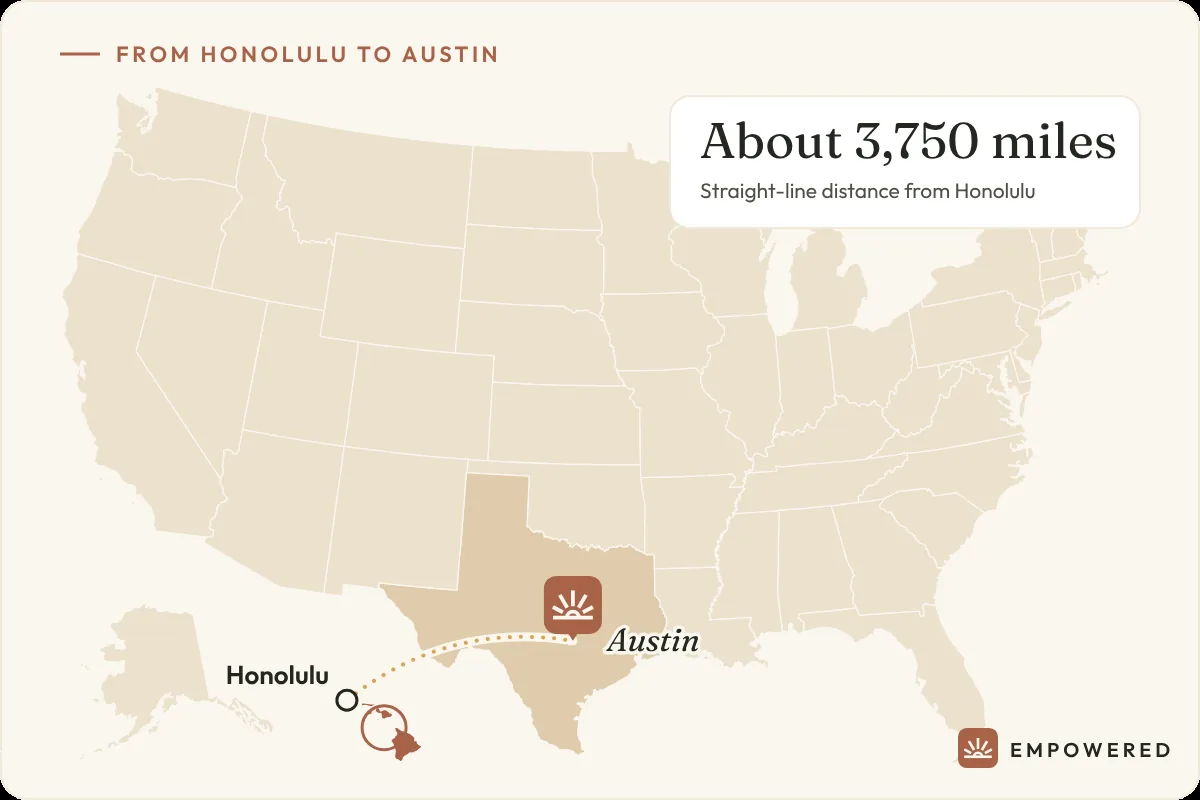
- Distance: about 3,750 miles from Honolulu as the crow flies
- Flying: Daniel K. Inouye International Airport (HNL) on Oʻahu, Kahului Airport (OGG) on Maui, and Kona International Airport (KOA) on Hawaiʻi Island all connect to Austin-Bergstrom International Airport (AUS)
- On arrival: AUS is roughly a 30-minute drive from our center, with traffic the main variable
- Where to stay: many people from far away choose our transitional housing, offered with either level of care
Questions about insurance
Plans differ a great deal in how they handle care on the mainland. Before you book a flight, our team can look over your benefits and walk you through how PHP, IOP, and out-of-network services are treated under your policy.
- Verify your insurance using the form on our site, or phone us to go through it together
- If your plan is based in Hawaii, ask whether it pays for mainland providers and what out-of-network benefits look like for Texas; we can help you prepare those questions
- The Hawaii Insurance Division answers health plan questions and explains how to file a complaint against a health insurer
- Read does insurance cover eating disorder treatment? for common terms and questions
Support waiting for you back home.
Recovery continues after you fly home. These statewide resources in Hawaii can help you and your family keep care and connection in place across the islands.
- Hawaii Department of Health: Adult Mental Health DivisionState adult mental health services and information on access, plus the Hawaii CARES 988 line for crisis support and treatment referrals.
- NAMI HawaiiFamily-to-Family education, family support groups, and other programs for people affected by mental illness and those who care about them.
- Hawaii Insurance DivisionHealth insurance guidance, a patients’ bill of rights, and help filing a complaint against a health plan.
- 988 Suicide & Crisis LifelineCall or text 988, any time, from anywhere in the United States. In an emergency, call 911.
What people in Hawaii want to know first.
Is it realistic to leave Hawaii for eating disorder care?
For some adults, yes. It takes planning around work, family, and travel, and we will help with each piece. Many people who come from far away stay in our transitional housing. Our piece on relocating to Austin for care explains what to expect.
How will my family stay involved from the islands?
Families can join family education and work with our family therapist, with sessions scheduled around the time difference whenever possible. We also help your loved one decide what to share and how often, so contact feels supportive rather than stressful.
Can I go to treatment while managing a job back home?
That depends on the level of care. PHP runs 30 hours a week, so most people take leave. Our page on telling your employer about treatment walks through how to have that conversation and what to consider.
What does an assessment involve?
It is a conversation, not a test. We ask about your eating, your health, your mood, and your history with treatment, and we talk about what you hope will change. Read what an eating disorder assessment involves for a fuller picture.
More for Hawaii
Articles and guides for readers in Hawaii.
Start with one conversation, at your own pace.
Call to talk with someone on our clinical team about what you are experiencing and whether our program could fit. There is no obligation, and no question is too small.