
For people struggling with eating disorders in Georgia, you are allowed to need more than you have.
Empowered Treatment is an Austin, Texas program for adults with eating disorders, offering partial hospitalization, intensive outpatient care, and a supportive transitional house for people who relocate while they heal. Whatever this has looked like for you, there is room here to talk about it.
Some struggles stay quiet for a very long time.
Georgia holds a lot of different lives. A graduate student in Athens counting every bite between seminars. A logistics coordinator near Hartsfield-Jackson who works through lunch until lunch stops existing. A new mom in Savannah, a middle school teacher in Macon, a retiree in the North Georgia mountains who has quietly been dieting for fifty years. Eating disorders can live inside any of those stories, in any body.
From the outside, things may look fine. Inside, food has become a math problem, a punishment, or the only thing that feels in your control. Many people tell us they kept waiting for it to get bad enough to justify help. You do not have to wait for that point. Noticing that something is off is already a meaningful step.

It is okay if part of you is not ready.
Ambivalence is common. The eating disorder may feel like protection, a habit, or simply the way things are. You can call while still unsure whether you want to change anything. A first conversation is about understanding, not signing up.
Our admissions staff will ask about your eating, your health, and your daily life, then describe how PHP and IOP differ in hours and support. If you want to know what that call involves, what happens when you call a treatment center walks through it.
For the people who love them
Maybe you are a parent in Marietta watching your grown daughter push food around her plate at Sunday dinner, or a husband in Augusta who has noticed the long runs and the skipped meals. Bringing it up can feel like risking the relationship. Our piece on talking to your adult child about their eating offers words that open the door rather than close it.
Once treatment starts, you stay involved. Our family education sessions teach parents, partners, and siblings how eating disorders work, how to handle hard moments at the table, and how to care for yourselves along the way.
Room to breathe between sessions.
Coming from Georgia usually means stepping away from home for a while, and evenings alone in an unfamiliar city can be the hardest hours. Our transitional house in Austin's Hyde Park neighborhood pairs with PHP or IOP and gives residents shared dinners, structure, and staff support, so recovery continues after the treatment day ends.
 Shared living spaces
 A room of your own
Clinicians who talk to each other.
An eating disorder touches nutrition, mood, relationships, and physical health at once, so treating one piece in isolation rarely works. Our therapists, registered dietitians, family therapist, and psychiatric providers coordinate around a single plan for each client, adjust it as you change, and help you build a follow-up team in Georgia before you head home.
Partial hospitalization (PHP)
Full treatment days at our Austin center: supported meals, daily groups, individual therapy, dietitian care, and medical and psychiatric monitoring.
About PHP →Intensive outpatient (IOP)
Group programming plus weekly individual and dietitian sessions, built to fit around work, school, and family once more structure is not needed.
About IOP →
“Moving into our housing is a big change, so we try to make the first days feel steady: a clear routine, people who know your name, and someone to talk with when the evening gets hard. Living close to treatment gives you a chance to practice recovery in everyday life before you take it home.”Maryam Mahmoud, LCSW, LCDCClinical Director of Transitional Services, Empowered Treatment
Flights, coverage, and the questions in between.
Making the trip from Georgia
Flying is the usual route from Georgia, and our staff can help coordinate your arrival with your start date and housing.
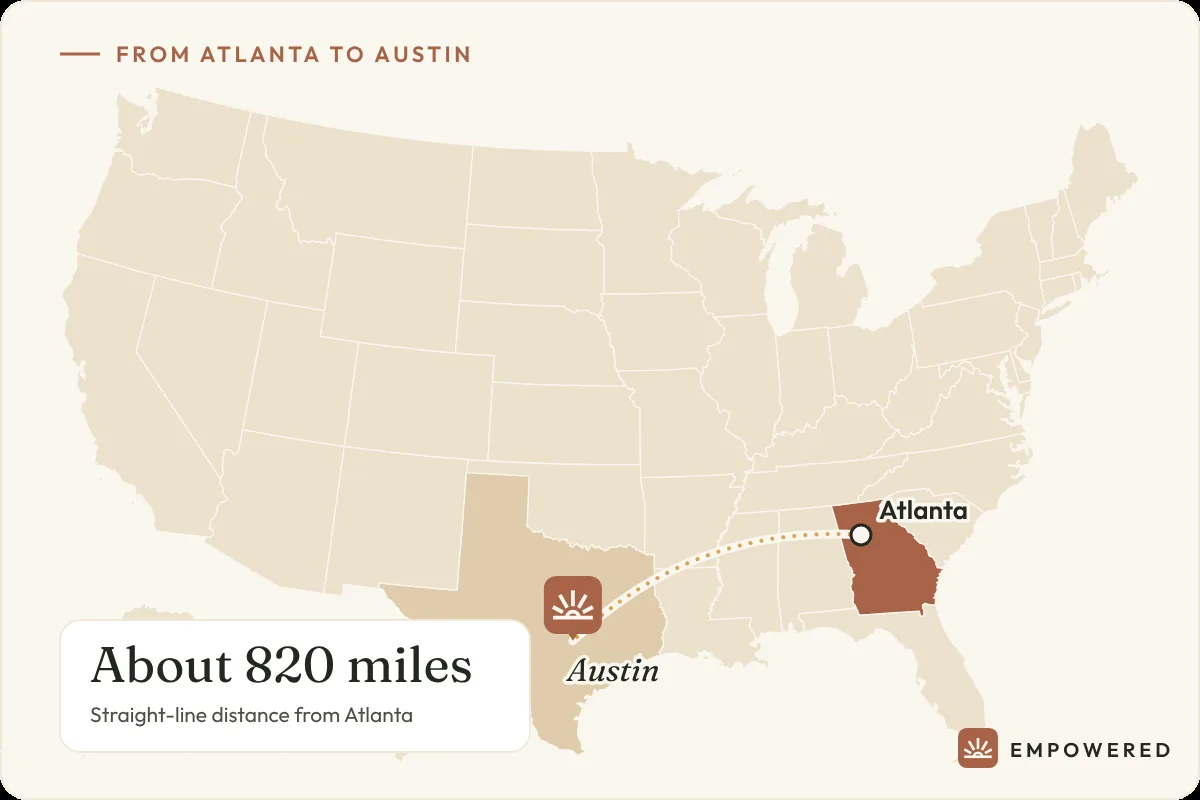
- Distance: about 820 miles from Atlanta as the crow flies
- By air: fly from Hartsfield-Jackson Atlanta International Airport (ATL) or Savannah/Hilton Head International Airport (SAV) into Austin-Bergstrom International Airport (AUS)
- On arrival: our center sits roughly 30 minutes by car from AUS, traffic permitting
- Where to stay: transitional housing is available to clients in PHP or IOP
Paying for treatment
Plans differ widely in how they handle specialty programs across state lines. We can check your benefits first, so you have real numbers before you make any decisions.
- Send your details through our verify insurance page and we will follow up with what we find
- Many plans issued in Georgia treat a Texas program as out of network; we can help you ask your insurer how out-of-network partial hospitalization and IOP are covered
- The Georgia Office of Commissioner of Insurance and Safety Fire has a Consumer Services Division that helps with insurance questions and disputes
- For a broader overview, read eating disorder treatment costs: what to know
Keeping help in reach back in Georgia.
Lasting recovery depends on the support around you after a program ends. These statewide resources in Georgia can help you and the people close to you stay connected to care, from metro Atlanta to the coast.
- Georgia DBHDD: Find ServicesThe Department of Behavioral Health and Developmental Disabilities explains how to reach crisis support through 988, find outpatient providers, and contact regional field offices.
- NAMI GeorgiaThe state organization of the National Alliance on Mental Illness, with education programs and support groups for people living with mental health conditions and their families.
- Georgia Office of Commissioner of Insurance and Safety FireConsumer insurance resources, including complaint filing and guidance on health coverage.
- 988 Suicide & Crisis LifelineCall or text 988, any time, from anywhere in the United States. In an emergency, call 911.
Questions we hear from Georgia families.
How do people from Georgia usually handle work during treatment?
It depends on the program. PHP runs about 30 hours a week, so most people take leave. IOP is shorter, though relocating from Georgia still means time away from a job. Our article on working while in eating disorder treatment covers leave, scheduling, and what to tell an employer.
Can my family in Georgia take part if they cannot travel?
Yes. Family involvement does not require moving to Austin. Our team will talk with you about how relatives can stay informed and engaged, and our guide to long-distance support has practical ideas for staying close from far away.
What if I am already in a program and it is not working?
Changing programs is more common than people think. We can talk through what has and has not helped, coordinate with your current providers if you want us to, and see whether Empowered fits. Read switching from another program.
What conditions does Empowered treat?
We treat adults with anorexia, bulimia, binge eating disorder, ARFID, and OSFED, and we address co-occurring anxiety, depression, trauma, and OCD within the same plan. See what we treat for details.
More for Georgia
Articles and guides for readers in Georgia.
When you are ready, we are here to listen.
A short call with our team can clarify what kind of support makes sense right now. There is no pressure and no fee to ask.