
Eating Disorders and Anxiety: How Fear, Avoidance, and Physical Symptoms Can Interact
Anxiety and eating disorders commonly occur together, but the connection is not the same for everyone. Anxiety may begin before an eating disorder, emerge as symptoms intensify, or become linked to food, fullness, body sensations, weight changes, uncertainty, or eating around other people.
Avoidance, rigid rules, checking, reassurance, or other eating-disorder behaviors may temporarily reduce fear or create predictability. Integrated treatment clarifies what the person fears, how the behavior is functioning, and which medical, nutritional, psychiatric, and psychological needs should be addressed together.
- Anxiety and eating-disorder symptoms can affect one another in both directions.
- Similar food avoidance may be connected to different fears or clinical conditions.
- Avoidance can reduce anxiety temporarily while strengthening fear and rigidity over time.
- An integrated approach keeps medical safety, nutrition, eating-disorder recovery, and anxiety-related needs within one coordinated plan.
On this page: jump to a section
How Are Anxiety and Eating Disorders Connected?
Prevalence of Anxiety in Eating Disorders
Anxiety disorders are common across eating-disorder diagnoses. The National Institute of Mental Health reports that 47.9% of adults with anorexia nervosa, 80.6% with bulimia nervosa, and 65.1% with binge eating disorder had a lifetime anxiety disorder in nationally representative U.S. data. This comorbidity is also frequently reported among people with avoidant/restrictive food intake disorder, other specified feeding or eating disorder, and clinically significant disordered eating. (Hudson et al., 2007; Hambleton et al., 2022; National Institute of Mental Health, n.d.)
A Bidirectional Relationship
Anxiety and eating-disorder symptoms can reinforce one another over time. In adolescent research, anxiety symptoms were associated with 58% higher odds of later eating-disorder symptoms, while eating-disorder symptoms were associated with 2.25 times the odds of later anxiety. The relationship can therefore move in either direction rather than one condition always being secondary to the other. (Trompeter et al., 2025)
Anxiety is one possible contributor within a larger combination of biological, psychological, and social influences, including genetics, brain chemistry, temperament, chronic stress, trauma, perfectionism, dieting history, and life events.
Overlap Across Diagnostic Categories
Anxiety can overlap with eating and feeding disorders in several ways. A person may have generalized anxiety disorder, social anxiety disorder, panic disorder, or specific phobias alongside an eating disorder. Another person may experience anxiety centered more specifically on body image, body shape, weight, eating more than an internal rule allows, losing control with food, or unfamiliar sensations after eating. A person may also experience both a separate anxiety disorder and eating-disorder-specific fears.
Social anxiety can become especially visible during recovery. Eating around other people may bring up fear of negative evaluation, judgment about food or portions, body image concerns, shame, comparison, or pressure to appear comfortable. Research has found elevated social anxiety across eating-disorder groups and an association between greater social anxiety and more severe eating-disorder symptoms. Fear of negative evaluation may contribute to social withdrawal, skipped social meals, restaurant avoidance, or difficulty participating in supported eating. (Kerr-Gaffney et al., 2018)
Anxiety does not always lead to rigid rules or fear of eating. Generalized anxiety, panic, chronic stress, physical tension, and gastrointestinal symptoms may also reduce appetite, disrupt meal routines, or make it harder to recognize and respond consistently to hunger.
How Can Anxiety Show Up Around Food and Eating?
Anxiety involving food may begin before eating, intensify during a meal, or continue afterward through rumination, checking, shame, or urges to compensate.
| Before eating | During eating | After eating |
|---|---|---|
| Anticipatory worry, repeated planning, delaying food, checking ingredients or portions, seeking reassurance, avoiding unfamiliar meals or social situations | Fear of fullness, nausea, bloating, uncertainty, being watched, unexpected portions, loss of control, or other physical sensations | Rumination about what was eaten, body checking, reassurance-seeking, fear of weight change, shame, or urges toward food restriction, purging, or exercise |
Timing can provide useful information without identifying the cause by itself. Anxiety may involve weight change, uncertainty, fullness, gastrointestinal symptoms, social judgment, choking, vomiting, contamination, loss of control, or several concerns at once.
Anxiety can also interact with binge eating, purging, and compulsive exercise. In one real-world study, distraction reduced anxiety temporarily, while distraction and emotional avoidance predicted later increases in excessive exercise and bulimic symptoms. This does not mean those behaviors always regulate anxiety, but it illustrates how short-term relief and longer-term symptoms can move in different directions. (Vanzhula et al., 2020)
The Fear-Function-Feedback Framework
Empowered's Fear-Function-Feedback Framework uses three questions:
- Fear: What does the person believe may happen?
- Function: What does the behavior prevent or reduce temporarily?
- Feedback: How do avoidance, temporary relief, eating-disorder symptoms, and nutritional instability shape what happens next?
Two people may avoid the same meal for different reasons. Identifying the feared outcome helps distinguish eating-disorder fears from panic, social anxiety, obsessive-compulsive disorder, OCD, ARFID, PTSD, trauma, medical concerns, or overlapping needs.
| What may feel threatening | Examples of the feared outcome | What assessment may need to distinguish |
|---|---|---|
| Weight or body change | Weight gain, shape changes, visible fullness, or clothes fitting differently | Eating-disorder fear, body image disturbance, or fear of social evaluation |
| Internal sensations | Fullness, nausea, bloating, dizziness, heart-rate changes, or feeling out of control | Panic symptoms, anxiety sensitivity, gastrointestinal concerns, medical symptoms, or nutritional instability |
| Social evaluation | Being watched while eating, judgment about portions, or criticism of appearance | Social anxiety disorder, shame, secrecy, or previous teasing or criticism |
| Uncertainty or disrupted control | Unknown portions, unfamiliar foods, schedule changes, or eating without measuring | Generalized anxiety disorder, perfectionism, OCD, or eating-disorder rigidity |
| A specific adverse event | Choking, vomiting, contamination, an allergic reaction, or becoming ill | ARFID, specific phobias, OCD, trauma associations, or medical risk |
Anxiety sensitivity refers to fear that anxiety-related physical sensations, such as a racing heart, dizziness, nausea, or fullness, signal danger or loss of control.
Research identifies food, weight gain, and judgment among common eating-disorder fears. This framework builds on those findings as an evidence-informed clinical synthesis, not a diagnostic test or standardized protocol. (Brown & Levinson, 2022)
Food anxiety does not automatically mean someone has an eating disorder. It can also occur with panic disorder, obsessive-compulsive disorder, specific phobias, PTSD, a medical condition, or avoidant/restrictive food intake disorder.
How Can Anxiety and Eating-Disorder Symptoms Reinforce Each Other?
The feedback component of the Fear-Function-Feedback Framework explains how short-term relief can make some behaviors harder to interrupt. When a person expects a food, sensation, body change, or social situation to be dangerous, avoiding the experience may reduce anxiety immediately. That relief can make the same response more likely the next time fear appears.
A person who avoids eating around others may feel immediate relief after escaping the situation. That relief can make avoidance feel necessary, even as it becomes more disruptive over time.
Temporary relief does not make an eating-disorder behavior safe, and anxiety does not explain every symptom. Eating-disorder behaviors may also be shaped by nutritional deprivation, depression, trauma, sensory discomfort, body image concerns, impulsivity, habit, or other factors.
Our page on eating disorders and co-occurring disorders explains why similar behaviors can arise from different or overlapping clinical processes.
How Nutritional Instability Can Complicate Anxiety
Restriction, irregular eating, binge eating, purging, and nutritional instability can contribute to weakness, dizziness, sleep disturbances, gastrointestinal discomfort, concentration problems, and emotional reactivity. These symptoms may feel threatening or become difficult to distinguish from anxiety.
Nutritional rehabilitation may improve some anxiety, but it does not reliably resolve every anxiety disorder or eating-disorder-specific fear. Medical and nutritional stabilization can make the clinical picture clearer while persistent anxiety receives direct treatment. (Kezelman et al., 2015)
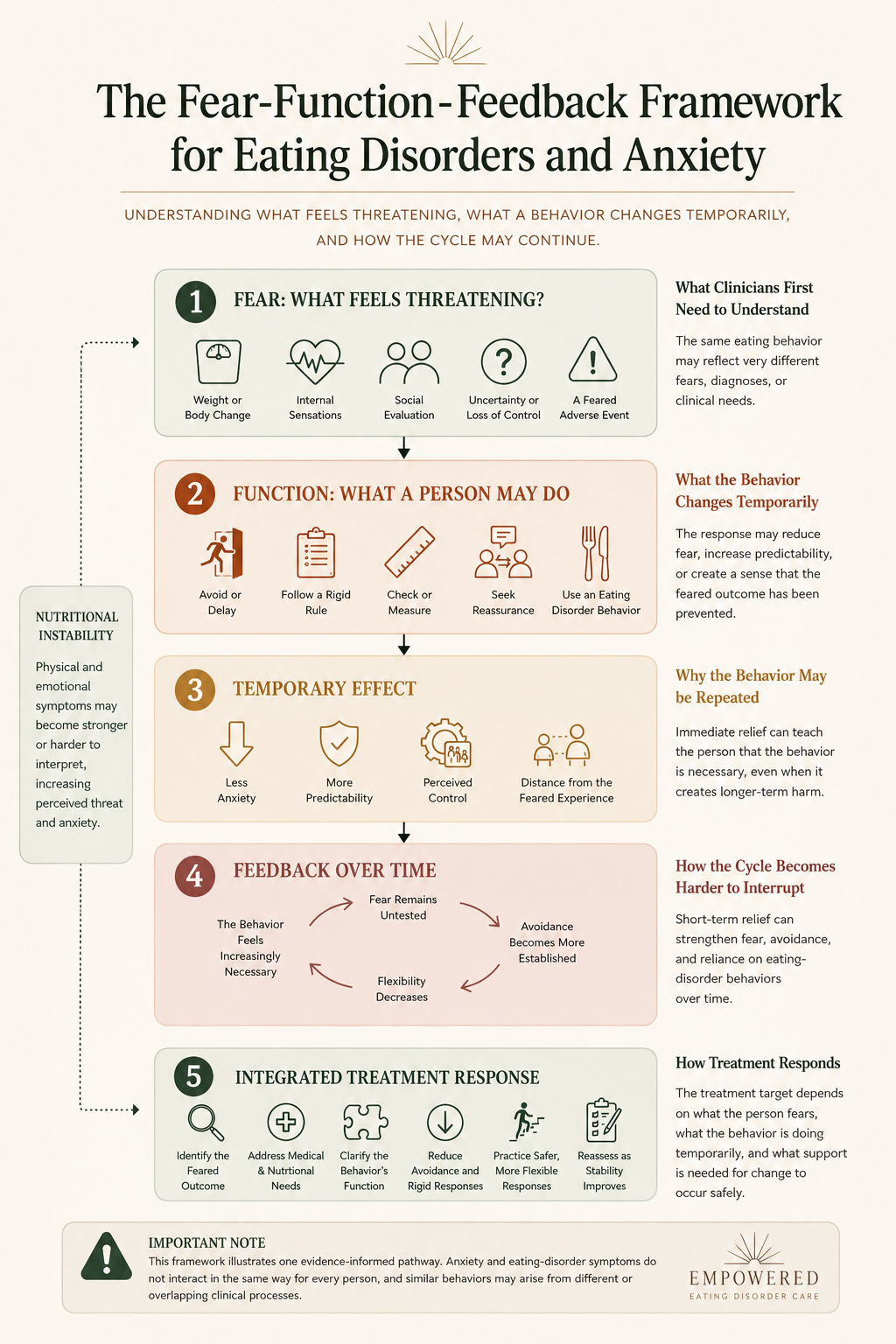
Figure: The Fear-Function-Feedback Framework illustrates how a feared outcome may lead to avoidance or an eating-disorder behavior, produce a temporary effect, and influence longer-term fear and symptom patterns. A secondary pathway shows how nutritional instability may intensify or complicate physical and emotional symptoms.
What Do Integrated Assessment and Treatment Address?
Treating a person's anxiety and eating disorder together does not mean applying the same anxiety treatment to every food-related fear. An integrated approach uses evidence-based practices from eating-disorder treatment, anxiety treatment, nutrition therapy, and medical monitoring, selected according to what the person fears, what maintains the behavior, and which medical, nutritional, psychiatric, and psychological needs require attention.
The American Psychiatric Association recommends a comprehensive, person-centered plan that includes assessment of co-occurring conditions and coordination of medical, nutritional, psychiatric, and psychological care. (American Psychiatric Association, 2023)
Clarifying the Clinical Picture
Assessment examines what a person fears, when the anxiety appears, what they do to prevent the feared outcome, and whether the behavior provides temporary relief. The team also considers medical and nutritional stability, psychiatric and developmental concerns, safety, daily functioning, and the amount of treatment structure required.
Dizziness, weakness, gastrointestinal symptoms, heart-rate changes, or other physical sensations may require medical and nutritional assessment before they are understood primarily as anxiety.
Supporting Medical and Nutritional Stability
Eating-disorder treatment remains a direct priority. Nutritional stabilization may include medical assessment, laboratory testing, medical monitoring, regular eating, dietitian support, nutrition therapy, and supported meals.
This care addresses medical risk, clarifies physical symptoms, reduces nutritional instability, and helps the team observe which anxiety symptoms improve with greater stability and which remain. Nutrition support does not need to wait until anxiety reduces.
Addressing Fear, Avoidance, and Rigidity
Depending on the formulation, treatment may include:
- Addressing eating-disorder beliefs involving food, body shape, weight, or control
- Reducing avoidance, checking, reassurance, rigid planning, or compensatory behaviors
- Building emotion regulation, distress tolerance, and flexibility
- Approaching physical sensations, social eating, and uncertainty more safely
- Distinguishing medical symptoms from panic, anxiety sensitivity, and eating-disorder fear
Cognitive-behavioral therapy can address feared predictions, eating-disorder beliefs, and avoidance. Dialectical behavior therapy can support emotion regulation, mindfulness, and distress tolerance. Experiential therapies can help clients practice flexibility and new responses within supported treatment. The method should follow the clinical formulation rather than being selected solely because anxiety is present.
Exposure-Based Work
Exposure-based strategies may help when fear and avoidance are maintaining eating-disorder symptoms. The target should be based on what the person believes is dangerous rather than the presence of anxiety alone.
Exposure may involve gradually approaching:
- Feared foods, unfamiliar meals, and unknown portions
- Fullness, body sensations, and body image triggers
- Eating with other people or changing established routines
- Refraining from checking, measuring, reassurance, or compensation
Exposure does not mean forcing someone into an overwhelming situation without preparation or support. It involves collaborative, planned opportunities to approach feared experiences while reducing the behaviors that usually prevent new learning.
A systematic review found promising results for feared-food exposure, exposure and response prevention, and mirror exposure. The evidence remains varied, and there is not one established exposure protocol for every eating disorder or anxiety presentation. (Butler & Heimberg, 2020)
Psychiatric Care, Safety, and Treatment Intensity
Psychiatric care may clarify whether a separate anxiety disorder is present, whether medication is appropriate, and how anxiety interacts with depression, obsessive-compulsive disorder, sleep disturbances, substance use disorder, self-harm, suicidal ideation, or other concerns. Clinically significant substance use may require specialized co-occurring or dual diagnosis coordination.
Anxiety can also affect treatment intensity when it interferes substantially with nutrition, safety, functioning, or participation in recovery. Appropriate care may range from outpatient treatment to an intensive outpatient program, partial hospitalization program, residential care, or hospitalization according to the complete medical, nutritional, psychiatric, and behavioral picture. Learn more about how clinicians determine the appropriate level of care.
How Does Empowered Treat Eating Disorders and Anxiety Together?
Empowered Treatment offers adult eating-disorder partial hospitalization and intensive outpatient programs for people whose recovery may involve anxiety alongside food, body image, medical, nutritional, trauma-related, or other mental health concerns.
Our integrated approach keeps eating-disorder symptoms and nutritional needs central while assessing how fear, avoidance, body sensations, social concerns, perfectionism, and emotion regulation may be affecting recovery.
When anxiety is part of the clinical picture, care may include:
- Medical assessment, medical monitoring, and psychiatric support
- Dietitian care, nutrition therapy, regular eating, and supported meals
- Individual therapy and group eating-disorder treatment
- Cognitive-behavioral, dialectical behavior, and experiential therapies
- Trauma-integrated care and coordination with outside providers when appropriate; learn more about eating disorders and trauma
- Continued-care and relapse-prevention planning, including community resources, family support, or outside support group meetings
Our team works with each client to determine what requires attention now, which concerns can be addressed together, and whether adult partial hospitalization or adult intensive outpatient treatment provides the appropriate level of care.
Frequently Asked Questions
Can anxiety cause an eating disorder?
Anxiety may contribute to the development or maintenance of an eating disorder, but it is not a universal cause. Eating disorders develop through interacting biological, psychological, social, and environmental influences. Research supports a bidirectional relationship: anxiety can precede eating-disorder symptoms, and eating-disorder symptoms can also predict later anxiety. (Trompeter et al., 2025)
Can not eating make anxiety worse?
Food restriction and irregular nutrition may contribute to weakness, dizziness, gastrointestinal symptoms, sleep disturbances, emotional distress, or concentration problems. These experiences can resemble anxiety or intensify it. Some symptoms may improve with medical and nutritional stability, while persistent anxiety may still require direct treatment.
Why do I feel anxious before or after eating?
Anxiety before eating may involve uncertainty, social judgment, weight change, choking, vomiting, physical sensations, or fear of losing control. Anxiety after eating may involve fullness, gastrointestinal discomfort, rumination, body checking, shame, or urges to compensate. Assessment helps clarify whether the pattern is primarily related to an eating disorder, panic, social anxiety, OCD, ARFID, trauma, or a medical concern.
Is food anxiety the same as an eating disorder or ARFID?
No. Food anxiety can occur within several presentations. In anorexia nervosa or another weight- and shape-related eating disorder, avoidance may be driven by fear of weight gain or body change. In avoidant/restrictive food intake disorder, restriction may relate to sensory characteristics, low interest in eating, or feared consequences such as choking or vomiting rather than weight or body shape.
Can eating disorders and anxiety be treated at the same time?
Often, yes. Integrated treatment may address medical safety, nutrition, eating-disorder behaviors, anxiety, avoidance, and other co-occurring conditions within one plan. Treatment is paced according to medical stability, nutritional status, psychiatric safety, distress tolerance, and the amount of support the person needs.
References
- American Psychiatric Association. (2023). The American Psychiatric Association practice guideline for the treatment of patients with eating disorders (4th ed.). American Psychiatric Association Publishing. https://doi.org/10.1176/appi.books.9780890424865
- Brown, M. L., & Levinson, C. A. (2022). Core eating disorder fears: Prevalence and differences in eating disorder fears across eating disorder diagnoses. International Journal of Eating Disorders, 55(7), 956-965. https://doi.org/10.1002/eat.23728
- Butler, R. M., & Heimberg, R. G. (2020). Exposure therapy for eating disorders: A systematic review. Clinical Psychology Review, 78, 101851. https://doi.org/10.1016/j.cpr.2020.101851
- Hambleton, A., Pepin, G., Le, A., Maloney, D., National Eating Disorder Research Consortium, Touyz, S., & Maguire, S. (2022). Psychiatric and medical comorbidities of eating disorders: Findings from a rapid review of the literature. Journal of Eating Disorders, 10, 132. https://doi.org/10.1186/s40337-022-00654-2
- Hudson, J. I., Hiripi, E., Pope, H. G., Jr., & Kessler, R. C. (2007). The prevalence and correlates of eating disorders in the National Comorbidity Survey Replication. Biological Psychiatry, 61(3), 348-358. https://doi.org/10.1016/j.biopsych.2006.03.040
- Kerr-Gaffney, J., Harrison, A., & Tchanturia, K. (2018). Social anxiety in the eating disorders: A systematic review and meta-analysis. Psychological Medicine, 48(15), 2477-2491. https://doi.org/10.1017/S0033291718000752
- Kezelman, S., Touyz, S., Hunt, C., & Rhodes, P. (2015). Does anxiety improve during weight restoration in anorexia nervosa? A systematic review. Journal of Eating Disorders, 3, 7. https://doi.org/10.1186/s40337-015-0046-2
- National Institute of Mental Health. (n.d.). Eating disorders. U.S. Department of Health and Human Services. nimh.nih.gov/health/statistics/eating-disorders
- Trompeter, N., Dârvariu, Ș., Brieva-Toloza, A. V., Opitz, M.-C., Rabelo-da-Ponte, F. D., Sharpe, H., Desrivières, S., Schmidt, U., & Micali, N. (2025). The prospective relationship between anxiety symptoms and eating disorder symptoms among adolescents: A systematic review and meta-analysis of a bi-directional relationship. European Child & Adolescent Psychiatry, 34, 1691-1718. https://doi.org/10.1007/s00787-024-02601-9
- Vanzhula, I. A., Sala, M., Christian, C., Hunt, R. A., Keshishian, A. C., Wong, V. Z., Ernst, S., Spoor, S. P., & Levinson, C. A. (2020). Avoidance coping during mealtimes predicts higher eating disorder symptoms. International Journal of Eating Disorders, 53(4), 625-630. https://doi.org/10.1002/eat.23254
Fear and food don't have to stay tangled together.
If anxiety and an eating disorder are both part of your story, call us. One confidential conversation, with a team built for exactly this.