
Three hours from home: medical leave for eating disorder treatment in Austin
For many adults in Dallas-Fort Worth, the right program is 190 miles down I-35. This is the practical side of saying yes to it: the leave, the paycheck, a place to stay, and how the people you love stay close.

Can you take medical leave for eating disorder treatment out of town?
Yes, in many cases. The U.S. Department of Labor names a treatment center for eating disorders as an example of care that can qualify for FMLA leave, which gives eligible employees up to 12 workweeks of job-protected leave a year. Where FMLA does not reach, the ADA, paid time off and short-term disability can fill the gaps.
- Treatment in Austin usually means a full leave. Our partial hospitalization program runs 30 hours a week, so most people from DFW step away from work rather than fit care around it.
- FMLA protects the job and the health plan. Eligible employees keep their group health coverage and return to the same or a virtually identical position.
- Pay is a separate question. FMLA leave can be unpaid. Paid time off and short-term disability are what usually keep income coming.
- You do not have to name a diagnosis. Neither an FMLA certification nor an ADA request requires one.
- Housing and family belong in the plan. Transitional housing in Austin and family sessions make the distance workable.
Treatment across town and treatment three hours away
Most advice about work and eating disorder care assumes the program is nearby. Someone attends an intensive outpatient program in the afternoon, works in the morning, and uses intermittent leave to cover the overlap. Our guides on telling your employer about treatment and working while in treatment cover that path, including what to share and sample scripts.
Coming to Austin from Dallas, Fort Worth, Plano or Arlington is a different plan. Our partial hospitalization program (PHP) is 30 hours a week of supported meals, groups, individual therapy, dietitian care and psychiatric monitoring at our Northwest Austin center. That is a full-time commitment. It usually calls for a continuous block of leave, a temporary address and a plan for keeping family involved from a distance. Our Dallas-Fort Worth page covers the drive and the flights; this guide covers everything else.
What FMLA covers, and who qualifies
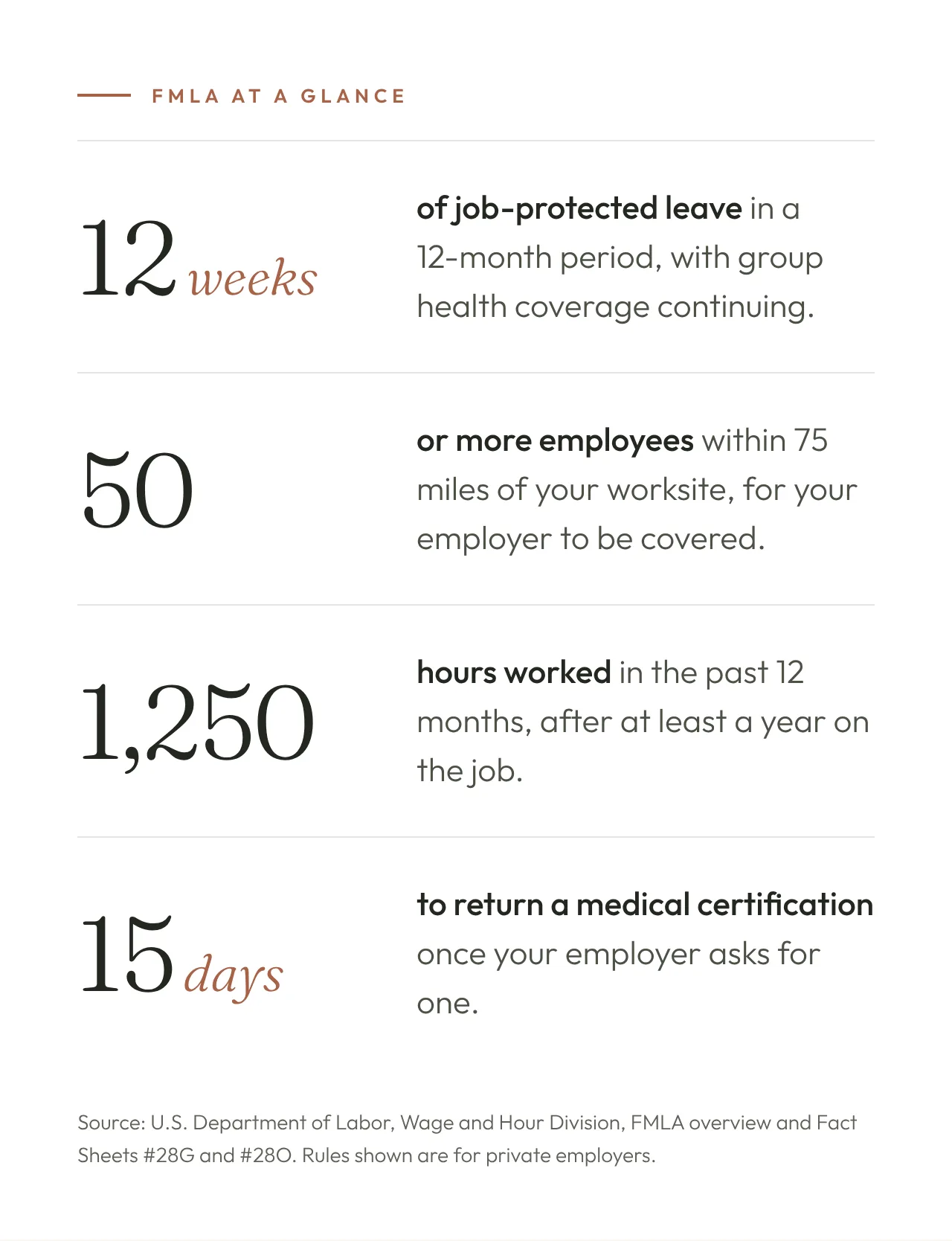
The Family and Medical Leave Act covers private employers with 50 or more employees. You are eligible if you have worked for your employer for at least 12 months, logged at least 1,250 hours in the past 12 months, and work at a location where the employer has at least 50 employees within 75 miles. Eligible employees can take up to 12 workweeks of leave in a 12-month period, with group health coverage continuing on the same terms.
Eating disorders are not a gray area here. The Department of Labor's fact sheet on mental health conditions says a mental health condition is a serious health condition when it requires inpatient care or continuing treatment by a health care provider, and its own example of inpatient care is a stay at "a treatment center for addiction or eating disorders." At the end of leave, the employer must restore you to the same or a virtually identical position.
Notice and paperwork
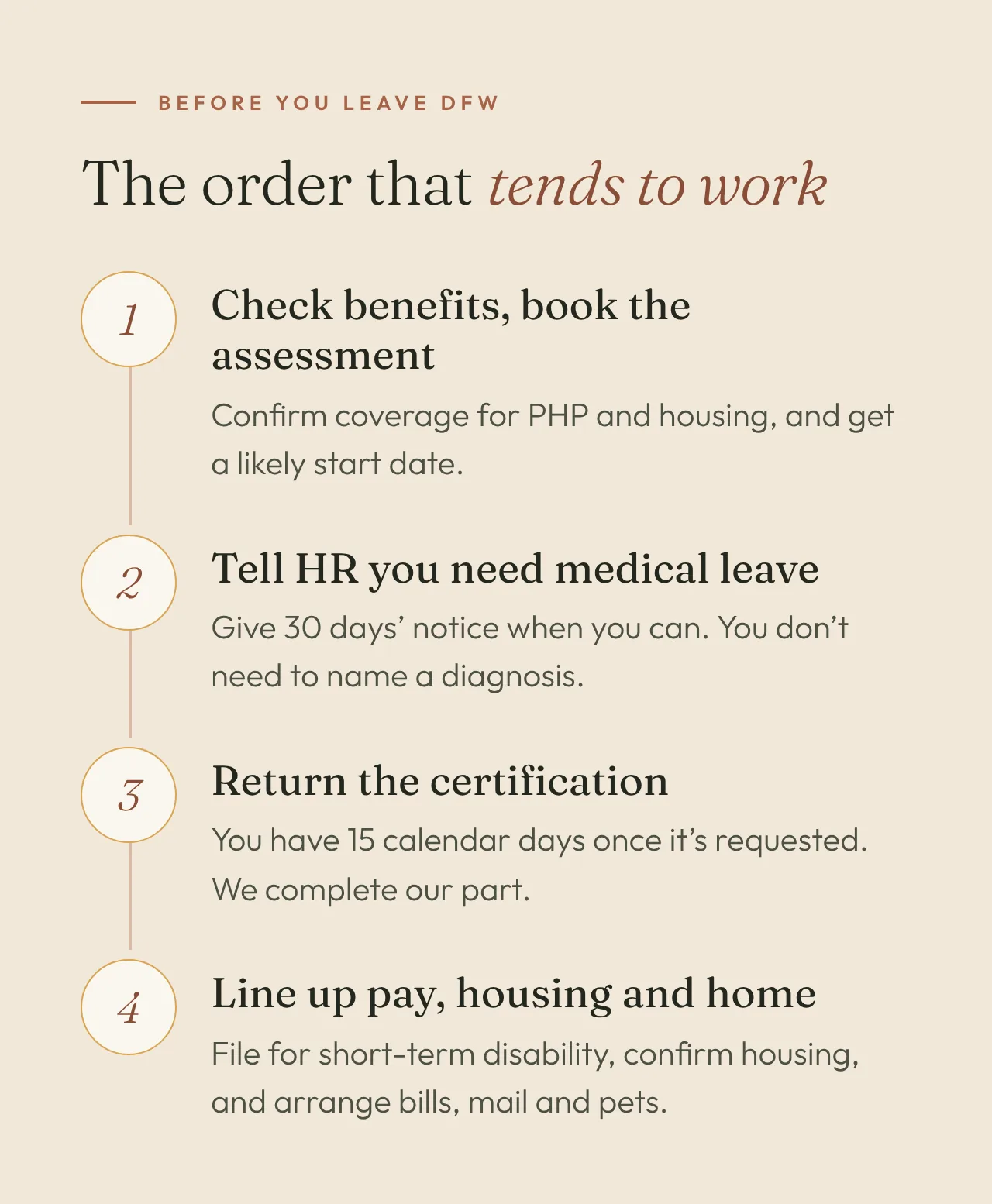
- Give 30 days' notice when you can. The Department of Labor asks for at least 30 days of advance notice if it is possible and practical, and otherwise as soon as you can. Your first request does not have to mention the FMLA by name.
- Expect a response within five business days. Employers must give an eligibility notice within five business days of your request.
- Return the certification within 15 calendar days. Your employer may ask for a medical certification. The provider may include a diagnosis but is not required to. Our clinical team completes these forms with the minimum detail they require.
If FMLA does not apply to you
Smaller employers, newer jobs and part-time schedules can fall outside the FMLA. The Americans with Disabilities Act may still help. The EEOC's guidance on leave and the ADA says employers with 15 or more employees may need to provide unpaid leave as a reasonable accommodation, even when someone is not eligible under the company's leave policy or has used up FMLA leave. A condition does not need to be permanent or severe to qualify, and an employer that receives medical information must keep it confidential, even from coworkers.
Texas law adds a parallel protection: the Texas Labor Code bars disability discrimination by employers with 15 or more employees, and the Texas Workforce Commission's Civil Rights Division takes complaints. Keep copies of every request and response. In August, KERA reported that Texas had the highest number and share of disability complaints filed with the EEOC in 2025. A paper trail protects you if anything goes wrong.
Keeping income steady: short-term disability basics
Job protection and pay are two different things. FMLA leave may be unpaid or run at the same time as paid leave your employer offers. Short-term disability insurance is what replaces part of a paycheck for many people.
According to the Texas Department of Insurance, short-term disability policies usually pay for up to a year, typically as a percentage of your pay, and can apply to a physical or mental disability that keeps you from working. Policies have a waiting period before benefits start, up to 90 days for short-term coverage. Many people use paid time off to bridge that gap. Before you set a start date, ask your benefits team:
- Do I have short-term disability through work, and what is the waiting period?
- Does the policy cover mental health conditions, and does it limit how long?
- Will my paid time off run alongside FMLA leave or before it?
- Who completes the claim form, and where does it go?
If your job does not offer coverage, TDI notes you can buy a policy on your own. Read the terms on existing conditions before you count on a new one.
What to tell HR, and what you can keep
For a leave request, HR needs dates and paperwork, not your history. One approach that works well: confirm your benefits and a likely start date with the treatment team first, then go to HR with a plan instead of a question.
"I need to take medical leave for a health condition that requires a full-time treatment program out of town. I expect to start on [date] and to be out for several weeks. Can you send me the leave and certification forms, and tell me how short-term disability and my paid time off work with it?"
If your employer asks for more, the EEOC notes that a general description of a condition can be enough when you would rather not disclose a specific diagnosis. Our guide for HR managers supporting employees with eating disorders is also worth sending to a supportive manager.
MayLinh Lucio, LMSW, Therapist, Empowered Treatment
Living in Austin during treatment
A daily commute from DFW is not workable during PHP, so most people from North Texas stay in our transitional housing. It is a real house on a residential street in Austin's Hyde Park neighborhood, with separate houses for men and women, private bedrooms, a full kitchen and a long table for shared meals, a short drive from the treatment center. Housing is optional, and cost and availability depend on your program and insurance, so ask about both when you call.
Maryam Mahmoud, LCSW, LCDC, Clinical Director of Transitional Services, Empowered Treatment
Before you drive south
- Set bills to autopay and decide how mail will be collected.
- Arrange care for pets, plants and anything that needs a weekly check.
- Tell your DFW therapist, doctor or psychiatrist, and sign releases so we can coordinate with them.
- Bring current medications and a list of prescribers.
- Pack for several weeks of comfortable, everyday living rather than a short trip.
Staying close from 190 miles away
Distance can make families feel shut out. It does not have to. With the client's consent, family education is built into treatment at Empowered: sessions with our family therapist, guidance on supporting meals at home, and planning for life after the program. Because our clients are adults, families hear what their person agrees to share, and that agreement is part of the work.
A few things help families in North Texas stay involved without hovering:
- Plan visits as weekend trips. Ask the team which times work best around the program schedule.
- Make visits about connection. A walk, a movie or a familiar game says more than questions about food.
- Ask before you bring up meals or weight. Your person and their team will know what is useful right now.
- Look after yourself. Supporting someone in treatment is tiring. Our page on caregiver burnout is written for you.
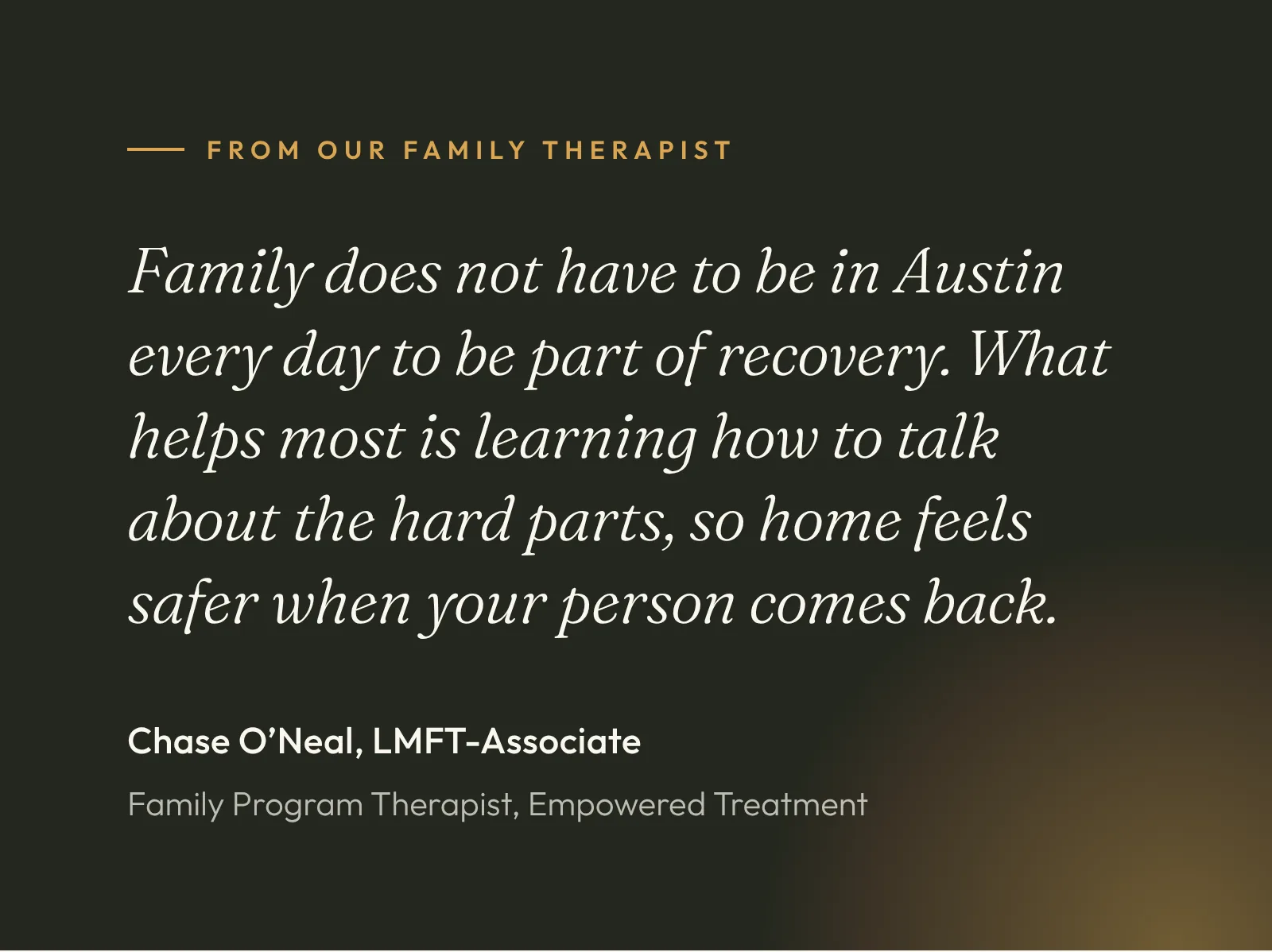
"The family work we do during treatment is what makes the first weeks at home easier," says Chase O'Neal, LMFT-Associate, our Family Program Therapist.
Planning the return to Dallas-Fort Worth
Leaving PHP is a step, not a finish line. Some people continue in our intensive outpatient program, which runs 9 hours a week, before heading home. Others return to DFW with a therapist, dietitian and psychiatric provider lined up. The FMLA allows leave intermittently or on a reduced schedule when medically necessary, which can cover follow-up appointments once you are back at work. Your team will build the step-down plan with you, well before discharge.
If you are weighing whether a higher level of care is needed at all, read how levels of care work. When you are ready to talk dates, you can check your insurance benefits online or call us. Adults from across Texas make this trip, and our admissions team can walk you through the sequence.
Medical leave for eating disorder treatment: FAQs
Does FMLA cover eating disorder treatment?
It can. The Department of Labor counts mental health conditions that need inpatient care or continuing treatment as serious health conditions, and it names a treatment center for eating disorders as an example. You still have to meet the eligibility rules for your employer and your hours.
Do I have to tell my employer my diagnosis?
No. An FMLA certification does not have to include a diagnosis, and the EEOC notes that a general description of a condition can be enough for an ADA request. Our team keeps paperwork to the minimum detail the form requires.
Will I be paid while I am on FMLA leave?
FMLA leave itself can be unpaid. Many people combine it with paid time off and short-term disability benefits. Ask your benefits team how those pieces fit together before you set a start date.
Can my family visit while I am in treatment in Austin?
Yes. Many families from Dallas-Fort Worth visit on weekends, and with your consent they can take part in family sessions and education. The team can help you plan visits around the program schedule.
This article is general education, not legal or medical advice. For questions about your specific rights, talk with HR or an employment attorney. If you are in crisis, call or text 988.
Sources
- U.S. Department of Labor, Wage and Hour Division. Fact Sheet #28O: Mental Health Conditions and the FMLA.
- U.S. Department of Labor, Wage and Hour Division. Family and Medical Leave Act.
- U.S. Department of Labor, Wage and Hour Division. Fact Sheet #28E: Employee Notice Requirements under the Family and Medical Leave Act.
- U.S. Department of Labor, Wage and Hour Division. Fact Sheet #28D: Employer Notification Requirements under the FMLA.
- U.S. Department of Labor, Wage and Hour Division. Fact Sheet #28G: Certification of a Serious Health Condition under the FMLA.
- U.S. Department of Labor, Wage and Hour Division. Fact Sheet #28F: Reasons that Workers May Take Leave under the Family and Medical Leave Act.
- U.S. Equal Employment Opportunity Commission. Employer-Provided Leave and the Americans with Disabilities Act. May 9, 2016.
- U.S. Equal Employment Opportunity Commission. Depression, PTSD, and Other Mental Health Conditions in the Workplace: Your Legal Rights.
- Office of the Texas Governor, Texas Governor's Committee on People with Disabilities. Employment Protections.
- Texas Workforce Commission, Civil Rights Division. Employment Discrimination.
- Texas Department of Insurance. What's disability insurance and how does it work? Updated December 17, 2025.
- Duke D. She says she was fired from a nursing home after taking medical leave. It's a common claim in Texas. KERA News. August 10, 2026.
Eating disorders are not a choice. Recovery can be.
One confidential conversation is all it takes to start. Our admissions team can help you sort out dates, benefits and housing, even if the right next step isn't with us.