
Eating disorder support groups, hotlines and free resources in Dallas-Fort Worth
Free help for eating disorders exists in North Texas, but it is scattered across national helplines, online groups, county agencies and university clinics. We checked each one on its own website so you can spend less time searching and more time getting support.

Where can I find free eating disorder support in Dallas-Fort Worth?
Most free eating disorder support for Dallas-Fort Worth adults is online or by phone. ANAD and the National Alliance for Eating Disorders run free helplines and weekly virtual support groups. Overeaters Anonymous lists in-person meetings across the Dallas area. For a crisis, call or text 988, or call your county's 24/7 crisis line.
- Helplines are free and staffed on weekdays. ANAD's helpline is open 9 a.m. to 9 p.m. Central, Monday through Friday. The Alliance's helpline is run by licensed therapists.
- Support groups are mostly virtual. Both national organizations offer weekly Zoom groups, including groups for men, LGBTQ+ adults, people in larger bodies and families.
- Low-cost counseling is available locally. University training clinics at UNT and SMU offer sliding-scale therapy.
- Groups support recovery; they do not replace treatment. If symptoms are getting worse, a higher level of care may be the safer next step.
How we built this list: every resource below was checked on its own official website in October 2026. Schedules and phone lines change, so confirm details before you go. We left out anything we could not verify.
If you or someone you love is in crisis
If someone has fainted, has chest pain, is confused or is in immediate danger, call 911. For a mental health crisis, these lines answer around the clock and cost nothing:
- 988 Suicide and Crisis Lifeline: call or text 988, or chat online. Free, confidential, 24 hours a day. Text and chat are available in Spanish.
- Crisis Text Line: text HOME to 741741 (HOLA for Spanish), 24 hours a day.
Each county also has a public mental health authority with a 24/7 crisis line, listed in the Texas Health and Human Services directory:
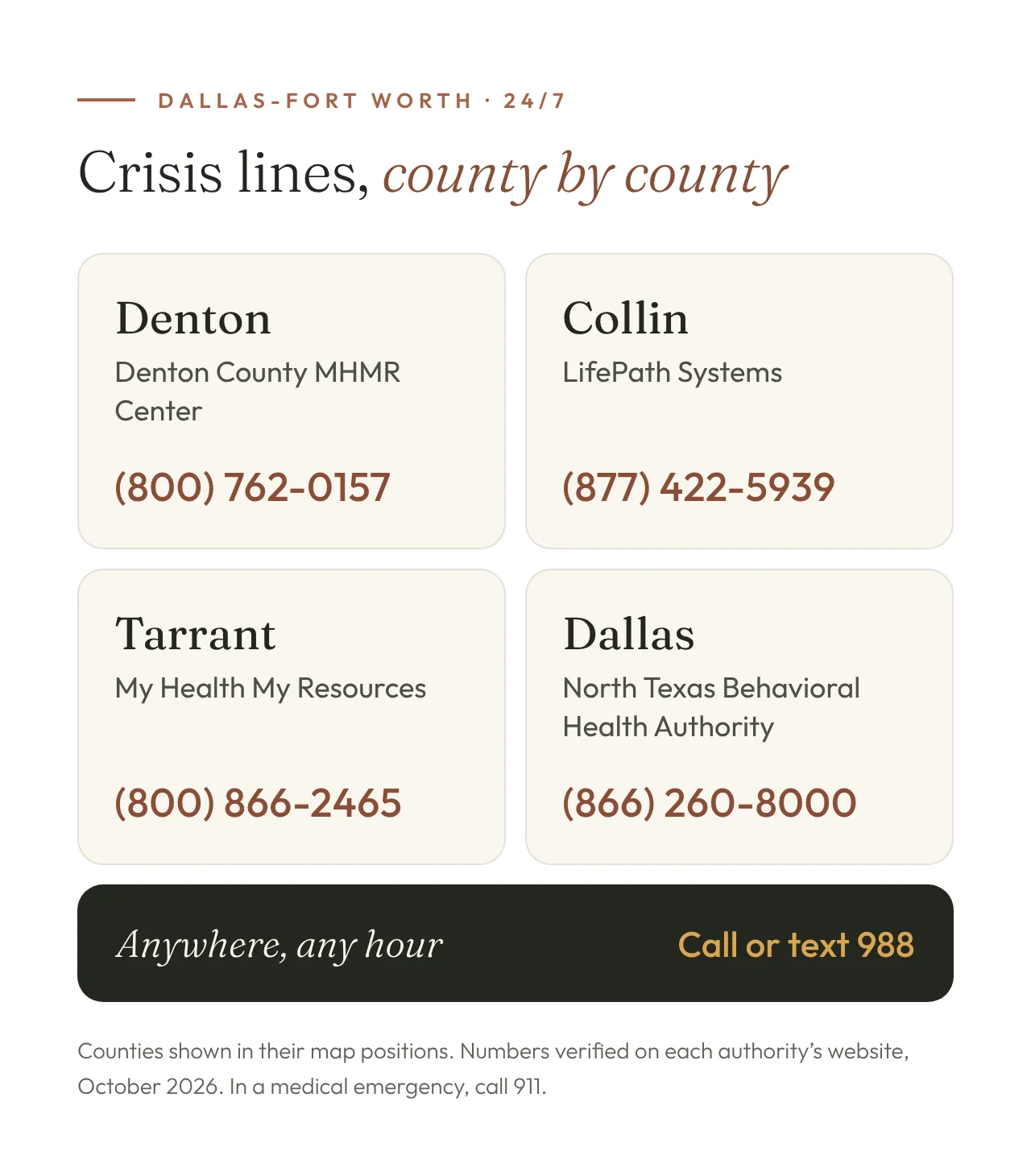
- Dallas County (also Ellis, Hunt, Kaufman, Navarro and Rockwall): North Texas Behavioral Health Authority crisis line, (866) 260-8000. Metrocare Services, the county's largest public provider, can be reached at (214) 743-1200.
- Tarrant County: My Health My Resources of Tarrant County, 24/7 crisis line (800) 866-2465 by call or text. For services, call (817) 335-3022.
- Collin County: LifePath Systems crisis line, (877) 422-5939.
- Denton County: Denton County MHMR Center crisis line, (800) 762-0157.
For help finding food, housing or other local services, 2-1-1 Texas can be reached by dialing 2-1-1 or (877) 541-7905. If self-harm is part of the picture, our page on eating disorders and self-harm offers gentle next steps.
Free eating disorder helplines
These lines are for questions, support and referrals rather than emergencies. Both are free.
ANAD Eating Disorders Helpline
ANAD (the National Association of Anorexia Nervosa and Associated Disorders) runs a free helpline at (888) 375-7767, open Monday through Friday from 9 a.m. to 9 p.m. Central. Messages left after hours are returned.
National Alliance for Eating Disorders Helpline
The National Alliance for Eating Disorders helpline at (866) 662-1235 is answered by licensed therapists who specialize in eating disorders. It is open Monday through Friday, 9 a.m. to 7 p.m. Eastern (8 a.m. to 6 p.m. Central).
NAMI HelpLine
For broader mental health questions, including support for families, the NAMI HelpLine is at (800) 950-6264, Monday through Friday, 10 a.m. to 10 p.m. Eastern.
Free eating disorder support groups
We could not verify any free, eating disorder specific support group that currently meets in person in Dallas-Fort Worth outside of a treatment program. The strongest free options for North Texas adults meet online, which also means you can join from Plano, Arlington, Denton or McKinney without a drive.
ANAD virtual support groups
ANAD's peer support groups are free and meet weekly on Zoom for 75 minutes. Alongside general groups, there are groups for men, BIPOC adults, LGBTQIA+ adults, older adults, athletes, people in larger bodies, binge eating disorder, ARFID and chronic illness, plus caregiver and sibling groups run with F.E.A.S.T. You fill out an interest form, then register for each session at least four hours ahead. Most groups are for adults 18 and older, and no diagnosis is required.
National Alliance for Eating Disorders groups
The Alliance's support groups are free and led by therapists. Virtual pro-recovery groups meet on most days of the week, with additional groups for friends and family, adults in mid-life and beyond, LGBTQ+ adults, BIPOC adults and larger-bodied individuals. Its in-person groups are currently outside Texas.
ANAD recovery mentors
ANAD also pairs people in outpatient care with a free recovery mentor who has been recovered for at least two years. Mentors meet weekly by video for six months, and your therapist needs to agree. The fall 2026 group is full; an interest form is open for spring 2027.
Peer fellowships with local meetings
Overeaters Anonymous
Overeaters Anonymous is a twelve-step program for anyone who feels they have a problem with food. There is no cost to attend and no registration. Its meeting finder lists face-to-face, online and hybrid meetings across the Dallas area.
Eating Disorders Anonymous
Eating Disorders Anonymous is a twelve-step fellowship whose only requirement is a desire to recover from an eating disorder. Many meetings run on Zoom; check the meeting listings for current times.
A practical note if you are in treatment: some twelve-step food plans ask members to avoid certain foods entirely. That can conflict with a meal plan built by an eating disorder dietitian, which usually works toward eating all foods again. Fellowship and treatment can work together, but talk it through with your team so the two are not pulling in different directions.
Low-cost counseling in Dallas-Fort Worth
University training clinics offer therapy from graduate students supervised by licensed faculty, at fees well below private practice. They are general counseling clinics rather than eating disorder specialists, so they work best for support and coping skills when medical risk is low.
- UNT Psychology Clinic, Denton. Reduced-cost sliding scale with a free intake appointment. Serves anyone located in Texas, in person or by telehealth. Does not bill insurance. (940) 565-2631.
- SMU Center for Family Counseling, Dallas. Sliding fee scale with a maximum of $45 a session, for adults, couples and families, at SMU-East Campus, 6116 N. Central Expressway. Does not bill insurance. (214) 768-6789.
If you are a college student, your campus counseling center is a good first call, and our guide for campus counselors explains how they can coordinate with a specialty program.
Support for families
Parents, partners and siblings need support too. Beyond ANAD's caregiver and sibling groups and the Alliance's friends and family group, NAMI Family Support Groups are free and peer-led, and many meet online. In Fort Worth, NAMI Tarrant County offers local support groups and classes; call (817) 332-6677 for the current schedule. Our family education page and our piece on caregiver burnout are written for you.
When a support group is not enough
Support groups are good at reminding people they are not alone. They are not built to manage medical risk, rebuild nutrition or treat the anxiety, depression or trauma that often sit underneath an eating disorder. Consider more support if:
- You are dizzy, fainting, or your heart races or skips
- Bingeing, purging or restricting is happening most days
- Weekly therapy has not been enough to stop things from sliding
- You cannot eat enough on your own, even with a plan
- The group is the only thing holding you up between hard days
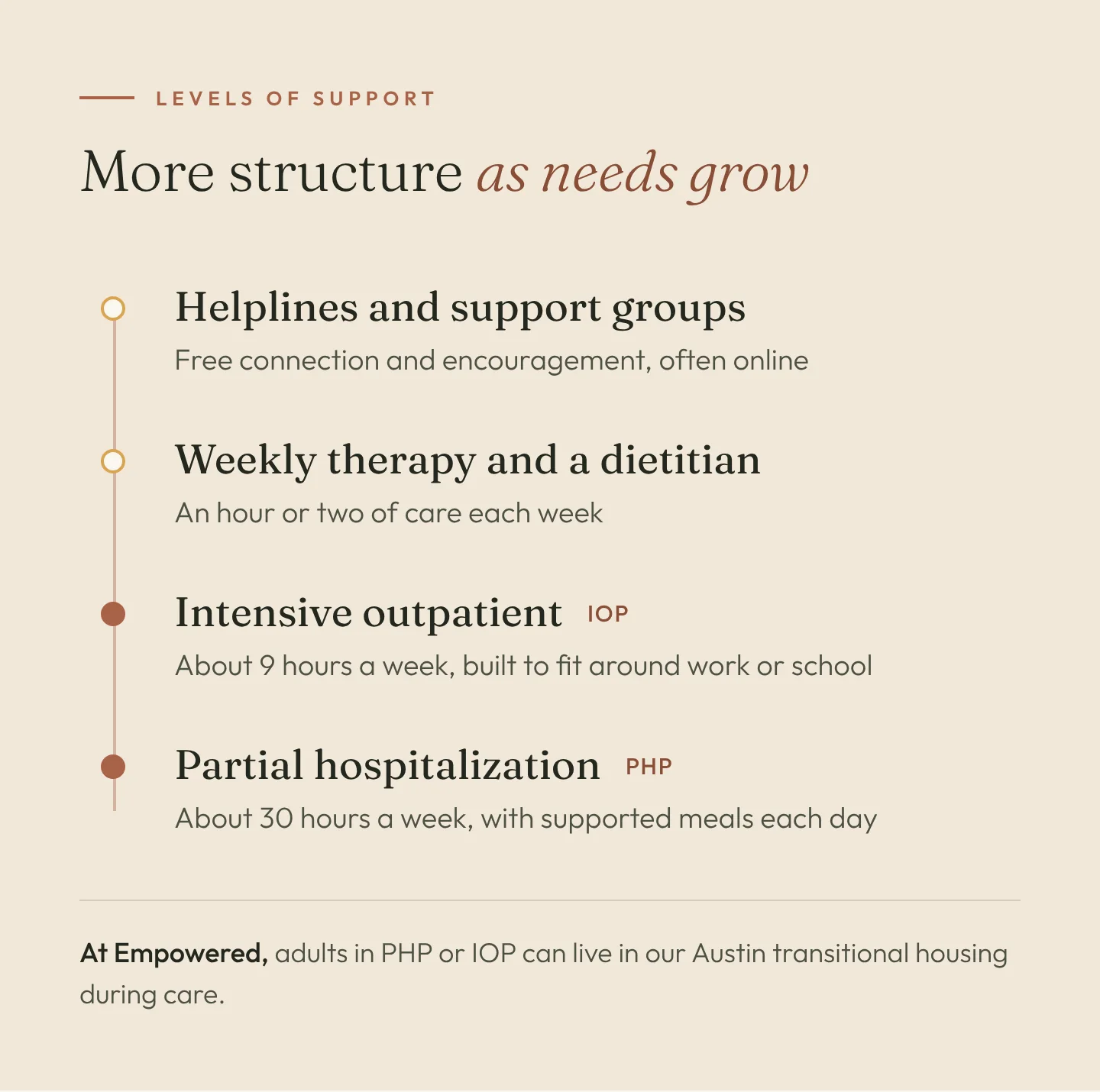
Empowered Treatment offers an adult intensive outpatient program (about 9 hours a week) and a partial hospitalization program (about 30 hours a week) in Northwest Austin, with therapists, registered dietitians and psychiatric providers on one team. Austin is about three hours from Dallas-Fort Worth by I-35, and our transitional housing in Hyde Park gives adults from across Texas a steady place to live during care. Our piece on when weekly therapy isn't enough goes deeper on how to tell.
Chris Ellis, LCDCi, RSPS, Director of Experiential Recovery Services, Empowered Treatment
You can check your insurance benefits online in a few minutes, or read what happens when you call before you pick up the phone.
Eating disorder support in DFW: FAQs
Is there a free eating disorder hotline?
Yes. ANAD's helpline at (888) 375-7767 is free and open weekdays from 9 a.m. to 9 p.m. Central. The National Alliance for Eating Disorders helpline at (866) 662-1235 is staffed by licensed therapists on weekdays. For a crisis, call or text 988 at any hour.
Are there eating disorder support groups in Dallas?
Overeaters Anonymous lists in-person and hybrid meetings around Dallas. Most free groups specific to eating disorders, including ANAD's and the Alliance's, meet online, so Dallas-Fort Worth adults can join them from home.
Can a support group replace eating disorder treatment?
No. Support groups offer connection and encouragement, but they do not monitor medical safety, nutrition or co-occurring conditions. They work best alongside therapy or a structured program.
Where can I get low-cost therapy in Dallas-Fort Worth?
University training clinics are a good start. The UNT Psychology Clinic in Denton uses a sliding scale, and the SMU Center for Family Counseling in Dallas charges no more than $45 a session.
This guide is for general information and is not medical advice. Listings were verified on each provider's website in October 2026 and may change. If you are in crisis, call or text 988.
Sources
- 988 Suicide and Crisis Lifeline. 988lifeline.org. Accessed October 29, 2026.
- Crisis Text Line. crisistextline.org. Accessed October 29, 2026.
- Texas Health and Human Services. Local Mental Health or Behavioral Health Authority directory. Accessed October 29, 2026.
- North Texas Behavioral Health Authority. ntbha.org; Metrocare Services. metrocareservices.org; My Health My Resources of Tarrant County. mhmrtarrant.org; LifePath Systems. lifepathsystems.org; Denton County MHMR Center. dentonmhmr.org. Accessed October 29, 2026.
- ANAD. Eating Disorders Helpline, About our support groups and Request a recovery mentor. Accessed October 29, 2026.
- National Alliance for Eating Disorders. Free, therapist-led support groups and helpline. Accessed October 29, 2026.
- NAMI. Support groups and HelpLine; NAMI Tarrant County, namitarrant.org. Accessed October 29, 2026.
- Overeaters Anonymous. Find a meeting. Eating Disorders Anonymous. Meetings. Accessed October 29, 2026.
- University of North Texas Psychology Clinic. Scheduling and fees. SMU Center for Family Counseling. FAQ. Accessed October 29, 2026.
- 2-1-1 Texas. 211texas.org. Accessed October 29, 2026.
Eating disorders are not a choice. Recovery can be.
One confidential conversation is all it takes to start. No pressure. We'll help you find the right next step, even if it isn't with us.