
More therapists, few specialists: finding eating disorder care in San Antonio
Bexar County has added thousands of mental health providers in five years, and Texas still meets only a fraction of its mental health need. For an eating disorder, the right provider matters as much as any provider, and knowing what to look for makes the search shorter.

How do you find an eating disorder specialist in San Antonio?
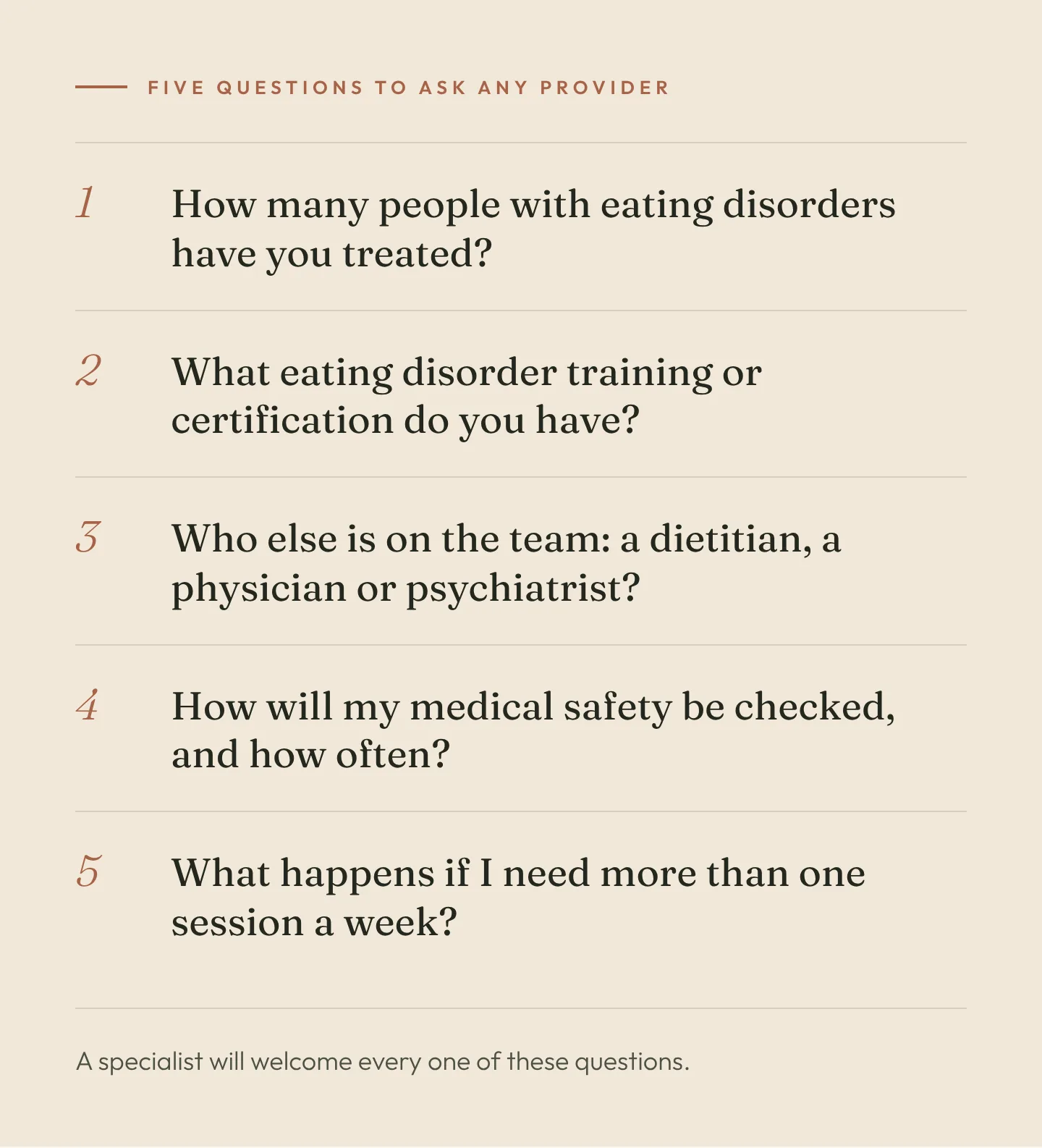
Look for eating disorder experience, not only a mental health license. Good eating disorder care pairs eating-disorder-focused therapy with a dietitian and regular medical monitoring. Before you book, ask any San Antonio provider how many people with eating disorders they have treated, who is on their team, and what happens if you need more support.
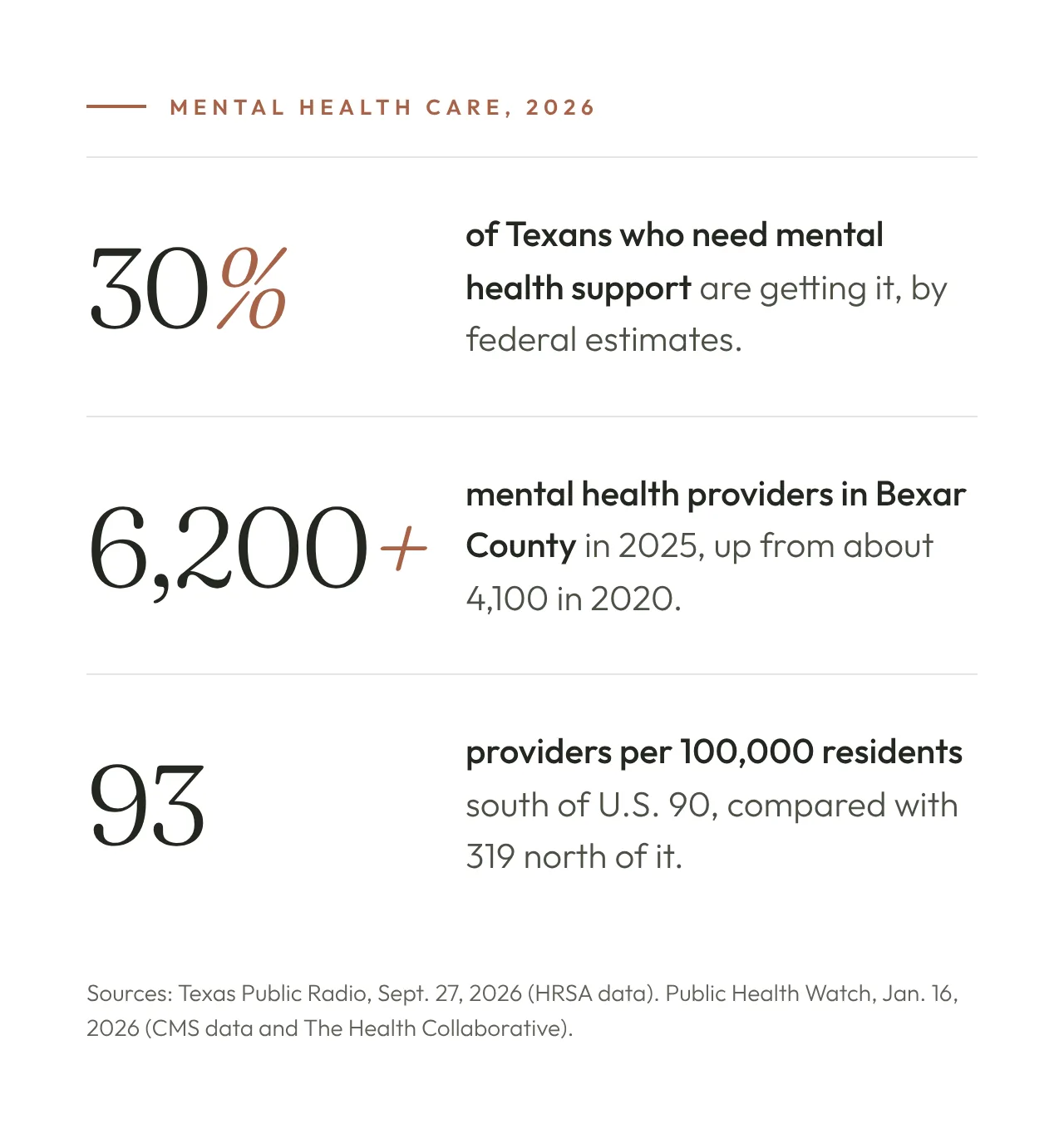
- Access is still tight. Texas Public Radio reported in September that only about 30% of Texans who need mental health support are getting it.
- More providers is not the same as more specialists. Bexar County's mental health workforce grew by more than 50% in five years, unevenly, and eating disorders need specific training.
- The medical side matters. National guidelines call for eating-disorder-focused therapy and a full evaluation that includes lab tests and an ECG.
- You are allowed to interview providers. A specialist will welcome questions about experience, team and levels of care.
A workforce that is growing, and still short
On September 27, Texas Public Radio's Science & Medicine series looked at a new effort at UT Health San Antonio to widen the state's mental health front line. Citing federal HRSA data, the story reported that only about 30% of Texans who need mental health support are receiving it, and that the shortage of behavioral health providers is expected to worsen over the next decade. Clinical psychologist David Roberts, PhD, developed a program called Reflective Training to teach counseling skills to community health workers, faith-based practitioners and doulas, with licensed clinicians coaching them in small groups.
Closer to home, the picture is mixed. Public Health Watch reported in January that Bexar County's mental health providers grew from about 4,100 in November 2020 to more than 6,200 in November 2025, using CMS data. Most of that growth landed north of U.S. 90, where there are 319 providers per 100,000 residents. South of it, there are 93.
Neither count tells you how many of those providers are trained to treat eating disorders. That number is much smaller, and it is the one that matters if you or someone you love is struggling with food.
Why eating disorders need specialized care
Eating disorders sit where mental health and physical health meet. The American Psychiatric Association's 2023 practice guideline recommends screening for eating disorders during an initial psychiatric evaluation, a comprehensive evaluation that includes laboratory tests and electrocardiograms, and eating-disorder-focused psychotherapy for anorexia, bulimia and binge eating disorder. A summary for family physicians adds that bulimia is best treated with cognitive behavioral therapy and medication, and binge eating disorder with CBT or interpersonal psychotherapy.
A caring generalist can miss a lot. Labs can come back normal while someone is restricting heavily. A person in a larger body may be praised for weight loss that is actually a symptom. Purging can stay hidden for years. Specialists are trained to look past those surface signals, and they work alongside a registered dietitian and a medical provider, because therapy alone rarely covers it.
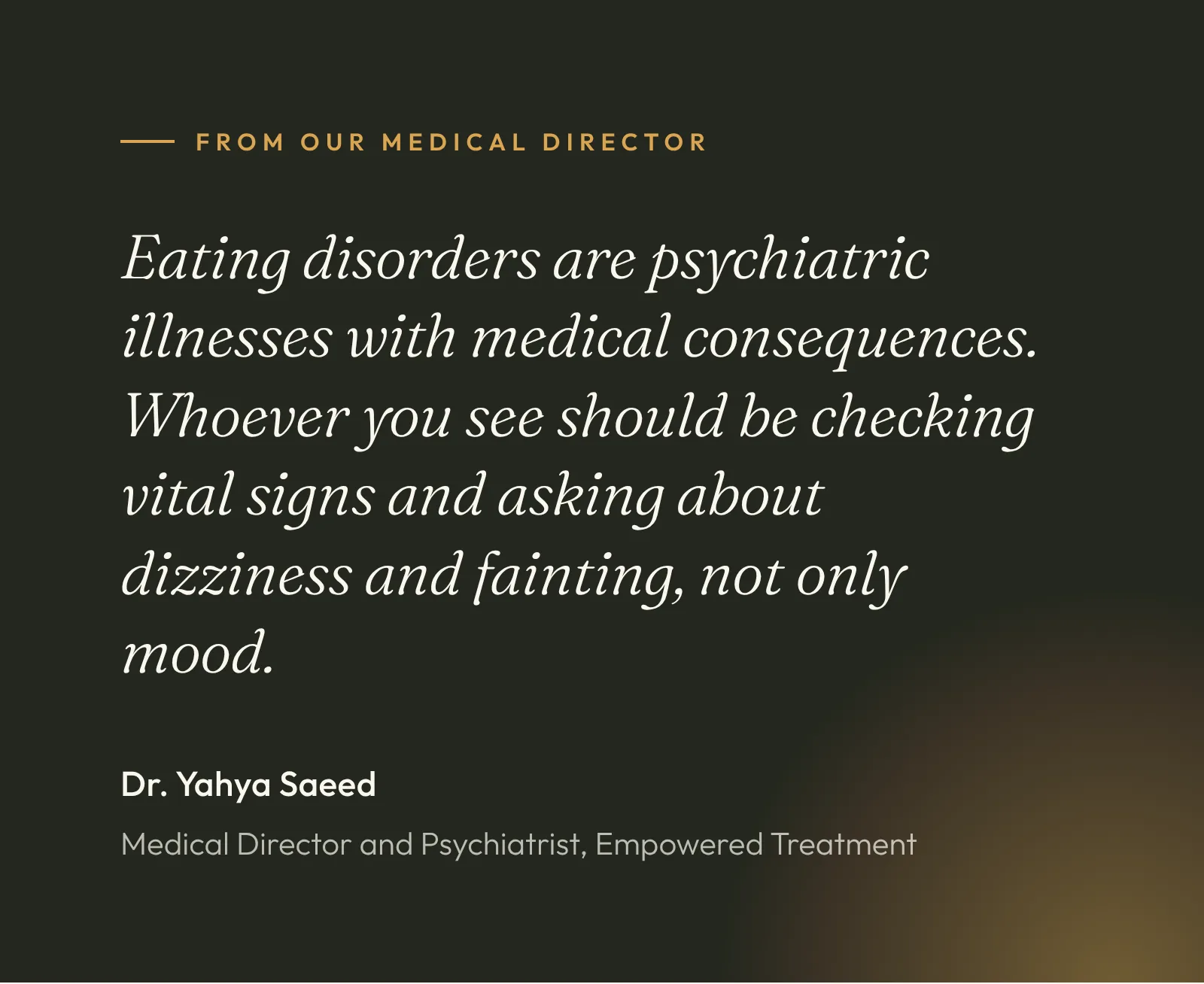
"Normal labs are reassuring, but they do not rule out danger," adds Dr. Yahya Saeed, our medical director. If you are a clinician, our guide to eating disorder red flags for medical providers covers what to watch for.
How to tell if a provider specializes
Training and experience
Ask directly about eating disorder experience. Some clinicians hold formal certification. The International Association of Eating Disorders Professionals' Certified Eating Disorder Specialist credential, for example, requires a current license, at least 2,500 hours of eating-disorder-specific experience over at least 24 months under an approved consultant, core coursework and an exam. Many skilled clinicians are not certified, so experience and supervision history count too.
A team, not a single provider
The strongest outpatient care connects a therapist, a registered dietitian and a physician or psychiatrist who talk to one another. If a provider works alone, ask who they partner with for nutrition and medical monitoring.
A plan for more support
Weekly therapy is the right fit for some people and not enough for others. Ask what the provider does when progress stalls, and whether they can refer to an intensive outpatient program or a partial hospitalization program. Our guide to levels of care explains the differences.
MayLinh Lucio, LMSW, Therapist, Empowered Treatment
The first person to notice is rarely a specialist
Programs like the one Dr. Roberts is building matter for eating disorders too. Most people never walk into a specialist's office first. They see a primary care doctor, a school or church counselor, a community health worker or a friend. Those people do not need to treat an eating disorder. They need to notice it and point toward help.
Simple tools help. The SCOFF is a five-question screen that asks about things like making yourself sick, losing control over eating and food dominating your life. As the American Family Physician summary notes, two positive answers suggest an eating disorder and are a reason for a fuller evaluation.
If you are the one struggling, you can skip the waiting and call a specialist yourself. If someone faints, has chest pain, seems confused or cannot keep fluids down, go to an emergency room or call 911 first.
Resources you can use this week
- ANAD Helpline: free support and referrals at 1-888-375-7767, Monday through Friday, 9 a.m. to 9 p.m. Central. ANAD also runs free virtual peer support groups and an online directory of therapists, dietitians and treatment programs.
- 988 Suicide and Crisis Lifeline: call or text 988 any time.
- Your insurance plan's member services: ask for in-network providers who list eating disorders as a specialty, and ask whether your plan covers IOP and PHP.
Our San Antonio page lists more local support, including NAMI San Antonio and The Center for Health Care Services.
When you need more than a weekly session
Many adults in San Antonio do well with a local outpatient team. Others need more structure than one or two appointments a week can give: daily support with meals, closer medical monitoring, or a break from the routines that keep the disorder going.
Empowered Treatment offers that in Northwest Austin, about 80 miles up I-35. Our IOP runs 9 hours a week and our PHP runs 30, with therapists, registered dietitians and psychiatric care on one team. Some San Antonio adults commute, and our guide to commuting from San Antonio walks through how that works. Others stay in our transitional housing in Hyde Park. We serve adults from across Texas, and you can check your insurance benefits before you decide anything.
Finding eating disorder care in San Antonio: FAQs
Can my regular therapist treat my eating disorder?
Sometimes, if they have eating disorder training and work with a dietitian and a medical provider. National guidelines recommend eating-disorder-focused therapy plus medical evaluation, so ask about both before you continue.
How do I know if a provider is an eating disorder specialist?
Ask how many people with eating disorders they have treated, what training or certification they hold, and who they partner with for nutrition and medical care. Certification such as iaedp's CEDS requires thousands of hours of supervised, eating-disorder-specific experience.
What level of care do I need?
It depends on medical stability, how often symptoms happen and how much they disrupt daily life. An eating disorder assessment answers this. Many adults start in outpatient care, IOP or PHP, and move between levels as they improve.
Do I have to leave San Antonio for treatment?
Not always. Many people find good outpatient care locally. When more structure is needed, some San Antonio adults commute to Austin for IOP or stay in transitional housing during PHP.
This article is for general education and is not medical advice. If you are in crisis, call or text 988.
Sources
- Petrie B. Science & Medicine: Training a new front line for Texas mental health care. Texas Public Radio. September 27, 2026.
- Jiménez G. San Antonio area sees a boom in mental health providers. But not where scarcity is severe. Public Health Watch. January 16, 2026.
- American Psychiatric Association. News release on the updated practice guideline for the treatment of patients with eating disorders. February 27, 2023.
- Arnold MJ. Treating patients with eating disorders: guidelines from the American Psychiatric Association. American Family Physician. 2024;109(2):185-187.
- International Association of Eating Disorders Professionals Foundation. CEDS certification. Accessed October 29, 2026.
- ANAD. Eating Disorders Helpline. Accessed October 29, 2026.
Eating disorders are not a choice. Recovery can be.
One confidential conversation is all it takes to start. No pressure. We'll help you find the right next step, even if it isn't with us.