
For people struggling with eating disorders in Delaware, recovery can start with one honest conversation.
Empowered Treatment is an adult eating disorder program in Austin, Texas, with partial hospitalization, intensive outpatient care, and a transitional house for clients who need somewhere to live during treatment. We work with the whole person, at whatever pace recovery asks.
What you are carrying is heavier than it looks.
Delaware is compact, and that can make privacy feel scarce. Maybe you work in finance or science along the I-95 corridor in Wilmington, study in Newark or Dover, farm in Kent County, or spend summers working the Sussex beaches. Wherever you are, an eating disorder can hide behind discipline, health goals, or simply being too busy to sit down and eat.
Many adults we hear from describe a slow shift. Food rules that once felt helpful started making decisions for them. Exercise stopped being optional. Social plans got canceled if a meal was involved. If parts of that sound familiar, you are not overreacting by looking for help. Eating disorders are treatable, and the right level of care can make room for the rest of your life again.

You can ask for help before things fall apart.
Some people only reach out after a medical scare. You do not have to wait for one. If you are thinking about food most of the day, feel panic when routines change, or have stopped trusting your own hunger, that is enough reason to talk with someone who specializes in this.
On a first call, we listen first. Then we explain how our IOP fits around work or school, how our more intensive PHP is structured, and what an assessment involves. You can ask anything, and you decide what happens next.
When your worry has nowhere to go.
Partners and parents often notice changes before anyone else does: smaller portions, new rules, long workouts, a mood that drops around dinner. Saying something can feel risky. Our page on what not to say to someone with an eating disorder can help you avoid the comments that tend to backfire.
If your loved one begins care in Austin, you still have a role. Our family education programming explains the illness, what treatment asks of your loved one, and how you can be a steady presence, whether you are in Wilmington or Lewes or anywhere between.
A place to live while the work happens.
Coming from the Mid-Atlantic, the hardest part of treatment in Texas can be the hours outside programming. Empowered’s transitional housing gives clients in PHP or IOP a shared home in the Hyde Park area of Austin, with others in recovery under the same roof. It turns the evenings into part of the healing instead of the time you have to get through alone.
 Shared living spaces
 A room of your own
Mind, body, and nutrition treated together.
Eating disorders affect sleep, heart rhythm, digestion, mood, and relationships all at once, so we do not split them up. Your therapist, registered dietitian, psychiatric provider, and family therapist share one treatment plan and talk about it often. When it is time to transition home, we help you find outpatient clinicians in Delaware to carry the work forward.
Partial hospitalization (PHP)
Full treatment days at our Austin center: supported meals, daily groups, individual therapy, dietitian care, and medical and psychiatric monitoring.
About PHP →Intensive outpatient (IOP)
Group programming plus weekly individual and dietitian sessions, built to fit around work, school, and family once more structure is not needed.
About IOP →
“When I meet someone new, I want to understand how their sleep, mood, anxiety, and physical health have been affected, because medication can be one helpful piece of a larger plan. We move at a pace that feels safe, and I stay closely connected with the rest of your team.”Reggie Graves, MSN, PMHNP-BC, FNP-CPsychiatric Nurse Practitioner, Empowered Treatment
Travel and insurance, step by step.
Getting from Delaware to Austin
Delaware has limited commercial air service, so most travelers use a nearby hub in Pennsylvania or Maryland and arrive in Austin in a single travel day.
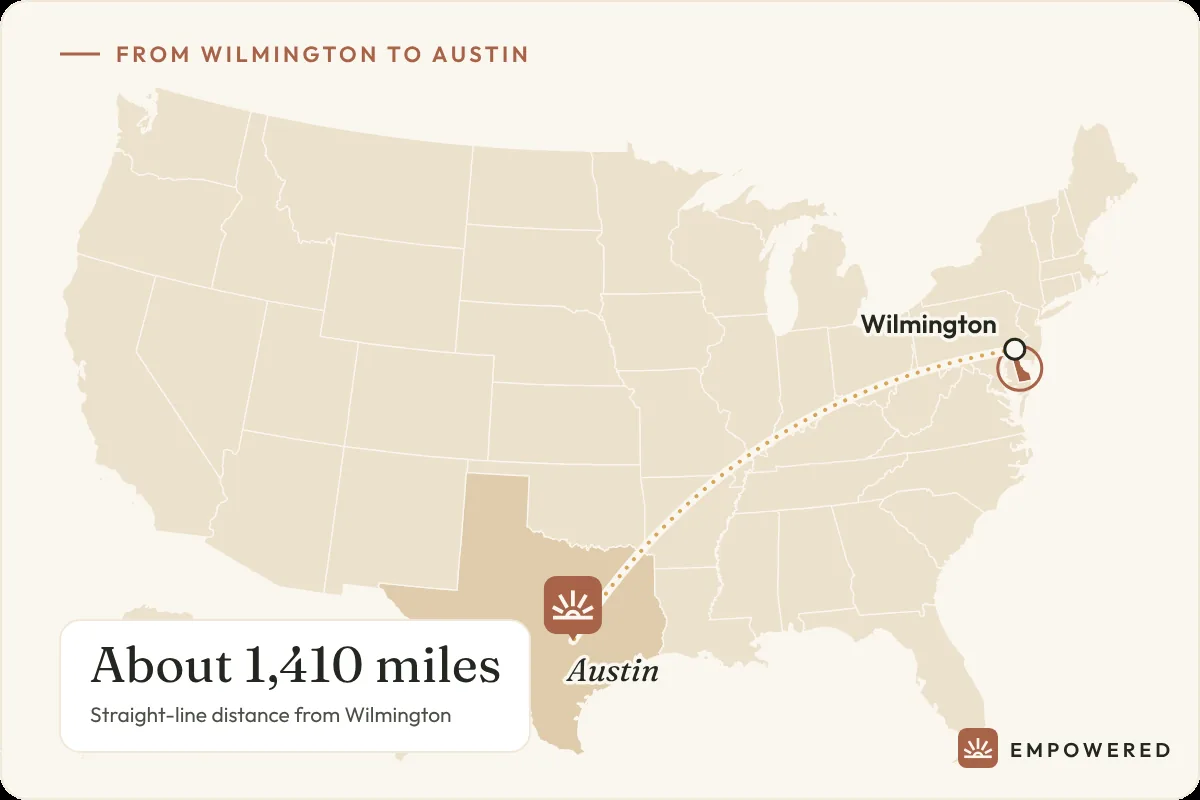
- Distance: about 1,410 miles from Wilmington as the crow flies
- Airports: Philadelphia International Airport (PHL), just over the state line, and Baltimore/Washington International Thurgood Marshall Airport (BWI) both offer flights to Austin-Bergstrom International Airport (AUS)
- Ground time: from AUS, our office on Spicewood Springs Road is usually about a 30-minute ride
- Staying in Austin: transitional housing can be arranged together with your PHP or IOP start
Making sense of coverage
Insurance language can be confusing, especially for care in another state. We can look up your benefits for partial hospitalization and intensive outpatient treatment and tell you what we learn before you make plans.
- Submit your details through verify insurance, or phone us and someone will look it up with you
- With a Delaware-based plan, ask whether care in Texas is treated as out-of-network and what that means for your costs; we can help you know what to ask
- The Delaware Department of Insurance Consumer Services Division answers coverage questions and helps with medical claim appeals
- Learn more in does insurance cover eating disorder treatment?
Delaware resources for the road home.
Lasting recovery depends on support that continues after you leave our program. When you start planning your return to Delaware, these statewide services can help you and your family stay connected.
- Delaware Division of Substance Abuse and Mental HealthThe state’s adult behavioral health division, with crisis hotlines, provider information, and links to treatment resources.
- Delaware 211A free, confidential statewide helpline that connects families to mental health, food, housing, and other services by phone, text, or chat.
- Delaware Department of InsuranceConsumer Services can explain policy language, forward complaints to insurers, and assist with medical claim appeals.
- 988 Suicide & Crisis LifelineCall or text 988, any time, from anywhere in the United States. In an emergency, call 911.
Questions from Delaware, answered plainly.
Delaware is far from Texas. How do people manage the distance?
Most people fly in, stay in our transitional housing or another arrangement, and attend programming in person each day. We help with planning ahead of time. Our page on moving to Austin for eating disorder care covers the practical side.
Can my Delaware therapist stay involved?
With your written permission, we are glad to coordinate with an outpatient therapist, dietitian, or physician you already see. That connection often makes the transition home smoother, since your existing provider understands where you have been and what you worked on here.
Do I have to stop working to attend?
Not always. PHP runs 30 hours a week, so most people take leave during that phase. IOP is lighter and many people work alongside it. If you are unsure how to raise it at your job, read telling your employer about treatment.
What eating disorders do you treat?
We treat adults with anorexia, bulimia, binge eating disorder, ARFID, and other specified feeding or eating disorders, often alongside anxiety, depression, trauma, or OCD. Our page on what we treat describes each in more detail.
More for Delaware
Articles and guides for readers in Delaware.
Let’s talk about what you need.
One phone call can clarify a lot. Our team will listen, explain your options in Austin, and help you think about timing, with no expectation that you decide right away.