
For people struggling with eating disorders in California, and for the people quietly worried about them.
Empowered Treatment is an adult eating disorder program in Austin, Texas, with partial hospitalization, intensive outpatient care, and transitional housing. If you have looked for help in California and still feel stuck, this may be a different path worth considering.

So much of California is built around how bodies look.
From the beaches of Orange County to the gyms of the Bay Area, it can feel like the whole state has an opinion about wellness, fitness, and what you put on your plate. When an eating disorder is part of your life, that constant background noise can make it harder to tell where healthy habits end and rigid rules begin. You might be a graduate student in Davis, a parent in the Inland Empire, or someone in Sacramento who has never said any of this out loud.
None of that means you have failed at taking care of yourself. Eating disorders are serious illnesses, not lapses in willpower, and they tend to grow in the gaps between busy days. If counting, restricting, bingeing, or compensating has started to take more than it gives, you deserve care built specifically for that, at a level of support that matches what you are actually carrying.

Maybe you have tried a few things already.
Plenty of people reach us after weekly therapy, an app, a nutrition plan, or a stretch of doing it alone. Those efforts count. Sometimes an eating disorder simply needs more structure and more hands than one appointment a week can offer, and that says nothing bad about you.
Calling us is not a commitment. A member of our admissions team will ask about what has been happening, explain how partial hospitalization and intensive outpatient care work, and talk honestly about whether a program in Austin makes sense for you right now. You can also read when weekly therapy isn't enough.
Supporting an adult who lives on the other side of the country.
Maybe your daughter is in San Diego, your partner travels for work out of San Jose, or your brother stopped coming to family dinners in Fresno. Caring about an adult with an eating disorder often means respecting their independence while still saying what you see. Our page on talking to your adult child about their eating offers a starting point.
If they do begin treatment in Austin, you are still part of the process. Our family education gives parents, partners, and siblings a clearer sense of what recovery involves, what helps, and how to stay connected without taking on the role of food monitor.
A steady home base, a long way from the usual pressures.
Stepping out of your routine in Los Angeles, Oakland, or a small town on the Central Coast can give recovery room to breathe. Our transitional housing is a real house in Austin's Hyde Park neighborhood that you can live in alongside PHP or IOP. Shared meals, housemates in the same work, and a calm place to return to each evening help turn what you practice in group into daily life.
 Shared living spaces
 A room of your own
One team, talking to each other every day.
Your therapist, dietitian, family therapist, and psychiatric provider are not scattered across different offices with separate notes. They work under one roof and coordinate your plan together, so what comes up in a meal session can shape what happens in therapy the next morning. As you approach discharge, we help line up follow-up care so the transition back home has support built in.
Partial hospitalization (PHP)
Full treatment days at our Austin center: supported meals, daily groups, individual therapy, dietitian care, and medical and psychiatric monitoring.
About PHP →Intensive outpatient (IOP)
Group programming plus weekly individual and dietitian sessions, built to fit around work, school, and family once more structure is not needed.
About IOP →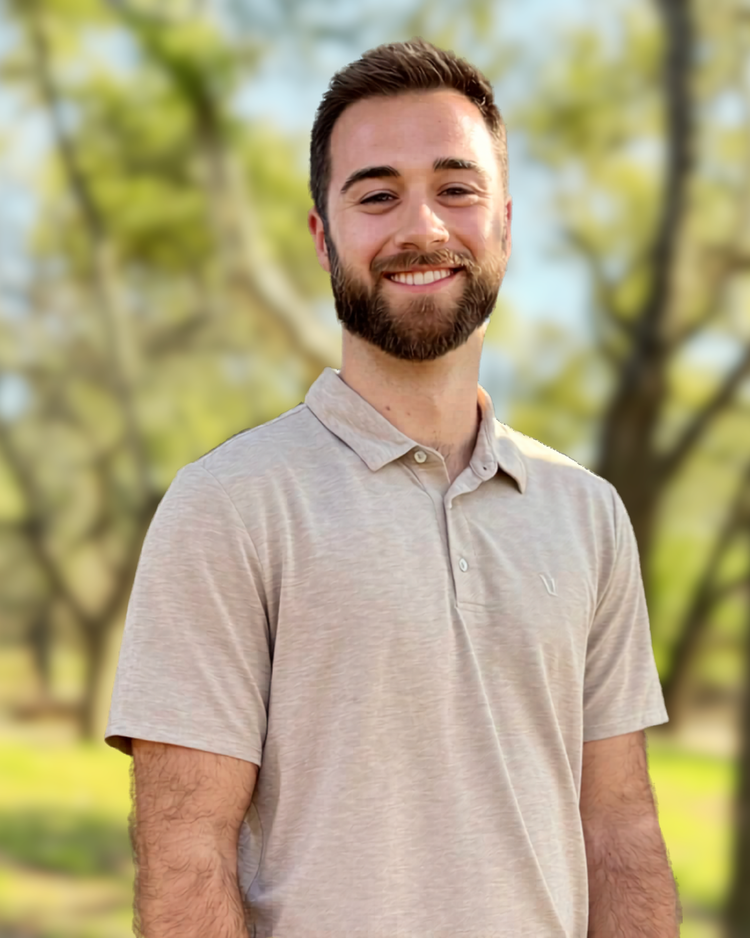
“Families often call us feeling like they have already said everything wrong, and I want them to know that showing up and staying curious matters far more than finding perfect words. When the people at home understand what the eating disorder is doing, recovery has more room to take hold.”Chase O'Neal, LMFT-AssociateFamily Program Therapist, Empowered Treatment
Travel, coverage, and the questions in between.
Traveling from California to Austin
Most people coming from California fly, and the trip from most of the state's large airports into Austin is a manageable travel day.
- Distance: about 1,230 miles from Los Angeles as the crow flies
- Airports: travelers often fly into Austin-Bergstrom International Airport (AUS) from Los Angeles International (LAX), San Francisco International (SFO), San Diego International (SAN), or Sacramento International (SMF)
- From the airport: AUS is roughly a 30-minute drive from our center in Northwest Austin, depending on traffic
- Where you'll stay: our transitional housing in Hyde Park can be arranged alongside your program
Using a California health plan
Many California plans are built around in-state networks, so how yours handles care in Texas is worth checking early. Our team can review your benefits before you make any decisions.
- Verify your insurance and we will follow up with what we learn
- If your plan is based in California, ask whether it offers out-of-network benefits or single-case agreements for care in Texas; we help you know which questions to ask
- The California Department of Insurance offers a consumer hotline and help with complaints and coverage questions
- Medi-Cal coverage for care outside California is usually limited, so call and we'll help you understand what applies to you
Keeping support in place after you go home.
Treatment in Austin is one chapter, not the whole story. When you return to California, these statewide resources can help you and your family find ongoing support and answers.
- California Department of Health Care Services: Mental Health ServicesThe state agency overseeing Medi-Cal mental health programs, county behavioral health services, and the Mental Health Services Act.
- NAMI CaliforniaA statewide network of families and affiliates offering mental health education, peer programs, and support groups across California.
- California Department of InsuranceConsumer guides, a hotline, and a way to file a complaint about an insurance company.
- 988 Suicide & Crisis LifelineCall or text 988, any time, from anywhere in the United States. In an emergency, call 911.
Common questions from California.
Why would someone in California look at a program in Texas?
Sometimes the right level of care has a long waitlist, is far from where you live, or simply has not been a good fit. Some people also find that stepping away from their daily environment makes it easier to focus. Our team can talk through whether traveling to Austin makes sense for you.
How do people from California handle the time zone and work?
Austin is two hours ahead of California. Many people pause or reduce work during PHP. Some continue limited work during IOP. Our page on working while in eating disorder treatment can help you plan conversations with an employer.
Is all of Empowered's care in person?
Yes. Every part of our program happens in person at our center in Northwest Austin, which is why many people coming from out of state stay in our transitional housing during treatment.
What if I'm already working with a therapist at home?
That relationship can be valuable. With your permission, we can coordinate with your outpatient providers during treatment and plan your return to them. Read more about switching from another program or adding a higher level of care.
More for California
Articles and guides for readers in California.
When you're ready to talk, we're here to listen.
Reach a member of our team to talk through what has been happening and what kind of support might help. Asking questions costs nothing and commits you to nothing.