
For people struggling with eating disorders in Arizona, steadier ground is possible, even from far away.
Empowered Treatment in Austin, Texas, cares for adults with eating disorders through a partial hospitalization program, an intensive outpatient program, and a transitional house for those who relocate during care. If your days now revolve around food, your body, or the private rules you keep about both, that is worth an honest conversation.
The heat is not the only thing that wears a person down.
In Arizona, disordered eating can tuck itself into ordinary routines: the sunrise hike before the Valley heats up, the extra shift at a Chandler fab or a Tucson hospital, the semester at ASU or Northern Arizona University where nobody notices you quit eating dinner. It can belong to a retiree in Prescott or a parent in Gilbert. It rarely looks dramatic from the outside, and it is never a sign that someone is weak.
What usually changes first is the inside of the day. Meals get negotiated. Exercise stops being a choice. Thoughts about weight follow you into conversations and keep you awake. If any of that is true for you, it does not mean you have failed at managing it. It may simply mean the illness needs more support than willpower and weekly appointments can offer.

You can ask for help before you have it all figured out.
People often wait for a clear sign: a certain number, a scary doctor visit, someone else saying it out loud. You do not need any of those to reach out. If the eating disorder is making your world smaller, that alone is worth talking about with someone who understands it.
When you call, someone from our admissions team will ask what has been happening, listen to what matters to you, and explain how our partial hospitalization program and intensive outpatient program differ. Some people like to read starting treatment after years of struggling before they dial.
Supporting an adult from a long way off
If someone you love is struggling and lives in Phoenix while you are in Flagstaff, or lives with you and keeps saying everything is fine, it is normal to feel caught between respecting their independence and wanting to step in. Our page on what not to say to someone with an eating disorder is a gentle place to begin.
Families stay part of the picture once treatment begins. Through family education, parents, spouses, and siblings learn what the eating disorder is, what to say at meals, and how to keep showing up during recovery, even when they are many miles away.
A house to come back to after each day of treatment.
Leaving the desert for several weeks of care is a real decision, and where you sleep matters as much as where you spend the day. Our transitional housing is a house in the Hyde Park part of Austin, paired with PHP or IOP, where residents share groceries, chores, and evenings with others in recovery rather than retreating alone to a rented room.
 Shared living spaces
 A room of your own
Several disciplines, one shared plan.
Recovery asks for more than one kind of expertise. At Empowered, eating disorder therapists, registered dietitians, a family therapist, and psychiatric clinicians compare notes every week, so decisions about your meals, your mood, and your medical needs pull in the same direction. As you improve, the team plans each step down with you and arranges support for the return to Arizona.
Partial hospitalization (PHP)
Full treatment days at our Austin center: supported meals, daily groups, individual therapy, dietitian care, and medical and psychiatric monitoring.
About PHP →Intensive outpatient (IOP)
Group programming plus weekly individual and dietitian sessions, built to fit around work, school, and family once more structure is not needed.
About IOP →
“In nutrition sessions, we start with what eating actually looks like on an ordinary day, without judgment, and build from there one meal at a time. My goal is for food to become something you can trust again, not something you have to win against.”Emily Van Eck, MS, RDNDietitian, Empowered Treatment
The logistics, laid out plainly.
Traveling from Arizona to Austin
Most people coming from Arizona fly. We can help you sort out timing, arrival, and lodging well before day one.
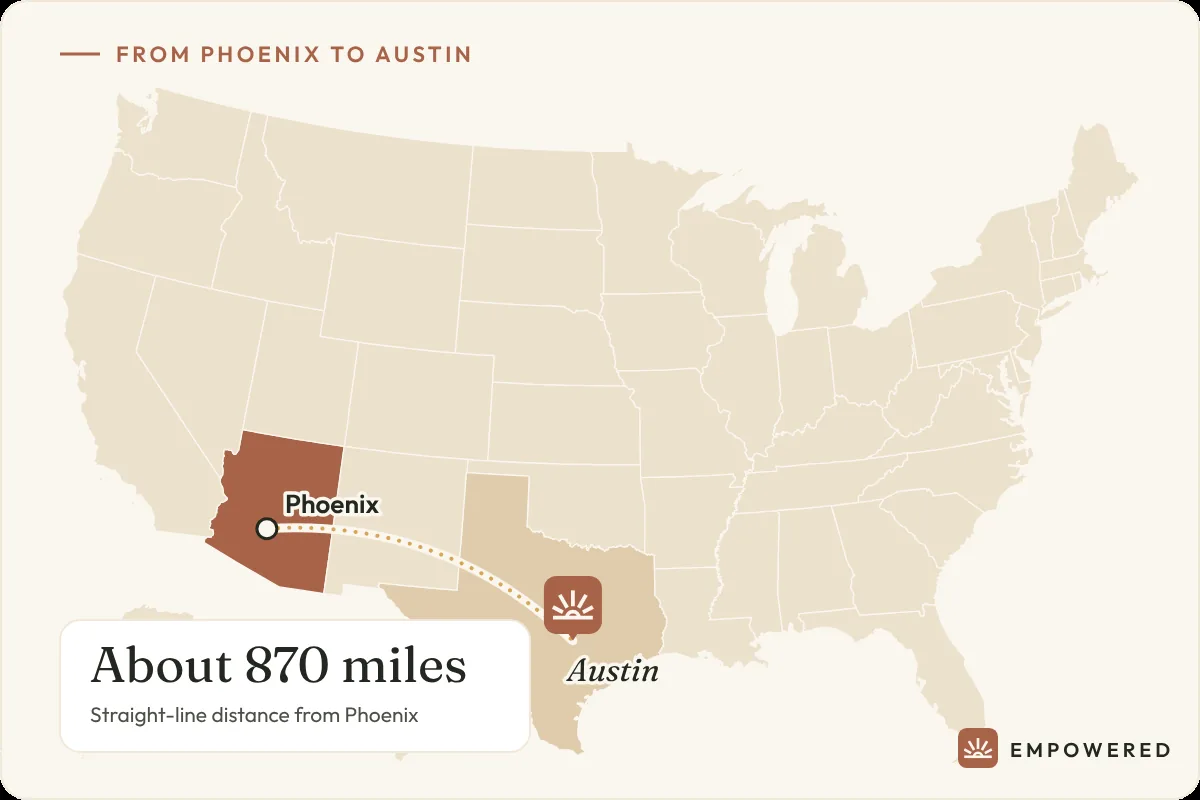
- Distance: about 870 miles from Phoenix as the crow flies
- Airports: Phoenix Sky Harbor International Airport (PHX) and Tucson International Airport (TUS) both have flights to Austin-Bergstrom International Airport (AUS)
- Last stretch: plan on roughly a 30-minute drive from AUS to Spicewood Springs Road, longer at rush hour
- Housing: a bed in our transitional housing can be lined up to start with PHP or IOP
Questions about coverage
Before anyone books a flight, we can review your benefits together and explain how your plan treats partial hospitalization, intensive outpatient care, and out-of-network providers.
- Use our insurance verification form, or phone us and we will look up your benefits while you are on the line
- Arizona-based plans vary in how they pay for specialized care in Texas, so ask about out-of-network benefits; we will help you frame the questions
- The Arizona Department of Insurance and Financial Institutions regulates insurers and handles consumer complaints about health plans
- AHCCCS members: coverage for care outside your home state is usually limited, so call and we'll help you understand what applies
Support that stays with you after you go home.
Treatment is one chapter, and the people and services around you afterward help the progress hold. These organizations in Arizona can help you and your family keep support in place between Phoenix, Tucson, and the rest of the state.
- AHCCCS (Arizona Health Care Cost Containment System)Arizona's Medicaid agency, which also oversees public behavioral health services and lists crisis service information for every county.
- NAMI ArizonaThe state organization of the National Alliance on Mental Illness, offering education and support for individuals and families affected by mental health conditions.
- Arizona Department of Insurance and Financial InstitutionsThe state regulator for insurance companies, with consumer assistance for health plan questions and complaints.
- 988 Suicide & Crisis LifelineCall or text 988, any time, from anywhere in the United States. In an emergency, call 911.
What Arizonans often ask before calling.
Is it realistic to leave Arizona for several weeks of treatment?
For many adults it is, especially when housing is part of the plan. Our team can talk through time away from work or school, what to bring, and how transitional housing fits with PHP or IOP. Read moving to Austin for eating disorder care for more.
What happens with my care when I return to Arizona?
Discharge planning starts early. Together we identify a therapist, dietitian, or psychiatric provider back home, share what has been working, and set a realistic first few weeks, so returning to Phoenix, Tucson, or a smaller town feels expected rather than abrupt.
I have tried outpatient therapy and I am still struggling. Is that a sign I need more?
It can be. Weekly sessions suit some people, while others need more structure, supported meals, and clinicians who coordinate closely. Our article levels of care explained describes how PHP and IOP add support beyond outpatient therapy.
Do you treat people who are not underweight?
Yes. Eating disorders affect people in every body size, and weight alone does not tell anyone how serious an illness is. We treat anorexia, bulimia, binge eating disorder, ARFID, and OSFED in adults.
More for Arizona
Articles and guides for readers in Arizona.
Start with a conversation, not a commitment.
Tell us what the last few months have been like and we will talk through which level of care could fit. The call is free and confidential.