
For people struggling with eating disorders in Alaska, even when the nearest specialist is a flight away.
Empowered Treatment offers adult partial hospitalization, intensive outpatient care, and transitional housing in Austin, Texas. If you are an Alaskan weighing care far from home, we can help you think it through, one honest question at a time.
Some struggles grow quietly in the dark months.
Alaska asks a lot of the people who live there. Days swing from endless light to a few gray hours, towns along the Kenai or in the Mat-Su can sit hours from a specialist, and residents of Bethel, Nome, or Kodiak often reach a larger hospital only by plane. In that kind of life, a pattern of restricting, bingeing, or compensating can stay hidden for a long time, especially when you have learned to handle hard things on your own.
None of that means you have to keep managing it alone. Eating disorders are medical and psychological conditions, not failures of willpower, and they respond to steady, specialized care. Whether you work a North Slope rotation, teach in a village school, study at UAA, or are raising kids in Eagle River, the eating disorder may have started setting the terms for your days. Noticing that is a real first step.

You can ask questions before you decide anything.
Considering treatment thousands of miles away can feel like too big a leap to even talk about. It helps to separate the call from the decision. Calling simply means getting information: what partial hospitalization involves, what an ordinary week looks like, and how people traveling a long way usually plan the logistics.
Our admissions team will listen without rushing you and help you sort out whether PHP or IOP fits, or whether another option makes more sense right now. If you have wondered whether you are sick enough for treatment, that question alone is worth raising with us.
Distance changes how you help, not whether you can.
If your adult child, partner, or sibling would be heading to Austin, the miles can make you feel shut out. Families in that position often do more than they realize: staying steady on the phone, helping with practical details, and learning what the illness is and is not. Our guide on supporting a loved one from a distance covers specific ways to stay involved.
Your own questions matter too. Through family education, parents, partners, and siblings learn how eating disorders work, what to say when meals are hard, and how to protect the relationship while recovery takes hold. Understanding tends to replace a lot of the fear.
A steady place to live while the work happens.
Coming from Alaska, treatment usually means relocating for a while, and that only works if daily life has somewhere to settle. Our transitional housing is a real house in Austin's Hyde Park neighborhood, used alongside PHP or IOP. You share it with other adults in recovery, return each evening to support around meals and routines, and do not have to figure out an unfamiliar city by yourself.
 Shared living spaces
 A room of your own
One team, looking at the whole picture.
Recovery tends to stall when nutrition, mood, and medical concerns are handled in separate places by people who never compare notes. At Empowered, eating disorder therapists, registered dietitians, psychiatric providers, and a family therapist share one plan and meet about it regularly. As discharge gets closer, we work with you on aftercare so the support you leave with can continue once you are back in Alaska.
Partial hospitalization (PHP)
Full treatment days at our Austin center: supported meals, daily groups, individual therapy, dietitian care, and medical and psychiatric monitoring.
About PHP →Intensive outpatient (IOP)
Group programming plus weekly individual and dietitian sessions, built to fit around work, school, and family once more structure is not needed.
About IOP →
“When someone is weighing treatment this far from home, I want our first conversations to make room for every worry, from the practical ones to the ones that are harder to say out loud. Therapy here is collaborative, so we move at a pace that feels challenging but never like you are doing it alone.”Sydney Kudeviz, LCSWTherapist, Empowered Treatment
The long trip, and the paperwork.
Traveling from Alaska to Austin
Nearly everyone coming from Alaska flies, usually with a connection somewhere in the Lower 48. We can help you plan your arrival around your start date.
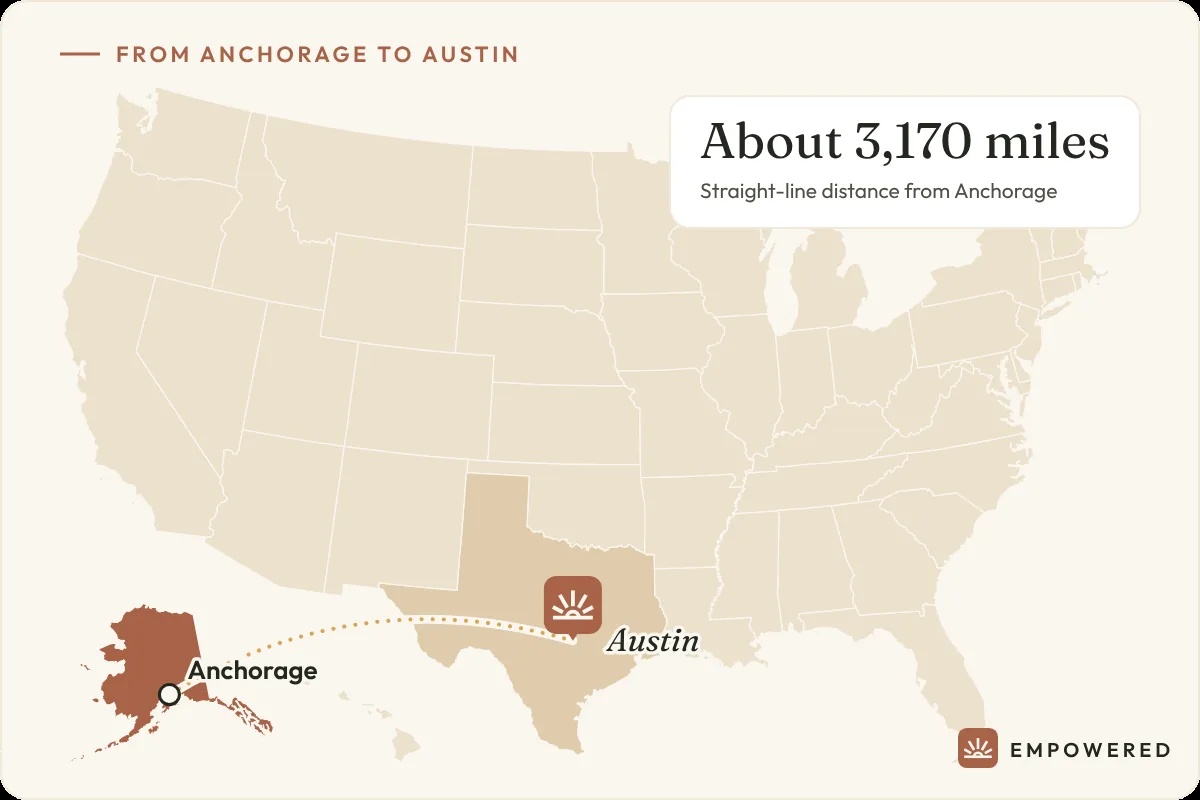
- Distance: about 3,170 miles from Anchorage as the crow flies
- Airports: Ted Stevens Anchorage International Airport (ANC) and Fairbanks International Airport (FAI) both offer routes that connect to Austin-Bergstrom International Airport (AUS)
- Arrival: AUS sits roughly 30 minutes by car from our center in Northwest Austin, depending on traffic
- Staying in Austin: our transitional housing gives you a supportive place to live during PHP or IOP
Using an Alaska health plan
Benefits for out-of-state care vary widely, so the most useful step is a benefits check before any travel is booked. We can do that with you and explain what we find in plain terms.
- Start with our insurance verification form, or call and a team member will gather the details with you
- If your plan is based in Alaska, ask how it handles out-of-network partial hospitalization and intensive outpatient care in Texas; we can help you prepare the right questions for your insurer
- The Alaska Division of Insurance helps consumers with health plan questions, complaints, and external review of denied claims
- If you have Medicaid, coverage for care outside your home state is usually limited, so call and we will help you understand what applies
Keeping support in place after you fly home.
Aftercare holds up better when it is planned before you leave Austin. These statewide resources in Alaska can help you and your family stay connected to support once treatment here ends.
- Alaska Department of Health: Division of Behavioral HealthStatewide behavioral health programs, crisis services including 988 and the Crisis Careline, and links for finding treatment providers.
- NAMI AlaskaNo-cost education and support, including Family-to-Family classes and family support groups for people who love someone with a mental health condition.
- Alaska Division of InsuranceConsumer guidance on health coverage, filing complaints, and requesting an external review of a denied claim.
- 988 Suicide & Crisis LifelineCall or text 988, any time, from anywhere in the United States. In an emergency, call 911.
What Alaskans often ask before calling.
Is it realistic to come to Austin for treatment from Alaska?
It can be, with planning. People traveling a long way often begin in PHP, live in our transitional housing, and step down to IOP as they progress. Our team can walk you through timing, travel, and what to bring before you commit. Read more in moving to Austin for eating disorder care.
Will Austin feel very different from home?
Probably, at least at first. Austin summers are hot and long, daylight hours barely change across the year, and the city is busy. A structured weekly schedule and a shared house can make the adjustment easier, and our team treats homesickness as part of the work rather than a distraction from it.
What does a week in partial hospitalization look like?
PHP runs about 30 hours a week, with group therapy, supported meals, individual therapy, nutrition work with a dietitian, and psychiatric care. It is intensive by design, so work or school is usually set aside while you attend.
How do I keep care going once I am back in Alaska?
We start discharge planning well before your last day. That plan can include identifying a therapist, dietitian, or psychiatric provider in Alaska and arranging a handoff so your next clinicians understand what has helped. Our page on recovery while traveling can also help with the trip home.
More for Alaska
Articles and guides for readers in Alaska.
The distance is real. So is the help.
Call to talk through what has been happening and what a stay in Austin could look like. A conversation with our team is free and commits you to nothing.