
Open enrollment in Dallas-Fort Worth: choosing a 2027 plan when eating disorder care is on the table
Marketplace open enrollment starts November 1, and many North Texas employers are running theirs now. If you or someone you love might need eating disorder treatment next year, the plan you choose this fall decides where that care is possible and what it costs.

How do you pick a health plan if you may need eating disorder treatment?
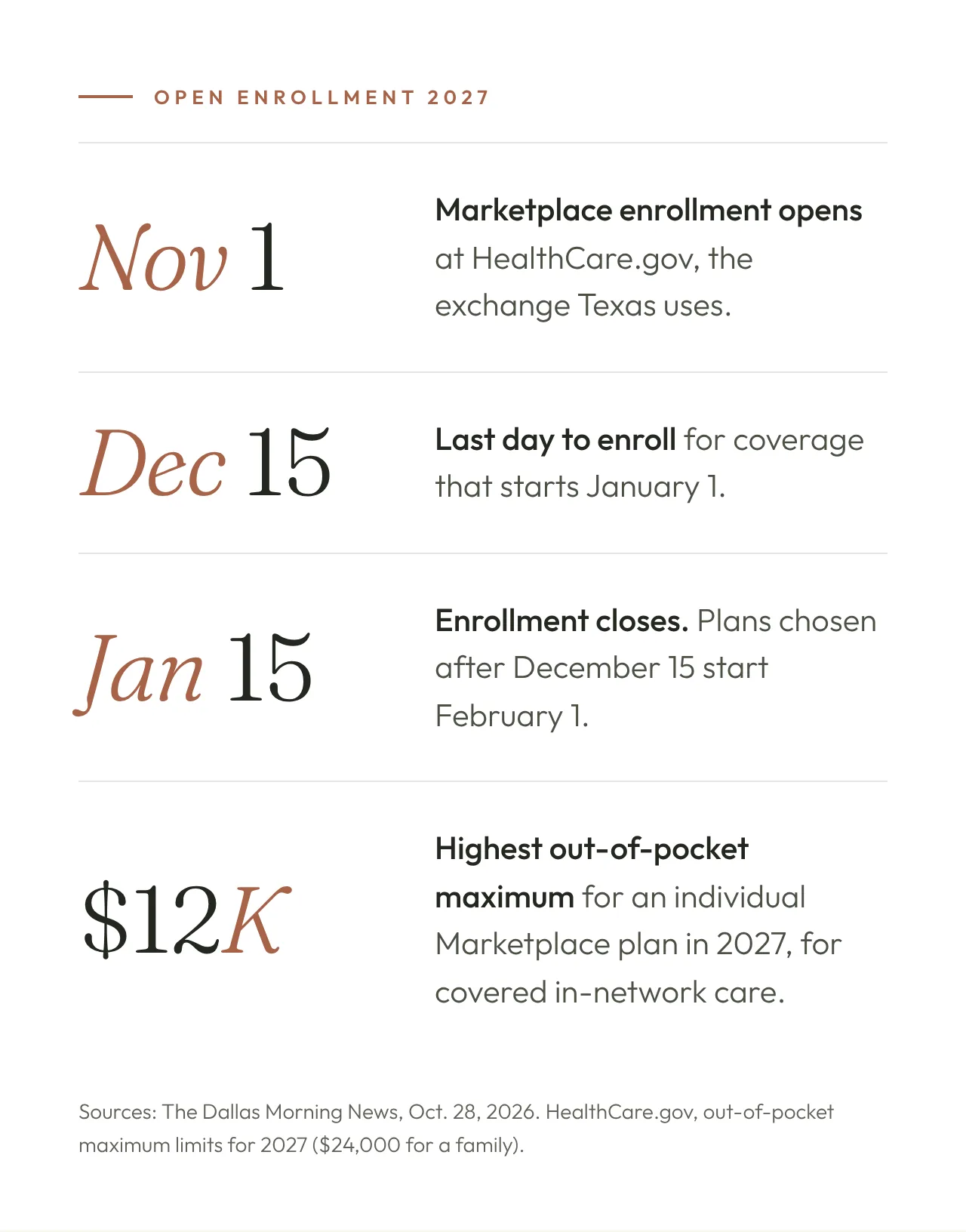
Look past the premium. Check whether the plan pays for out-of-network care, whether an eating disorder program at the level of care you may need is in network, whether day programs need prior authorization, and what the out-of-pocket maximum is. For 2027 Marketplace plans, yearly costs for covered in-network care are capped at $12,000 for an individual.
- The window is short. Marketplace enrollment runs November 1 to January 15. Sign up by December 15 for coverage that starts January 1.
- The market is shifting. Baylor Scott & White Health Plan is leaving the Marketplace at the end of 2026, affecting about 100,000 Texans, and other carriers are exiting in some states.
- Plan type matters most for specialty care. HMOs and EPOs generally cover only in-network care outside emergencies. PPOs pay for out-of-network care at a higher cost.
- Look for the program, not just the provider. A network full of therapists may still have no eating disorder day program.
- Free help exists in DFW. Navigators and the state insurance help line can walk you through the choice.
What is changing for North Texas shoppers
On October 28, The Dallas Morning News laid out the 2027 enrollment calendar: Marketplace open enrollment runs from November 1 to January 15. Plans chosen by December 15 start January 1, and plans chosen from December 16 through January 15 start February 1. Texas uses the federal exchange at HealthCare.gov. Daniel Bouton of United Way of Metropolitan Dallas put the advice plainly: "We always encourage our clients to look beyond the monthly premium."
The choices themselves are moving. As of October 28, KFF counts 11 carriers that have announced exits from the Marketplaces in 2027, in some or all of their states, after enhanced premium tax credits expired at the end of 2025. Closer to home, Baylor Scott & White Health Plan is leaving the Marketplace at the end of this year, a change affecting about 100,000 Texans who will need a new plan.
Most coverage of open enrollment is about premiums, and for good reason. For anyone living with an eating disorder, or watching someone they love struggle, a few other details matter more.
Read the plan type before the price
Eating disorder care is specialty care. There are far fewer programs than therapists, and the right one may not be in your county. That makes the plan's network rules the first thing to check. HealthCare.gov describes the main types this way:
- HMO: usually limits coverage to providers who work for or contract with the plan, and generally will not cover out-of-network care except in an emergency.
- EPO: covers services only from in-network providers, except in an emergency.
- PPO: lets you see providers outside the network without a referral, at an additional cost.
- POS: requires a referral from your primary care doctor to see a specialist.
For people in Dallas-Fort Worth, there is a geographic wrinkle. A network built around North Texas providers may not include a program in Austin, Houston or elsewhere in Texas. If you think you might travel for care, ask the plan directly whether it covers programs outside the metro.
One more detail catches people off guard. On Marketplace plans, out-of-network care does not count toward the out-of-pocket maximum. A PPO with out-of-network benefits is useful, but those costs can keep climbing after your in-network limit is met.
Look for the program, not just the provider
Many plans list dozens of in-network therapists. Far fewer have an in-network partial hospitalization program or intensive outpatient program that specializes in eating disorders. If weekly therapy has not been enough, those day programs are often the next step, so they are worth checking before you commit to a plan.

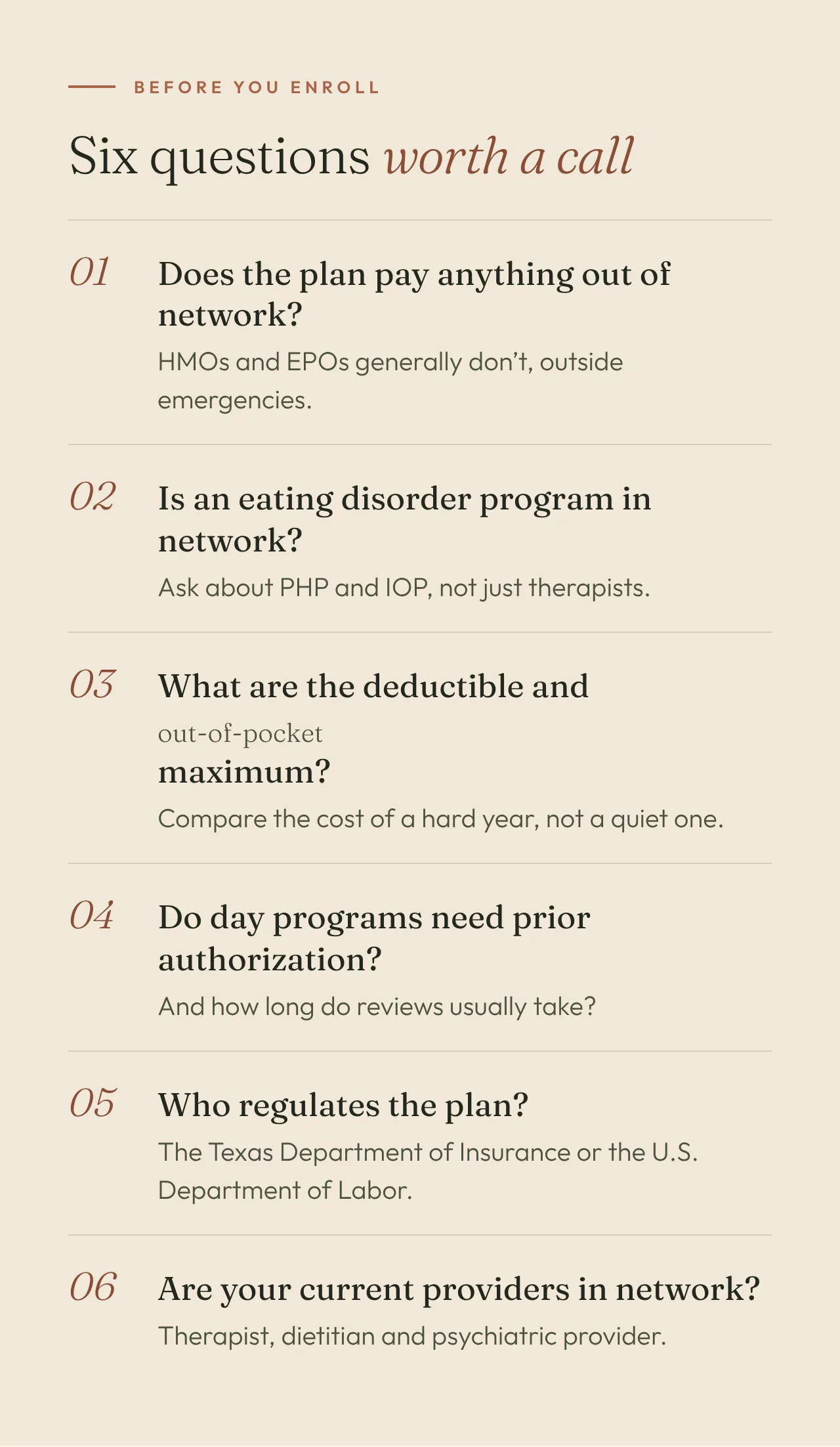
Call member services for any plan you are seriously considering and ask the questions below. Write down the date, the name of the person you spoke with and a reference number. If you already have coverage, our admissions team can verify your current benefits for PHP and IOP, which gives you a baseline to compare new plans against.
"If you are thinking about switching, call us first," says Brittni Pogue, our Co-Founder and Director of Admissions and Business Development. "Knowing exactly how your current plan treats PHP and IOP makes every other plan easier to judge."
Six questions to ask before you enroll
Do the math on a hard year
Premiums are what you pay every month. The deductible and out-of-pocket maximum are what you pay in a year when you actually use care. Once you reach the out-of-pocket maximum, the plan pays 100% of covered in-network benefits for the rest of the year. For 2027, HealthCare.gov caps that amount at $12,000 for an individual and $24,000 for a family on Marketplace plans. Many plans set it lower. When treatment is likely, a plan with a higher premium and a lower out-of-pocket maximum can cost less over the year.
Timing matters too. Deductibles generally reset at the start of each plan year, so care that begins in January starts the count over. Our guide to eating disorder treatment costs walks through how those pieces add up.
Ask about prior authorization
Many plans require approval before a day program starts, plus reviews as treatment continues. That is normal, and a good treatment team handles the clinical paperwork. What you want to know in advance is whether the plan requires it, how long it usually takes, and who to call if a review is denied.
Parity, and who to call when coverage falls short
Every Marketplace plan covers mental health services as an essential health benefit, must follow parity rules between mental health and medical benefits, and cannot deny you or charge more because of a pre-existing condition. Our page on whether insurance covers eating disorder treatment explains what parity does and does not guarantee.
Who enforces those rules depends on how your plan is funded. According to the Texas Department of Insurance, TDI regulates fully insured plans, which usually show "TDI" or "DOI" on the ID card. Self-funded employer plans fall under the U.S. Department of Labor instead. If you think a plan is breaking the rules, TDI's Consumer Help Line is 1-800-252-3439.
When your insurer leaves the market
If you are one of the Texans whose Baylor Scott & White Marketplace plan ends on December 31, choose a new plan by December 15 to avoid a gap on January 1. If you or a family member is in treatment now, tell the treatment team right away so they can check the new plan's network and authorization rules before the switch.
Outside open enrollment, changing plans usually requires a special enrollment period, such as losing other coverage in the past 60 days. A health need on its own does not open one, and HealthCare.gov notes that moving only for medical treatment does not qualify. That is why the choice you make this fall carries through the whole year.
Where to get help in Dallas-Fort Worth
- United Way of Metropolitan Dallas Healthcare Navigators help with comparing plans, understanding benefits and applying for financial assistance. Start at United Way's healthcare assistance page.
- HealthCare.gov local help lists free, in-person assisters by ZIP code at healthcare.gov/find-local-help.
- Texas Department of Insurance answers coverage and complaint questions at 1-800-252-3439.
- In crisis? Call or text 988, the Suicide and Crisis Lifeline, any time.
Our Dallas-Fort Worth page lists local mental health resources and explains how adults from North Texas attend treatment in Austin, often staying in our transitional housing. Adults from across Texas come to us for PHP and IOP, and our team can verify your benefits before you decide anything.
Open enrollment and eating disorder care: FAQs
Do Marketplace plans cover eating disorder treatment?
All Marketplace plans cover mental health services as essential health benefits and must follow parity rules. Whether a specific eating disorder program is covered depends on the plan's network, authorization rules and cost sharing, so verify before you enroll.
Is a PPO better than an HMO for eating disorder treatment?
Not always, but a PPO gives you more room. HMOs and EPOs generally cover only in-network care outside emergencies, so they work well only if an eating disorder program you trust is in the network. A PPO can pay for out-of-network care at a higher cost.
Can I change plans in the middle of the year if I need treatment?
Usually not. Outside open enrollment you generally need a special enrollment period, such as losing other coverage. A health need on its own does not qualify, which is why it pays to choose carefully now.
Does out-of-network care count toward my out-of-pocket maximum?
On Marketplace plans, no. The out-of-pocket maximum applies to covered in-network care. Out-of-network costs, premiums and services the plan does not cover are counted separately.
This article is general education, not insurance or legal advice. Plan details change every year, so confirm everything with the plan before you enroll.
Sources
- Brindley E. Looking for an ACA Marketplace health plan? Here's where to start. The Dallas Morning News. October 28, 2026.
- Ortaliza J, Lo J, Cotter L, McGough M, Cox C. Tracking Insurer Participation Changes in the ACA Marketplaces in 2027. KFF. Updated October 28, 2026.
- Duke D. Baylor Scott & White Health Plan will stop providing Medicaid and marketplace coverage in Texas. KERA News. April 15, 2026.
- HealthCare.gov. Out-of-pocket maximum/limit.
- HealthCare.gov. Health insurance plan and network types.
- HealthCare.gov. Mental health and substance abuse coverage.
- HealthCare.gov. Special Enrollment Period.
- Texas Department of Insurance, Texas Health Options. Insurance coverage and parity for mental health and substance use disorder services.
- United Way of Metropolitan Dallas. Financial Assistance for Healthcare Coverage.
Eating disorders are not a choice. Recovery can be.
One confidential conversation is all it takes to start. We can check your benefits and help you find the right next step, even if it isn't with us.