
GLP-1 medications and eating disorders: what young adults in Texas should know
A Dallas study shows GLP-1 drugs have become the near-default obesity treatment for people in their teens and early twenties. For most, that is a medical decision made with care. For someone with an eating disorder, past or present, it raises questions worth asking before the first dose.
Can a GLP-1 medication trigger or worsen an eating disorder?
It can for some people, especially those with a history of restriction, bingeing or purging. GLP-1 drugs such as Ozempic, Wegovy and Zepbound turn appetite down, which can hide early warning signs or reinforce restrictive habits. Evidence is still early, so the safest step is to get screened for an eating disorder before starting, then keep checking in.
- Use is climbing fast among young people. A UT Southwestern study of more than 204,000 people ages 13 to 25 found that 96.1% of recent obesity treatment was GLP-1 medication alone.
- People with eating disorders are using them too. In a 2026 survey of 436 adults with eating disorders, about one in three had taken a GLP-1, and one in ten reported misusing one.
- Appetite is the overlap. Recovery depends on noticing and answering hunger. A drug that quiets hunger can make that harder to do and harder for others to see.
- Screening is the safeguard. A few honest questions about eating history, asked early, change the whole conversation.
What the Dallas study found
In July, researchers at UT Southwestern Medical Center published a research letter in JAMA Pediatrics on how adolescents and young adults are being treated for obesity. Using the Epic Cosmos health record database, they reviewed more than 204,000 patients ages 13 to 25 treated between May 2022 and January 2026 with GLP-1 medication, weight-loss surgery or both.
The shift was steep. GLP-1 medication alone accounted for 88.2% of that treatment from May to November 2022 and 96.1% from June 2025 to January 2026, while surgery fell from 11.6% to 3.7%. Lead author Sarah Messiah, PhD, MPH, of UTSW's O'Donnell School of Public Health, called it an inflection point. The authors wrote that evidence-based guidance on how best to use and combine these treatments is urgently needed, as noted in coverage by The American Journal of Managed Care.
The study did not look at eating disorders, and it was not designed to. That is the gap families and young adults are left to navigate on their own, and it is the reason we wrote this guide. Empowered Treatment works only with adults, so our focus here is the 18 to 25 end of that range, and the parents who still worry about them.
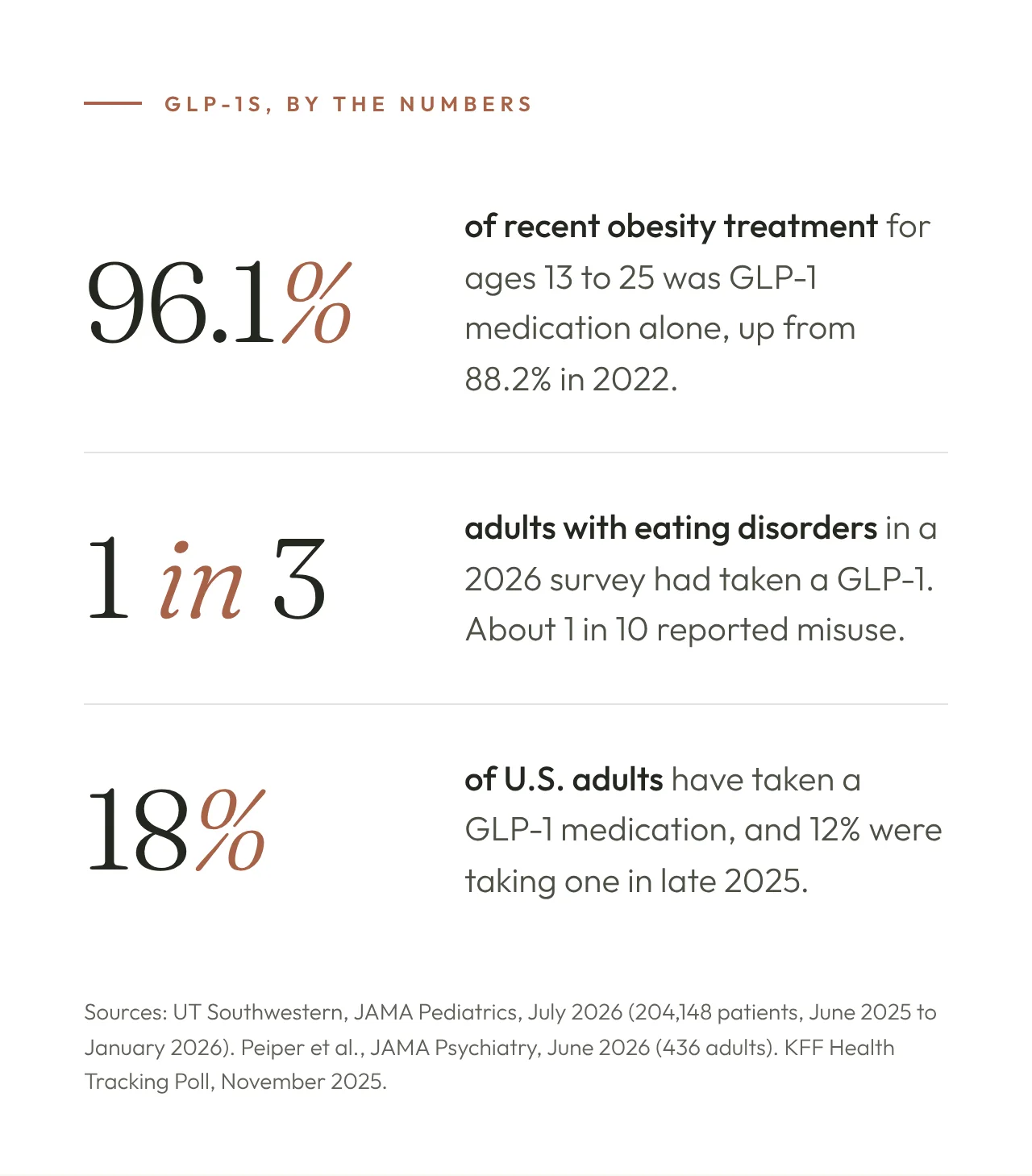
Young adults are not the only ones taking these drugs. A KFF poll released in November 2025 found that 18% of U.S. adults had taken a GLP-1 and 12% were taking one at the time. About 17% of users said they got the medication from an online provider or website, where an in-depth conversation about eating history is less likely to happen.
What researchers are seeing in people with eating disorders
The clearest data so far comes from a research letter in JAMA Psychiatry published in June 2026. Researchers led by Nicholas Peiper, PhD, MPH, of the University of Louisville surveyed 436 adults with eating disorders. According to Healio's report on the study:
- 32.1% had used a GLP-1 at some point, and 22% were using one when surveyed.
- 10.1% reported misuse, such as taking more than prescribed, and 9.9% had used compounded products.
- Use was highest among people with binge eating disorder (54.6%) and atypical anorexia (42%), and lower among people with anorexia nervosa (11.2%).
The authors are clear about the limits. It was an interim, self-reported online survey, mostly of white women, and they expect their estimates are conservative. Peiper told Healio that no clinical guidance yet exists for this situation.
Clinicians are raising the same concern. A Washington Post investigation this year described treatment providers seeing relapses and new cases among patients taking GLP-1s. It cited a New England Journal of Medicine perspective estimating that more than 420,000 people could develop an eating disorder with long-term use. That figure is a projection, not a measured rate. The same reporting noted that some medical societies recommend eating disorder screening before prescribing, and that providers say it is not happening routinely.
Why appetite is the overlap
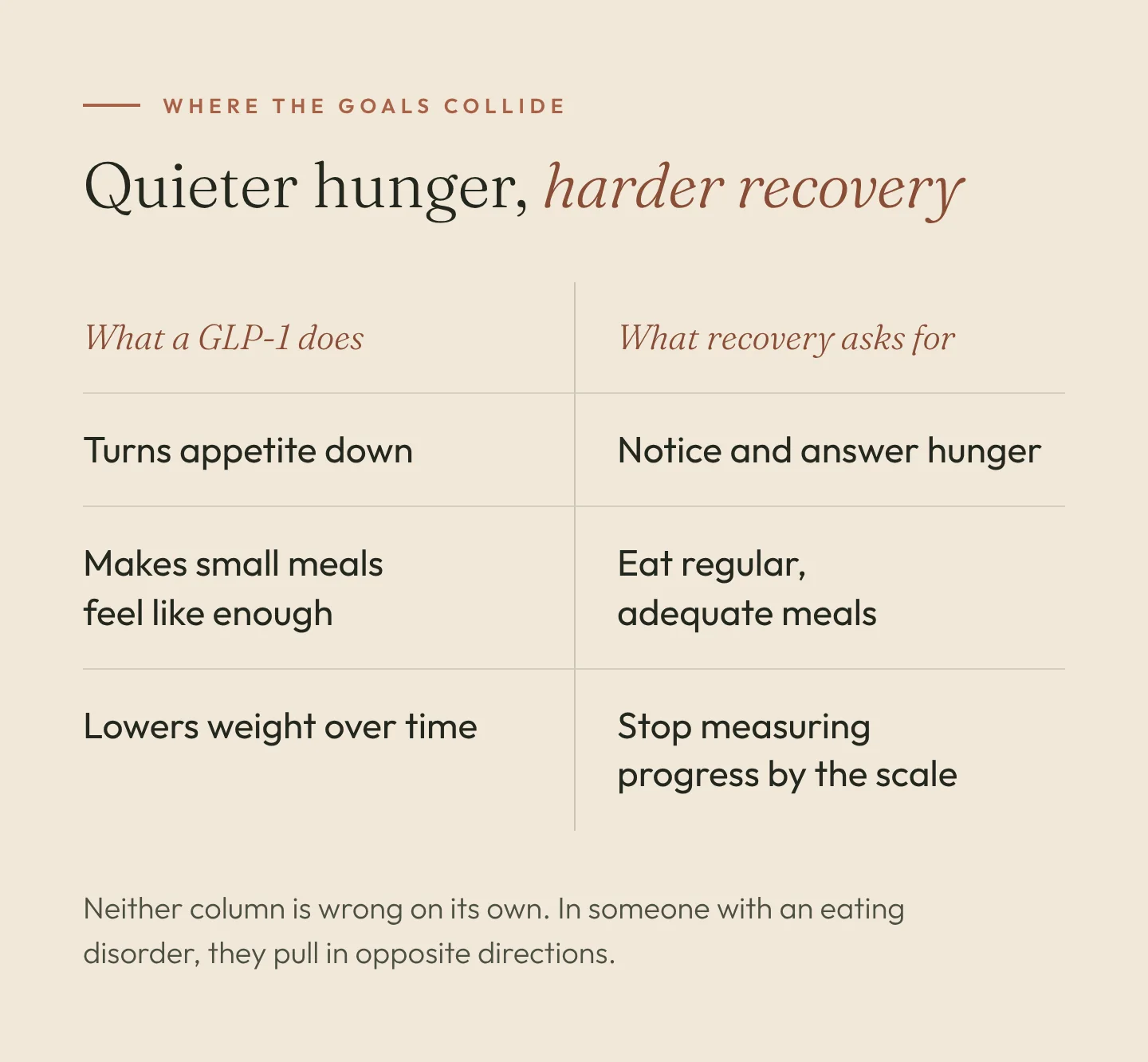
For most patients, a quieter appetite is the point of the medication. Eating disorder recovery asks for nearly the opposite: noticing hunger, answering it with regular meals, and letting weight stop being the measure of a good week. When those two goals meet in the same person, they pull against each other.
The American Psychological Association's Monitor on Psychology put the problem plainly in June: rapid weight loss, nausea and low appetite overlap with the symptoms of restrictive eating disorders, which makes those disorders harder to spot. There are almost no controlled studies of GLP-1s in restrictive eating disorders, though case reports raise concern. For binge eating, early research is mixed, with some studies showing fewer binge symptoms and others showing no effect.
It also matters who gets noticed. The National Institute of Mental Health notes that eating disorders affect people of all body weights, and that people who appear healthy can be extremely ill. A young adult in a larger body who loses weight quickly on a GLP-1 is more likely to be praised than screened, even when the weight loss comes from restriction. Our page on atypical anorexia explains why that pattern is so easy to miss.
Signs worth a closer look
Whether you are taking a GLP-1 yourself or watching someone you love start one, these patterns are worth raising with the prescriber or an eating disorder specialist:
- Going most of the day without eating and calling it “not hungry anyway”
- Food rules that keep getting stricter, or anxiety when a meal is unplanned
- Fear or distress about a dose being lowered, paused or stopped
- Taking more than prescribed, or buying medication online to avoid a doctor's questions
- Bingeing that returns, or feels worse, when a dose wears off or the medication stops
- Dizziness, fainting, exhaustion or feeling cold much of the time
- A past history of restriction, bingeing, purging or compulsive exercise that no prescriber has asked about
One sign on its own does not mean an eating disorder. A pattern that keeps tightening deserves a conversation. If you are not sure what an evaluation looks like, our guide to what an eating disorder assessment involves walks through it.
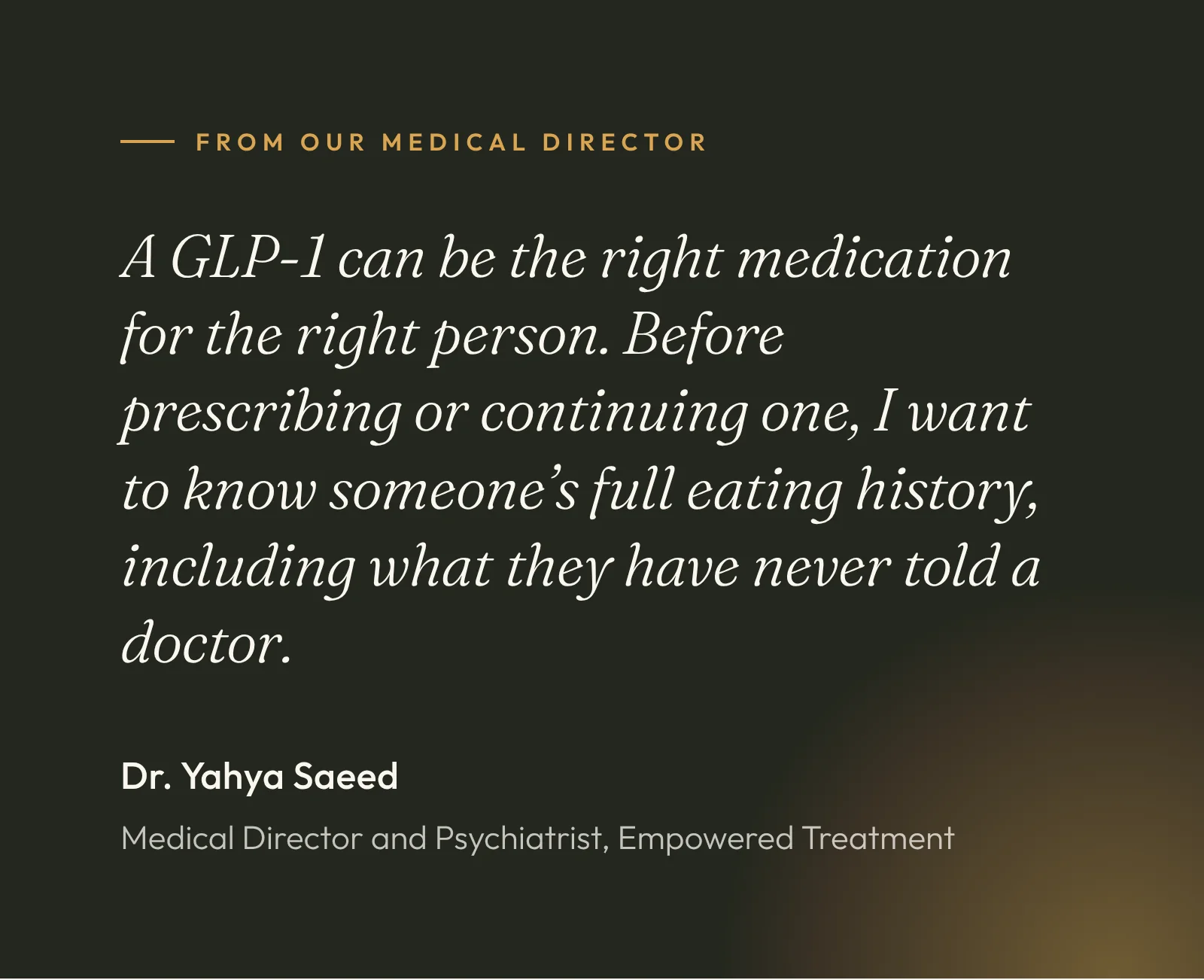
Dr. Yahya Saeed, Medical Director and Psychiatrist, Empowered Treatment
Questions to bring to the prescriber
These questions are fair to ask at any appointment, whether the medication is new or has been part of the plan for months:
- Have you screened me for an eating disorder, past or present?
- How will we track meals, nutrition and mood, not just weight?
- Should a registered dietitian be part of this plan?
- What happens if I am eating very little, or if I need to stop the medication?
- Who should I call if eating starts to feel out of control?
If you are the parent of an adult child
Your son or daughter makes their own medical decisions now, and that can leave parents feeling shut out. You can still be honest about what you notice, ask questions without arguing about the medication itself, and offer to help find a specialist. Our guide to talking to your adult child about their eating disorder has words that tend to land better than worry or pressure.
Reggie Graves, MSN, PMHNP-BC, FNP-C, Psychiatric Nurse Practitioner, Empowered Treatment
When to get specialist help
Reach out if eating has become very restricted, if bingeing or purging has returned, or if the medication has become something you feel you cannot stop. You do not need to be certain something is wrong to ask.
Empowered Treatment is an adult eating disorder program in Austin with psychiatric providers, therapists and registered dietitians on one team, so medication questions are answered alongside nutrition and therapy rather than in separate offices. We offer a partial hospitalization program (about 30 hours a week) and an intensive outpatient program (about 9 hours a week). Adults come to us from Dallas-Fort Worth and elsewhere in Texas, and our transitional housing in Austin's Hyde Park makes that possible without a daily drive. You can check your insurance benefits in a few minutes, and our binge eating disorder page explains how that condition is treated.
GLP-1s and eating disorders: FAQs
Can Ozempic or Wegovy cause an eating disorder?
There is no proof that GLP-1 drugs cause eating disorders on their own, and research is still early. Clinicians and case reports describe relapses and new restrictive patterns in some people taking them, which is why screening for eating disorder history before and during treatment matters.
Are GLP-1s used to treat binge eating disorder?
They are not approved for binge eating disorder. Early studies are mixed, with some showing fewer binge symptoms and others showing no effect. Binge eating disorder is usually treated with therapy, nutrition support and, when helpful, other medications.
Should I stop my GLP-1 if I think I have an eating disorder?
Do not start, stop or change a medication on your own. Tell your prescriber what you are noticing and ask for an eating disorder assessment. A specialist team can work with your prescriber on a safe plan.
Can I be in eating disorder treatment while taking a GLP-1?
Often, yes. At Empowered, our psychiatric providers can review medications as part of the assessment and coordinate with the prescriber, so the decision is made with the full picture in view.
This article is for general education and is not medical advice. Never start, stop or change a medication without talking to your prescriber. If you are in crisis, call or text 988.
Sources
- UT Southwestern Medical Center. GLP-1 use rising rapidly among U.S. adolescents, young adults. July 20, 2026.
- Messiah SE, Ernest DK, Elnakieb Y, et al. GLP-1 receptor agonist and bariatric surgery utilization among adolescents and young adults. JAMA Pediatrics. Published online July 20, 2026. doi:10.1001/jamapediatrics.2026.2828. Summarized in The American Journal of Managed Care, July 21, 2026.
- Peiper NC, Zibbell JE, LaJoie AS, Wahlang B, Krishnasamy SS, Levinson CA. Use and misuse of GLP-1 receptor agonists among people with eating disorders. JAMA Psychiatry. 2026;83(8):880-882.
- Healio. About 10% of patients with eating disorders have misused GLP-1 receptor agonists. August 3, 2026.
- KFF. Poll: 1 in 8 adults say they are currently taking a GLP-1 drug. November 14, 2025.
- Rowland C, Cha AE. People with eating disorders are taking GLP-1s, and doctors are alarmed. The Washington Post, republished by the Daily Herald, June 5, 2026.
- Abrams Z. Navigating GLP-1 use in therapy. Monitor on Psychology, American Psychological Association. June 1, 2026.
- National Institute of Mental Health. Eating Disorders: About More Than Food.
Eating disorders are not a choice. Recovery can be.
One confidential conversation is all it takes to start. No pressure. We'll help you find the right next step, even if it isn't with us.