
Where to start: finding eating disorder help in Houston
A new study of Houston-area adults found that fewer than half of people living with a mental illness know what services exist in their community. With eating disorders, the gap is often wider, because the help that fits is specialized and rarely advertised where people look first.

How do I find eating disorder help in Houston?
Start with one call to whichever door is easiest: your primary care doctor, the behavioral health number on your insurance card, or a free navigator such as Mental Health America of Greater Houston. Say the words "eating disorder" plainly. Then ask for a specialist team that includes a therapist, a registered dietitian and medical oversight.
- Most Houstonians are unsure where to turn. In a survey of about 1,000 adults in Harris and Fort Bend counties, only 49% of people who reported a mental illness said they knew of services nearby.
- Eating disorders are routinely missed. National data show only a minority of adults with bulimia or binge eating disorder ever seek treatment for it.
- General care is a start, not the finish. Eating disorders respond best to a team trained for them, at the right level of care.
- You do not need to be sure. A good first call is for sorting out what is happening, not for proving that you are sick enough.
What the new Houston study found
On October 28, researchers from Texas A&M University and Mental Health America of Greater Houston published a study in Frontiers in Public Health that asked a simple question: do Houston adults know where to find mental health or crisis services in their own community? The team surveyed about 1,000 adults in Harris and Fort Bend counties, half in July 2024 and half in January 2026.
The answer was sobering. Among respondents who said they had experienced a mental illness, 49% reported being aware of local services. Among those who had not, it was about 35%. Awareness was lower among adults 45 to 64, and lower still among adults 65 and older, compared with adults 25 to 44. Men were less likely than women to know where to go.
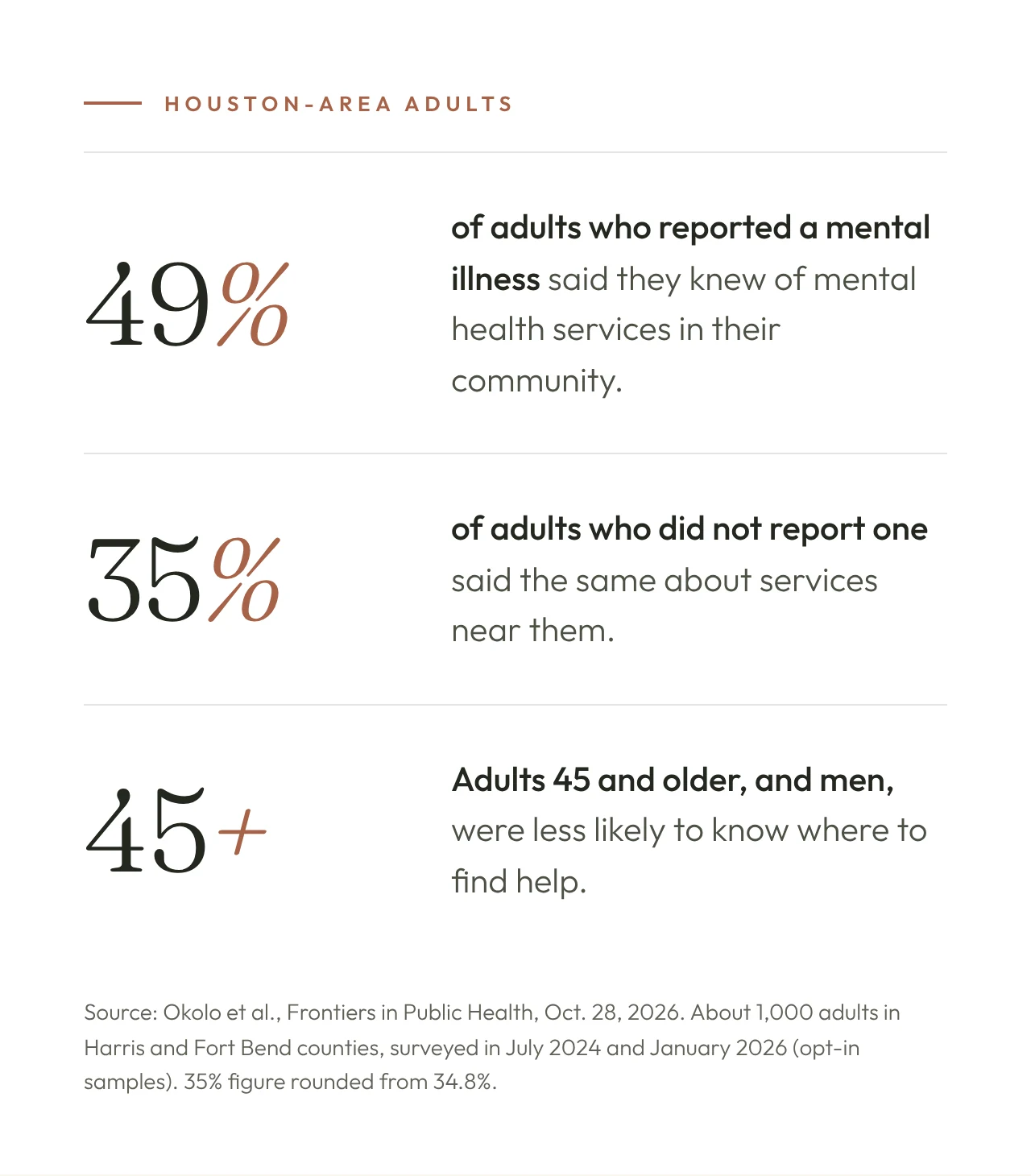
The authors are careful about limits. The samples were opt-in rather than random, and knowing that services exist is not the same as using them. They also stress that lower awareness in some groups is not evidence of lower need. Still, the core finding matches what eating disorder clinicians hear on intake calls every week: people often struggle for years before anyone, including the person themselves, names what is going on.
Why eating disorders are especially easy to miss
General awareness gaps hit eating disorders hard. In the landmark National Comorbidity Survey Replication, most adults with bulimia nervosa or binge eating disorder reported that the illness interfered with their lives, yet only a minority had ever sought treatment for it. Three things tend to keep adults in Houston, and everywhere else, from getting the right help:
- It hides behind other diagnoses. Eating disorders commonly travel with anxiety, depression, trauma and substance use. Many adults are treated for those while the eating disorder goes unnamed.
- It does not look the way people expect. Adults in larger bodies, men, and people in midlife are routinely overlooked. The Houston survey's findings about older adults and men echo that pattern, and our guide to eating disorders in midlife and beyond explains why onset and relapse after 40 are more common than most people think.
- The right care is specialized. A caring generalist therapist is a real asset, but eating disorders usually need a coordinated team: therapy, nutrition rehabilitation with a registered dietitian, and medical and psychiatric monitoring.
Sydney Kudeviz, LCSW, Therapist, Empowered Treatment
Four doors into care in Houston
There is no single right entrance. Pick the door that feels least daunting this week, and know that any of them can lead to the others.
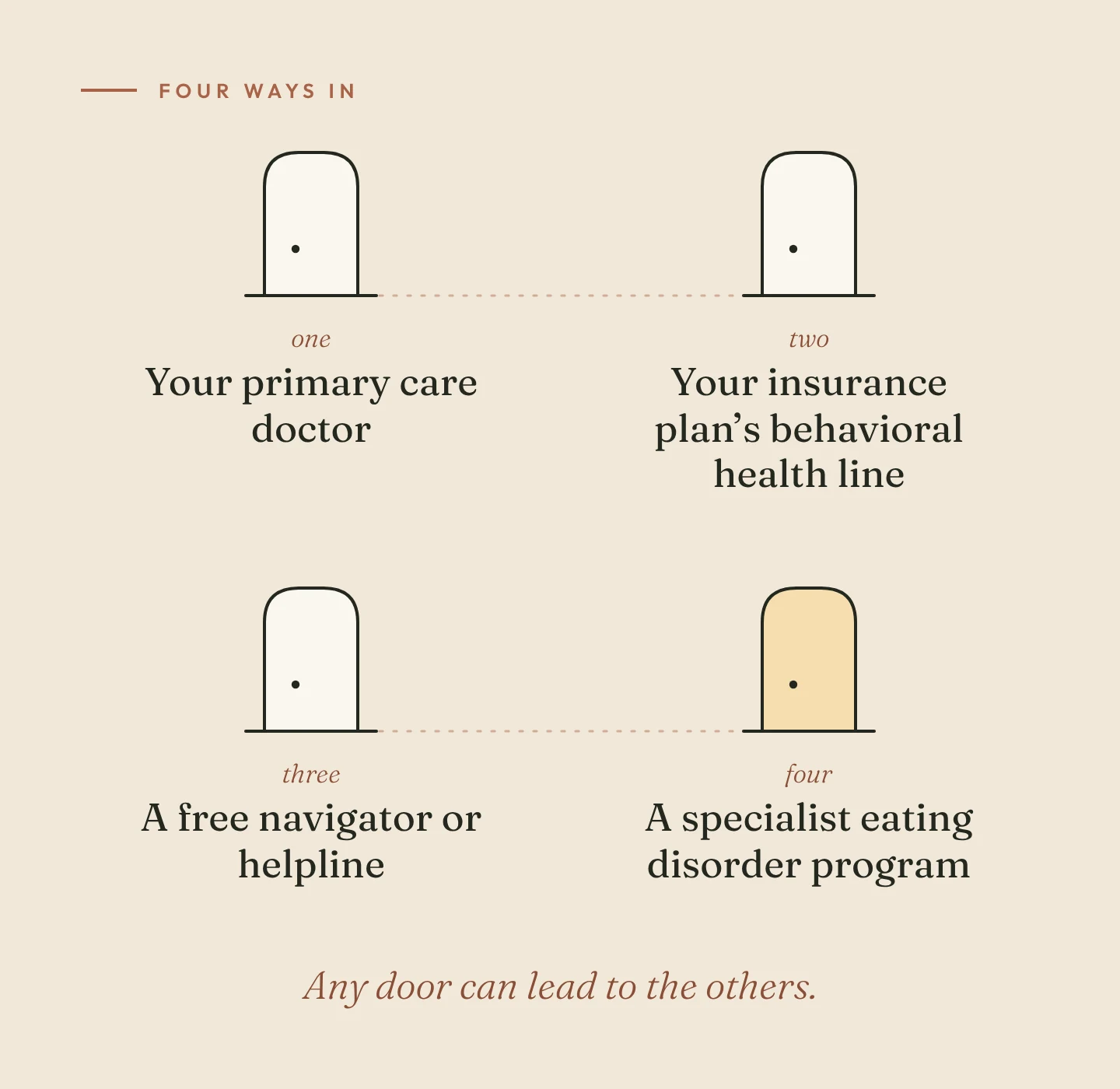
1. Your primary care doctor
A primary care visit can check what an eating disorder may be doing to your body, including vital signs, labs and heart rhythm, and it can produce a referral that some insurance plans require. Be direct: "I think I may have an eating disorder, and I would like to be checked and referred to a specialist." Our guide for primary care providers shows what a thorough screening looks like, so you know what to expect.
2. The number on the back of your insurance card
Most plans list a behavioral health or mental health line. Ask three questions: which eating disorder specialists are in network, whether intensive outpatient (IOP) and partial hospitalization (PHP) programs are covered, and whether prior authorization is required. Write down the name of the person you spoke with and the date. Our page on how insurance covers eating disorder treatment explains the terms you will hear.
3. A free navigator or helpline
If you are not sure where to begin, let someone help you sort it out:
- Mental Health America of Greater Houston, Care Connect: resource specialists who help match people with providers. Call 877-755-9988, Monday to Friday, 8:30 a.m. to 8:30 p.m., with help available in Spanish. Details at mhahouston.org.
- ANAD Eating Disorders Helpline: a free helpline focused on eating disorders. Call (888) 375-7767, Monday to Friday, 9 a.m. to 9 p.m. Central. ANAD also runs free virtual support groups. Details at anad.org.
- The Harris Center for Mental Health and IDD: the 24/7 Crisis and Access Line is 713-970-7000. Details at theharriscenter.org.
- In crisis? Call or text 988, the Suicide and Crisis Lifeline. It is free, confidential and available 24/7.
4. A specialist eating disorder program
You can also call a program directly. A good one will ask about your eating, your health and your daily life, then tell you honestly which level of care fits, even when that is not their program. If you are comparing options, our checklist on how to choose an eating disorder program covers the questions worth asking.
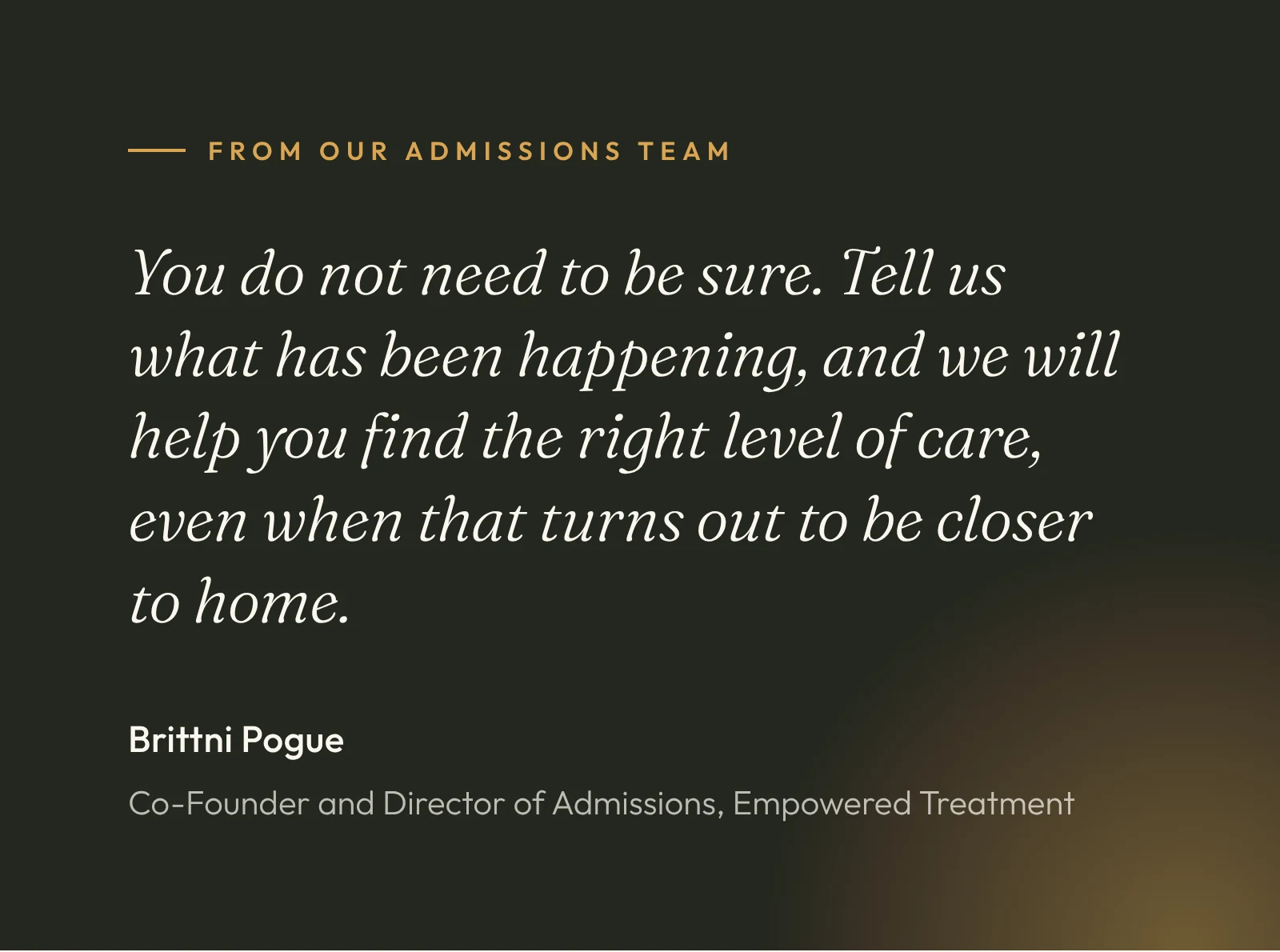
"Most people who call us start by apologizing for not being sure," says Brittni Pogue, our co-founder and director of admissions. That uncertainty is normal, and it is exactly what a first call is for.
What to have ready for the first conversation
None of this is required, and nobody expects a polished summary. A few notes can make the first call shorter and more useful:
- What has been happening with food, exercise or your body, and roughly how long
- Any physical symptoms: dizziness, fainting, heart racing, missed periods, injuries that will not heal
- Other diagnoses or treatment you have had, including medications
- Your insurance card, or a note that you are uninsured or paying privately
- Your real constraints: work hours, caregiving, transportation, how far you can travel
If you would like to know exactly what a first call covers, we wrote it out in what happens when you call an eating disorder center.
If you are worried about someone else
Partners, parents of adult children and friends call too. You can ask a navigator or a program how to raise the subject, and our guide on how to help someone with an eating disorder covers what to say and what to avoid. The person you love is an adult, so the decision to start treatment is theirs, but you do not have to figure out the first conversation alone.
When Austin is the right fit
For some Houston adults, the right level of care is close to home. For others, a structured program is what makes progress possible. Empowered Treatment offers an adult intensive outpatient program (about 9 hours a week) and a partial hospitalization program (about 30 hours a week) in Northwest Austin, with therapists, registered dietitians and psychiatric providers on one team.
Houston is about three hours away, and our transitional housing in Austin's Hyde Park neighborhood makes daily programming possible without the commute. Our page for Houston residents covers travel, family visits and how care continues when you return home, and adults come to us from across Texas. You can check your insurance benefits in a few minutes, or call us at (512) 882-4599.
Finding eating disorder care in Houston: FAQs
Do I need a diagnosis before I ask for help?
No. Sorting out whether something is an eating disorder is part of what a primary care doctor, therapist or specialist program does. If food, weight or exercise is taking up a lot of your attention, that is reason enough to ask.
Is a regular therapist enough for an eating disorder?
Sometimes, for milder concerns and with a therapist trained in eating disorders. Many adults need more: a team that includes a registered dietitian and medical or psychiatric oversight, at a level of care matched to their symptoms.
Where can I get free help finding a provider in Houston?
Mental Health America of Greater Houston runs Care Connect at 877-755-9988 on weekdays, and the ANAD Eating Disorders Helpline is free at (888) 375-7767. In a crisis, call or text 988 any time.
Can I attend an Austin program if I live in Houston?
Yes. Adults from Houston can attend IOP or PHP at Empowered and stay in our transitional housing in Austin during treatment, then continue care with providers back home.
This article is for general education and is not medical advice. If you are in crisis, call or text 988.
Sources
- Okolo EC, Kearney A, Wingenbach G, Engels J, Usanga A. Experience with mental illness and awareness of health or crisis services among adults in Houston, 2024 to 2026. Frontiers in Public Health. October 28, 2026. doi:10.3389/fpubh.2026.1900430.
- Hudson JI, Hiripi E, Pope HG Jr, Kessler RC. The prevalence and correlates of eating disorders in the National Comorbidity Survey Replication. Biological Psychiatry. 2007;61(3):348-358. doi:10.1016/j.biopsych.2006.03.040.
- Mental Health America of Greater Houston. Care Connect helpline.
- ANAD. Get help: Eating Disorders Helpline and support groups.
- The Harris Center for Mental Health and IDD. 24/7 Crisis and Access Line.
- 988 Suicide and Crisis Lifeline. 988lifeline.org.
Eating disorders are not a choice. Recovery can be.
One confidential conversation is all it takes to start. No pressure. We'll help you find the right next step, even if it isn't with us.