
Eating disorders in military families: a guide for San Antonio
San Antonio is known as Military City USA, and for good reason. For the service members, veterans and spouses who live here, the pressures of military life can show up at the dinner table in ways that are easy to miss and very treatable.

Are eating disorders common in the military?
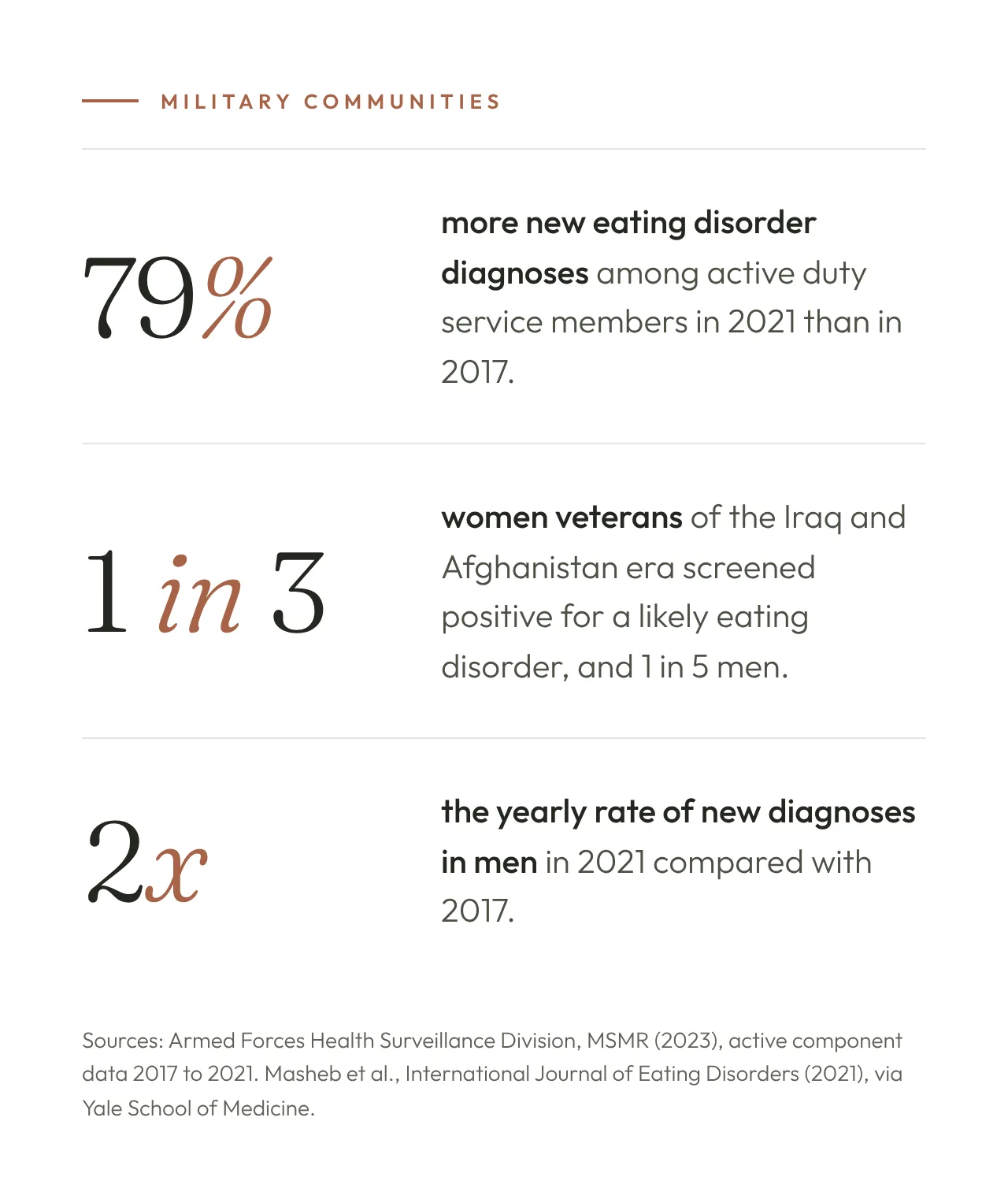
Eating disorders are more common in military communities than most people assume. New diagnoses among active duty service members rose about 79% from 2017 to 2021, and a study of Iraq and Afghanistan era veterans found likely eating disorders in one in three women and one in five men. Military spouses carry real risk too.
- The numbers are rising. Military surveillance data show new eating disorder diagnoses climbing, with the rate in men doubling between 2017 and 2021.
- Military life adds specific pressure. Twice-yearly body composition checks, frequent moves, deployments and trauma can all feed disordered eating.
- Spouses are part of the picture. A study of more than 5,000 military spouses tracked new cases of probable binge eating disorder.
- Coverage depends on the details. TRICARE and VA both have rules about referrals, approvals and which programs qualify. Ask before you assume.
A new way of measuring bodies
In January, the Pentagon directed every branch to assess body fat using a waist-to-height ratio. According to Military Times, the memo sets the limit at a ratio below 0.55, calls for all service members to be evaluated twice a year, and warns that failing the standard may mean withheld promotions and, with continued violations, possible separation.
The Army put its version in place on July 9. As the Joint Base San Antonio news site reported, soldiers now get a waist-to-height assessment twice per calendar year, commanders can order one at any time, and anyone who fails is enrolled in the Army Body Composition Program until they meet the standard.
Fitness standards exist for real reasons, and most people meet them without harm. For someone already vulnerable, though, a measurement with a career attached can become the start of a dangerous pattern: cutting food hard before a weigh-in, then eating urgently once it passes. Military health researchers have named this directly. In a 2023 analysis, the Defense Health Agency's surveillance team pointed to "unhealthy 'making weight' behaviors" as one possible explanation for the diagnoses they were seeing.
What the data show for troops, veterans and spouses
Active duty service members
The Armed Forces Health Surveillance Division counted 2,454 new eating disorder diagnoses among active component service members from 2017 through 2021. The yearly rate rose from 2.8 to 5.0 per 10,000 person-years, an increase of about 79%. Women were diagnosed at more than eight times the rate of men, but the rate among men doubled over the five years. Most cases were bulimia, binge eating disorder, or other and unspecified eating disorders, which do not always look like the textbook picture of anorexia.
Veterans
A Yale and VA team led by Robin Masheb, PhD, surveyed more than 1,100 veterans who served in the Iraq and Afghanistan era. About one third of women and one fifth of men screened positive for a likely eating disorder. Probable atypical anorexia appeared in 14% of women and 5% of men, and bulimia in 6% of women and 3.5% of men. Eating disorders were associated with other concerns veterans commonly carry, including trauma, depression and insomnia.
Military spouses
Spouses rarely appear in this conversation, and they should. The Millennium Cohort Family Study followed 5,269 military spouses over about three years and found that 165 of them, roughly 3%, screened positive for probable binge eating disorder at follow-up. Probable PTSD and adverse childhood experiences raised the risk, and so did having a service member who deployed with combat exposure, compared with one who deployed without it.
The pressures that add up
No single part of military life causes an eating disorder. Genetics, temperament, trauma and history all play a part. But a few features of military life press on the same places eating disorders tend to grow.
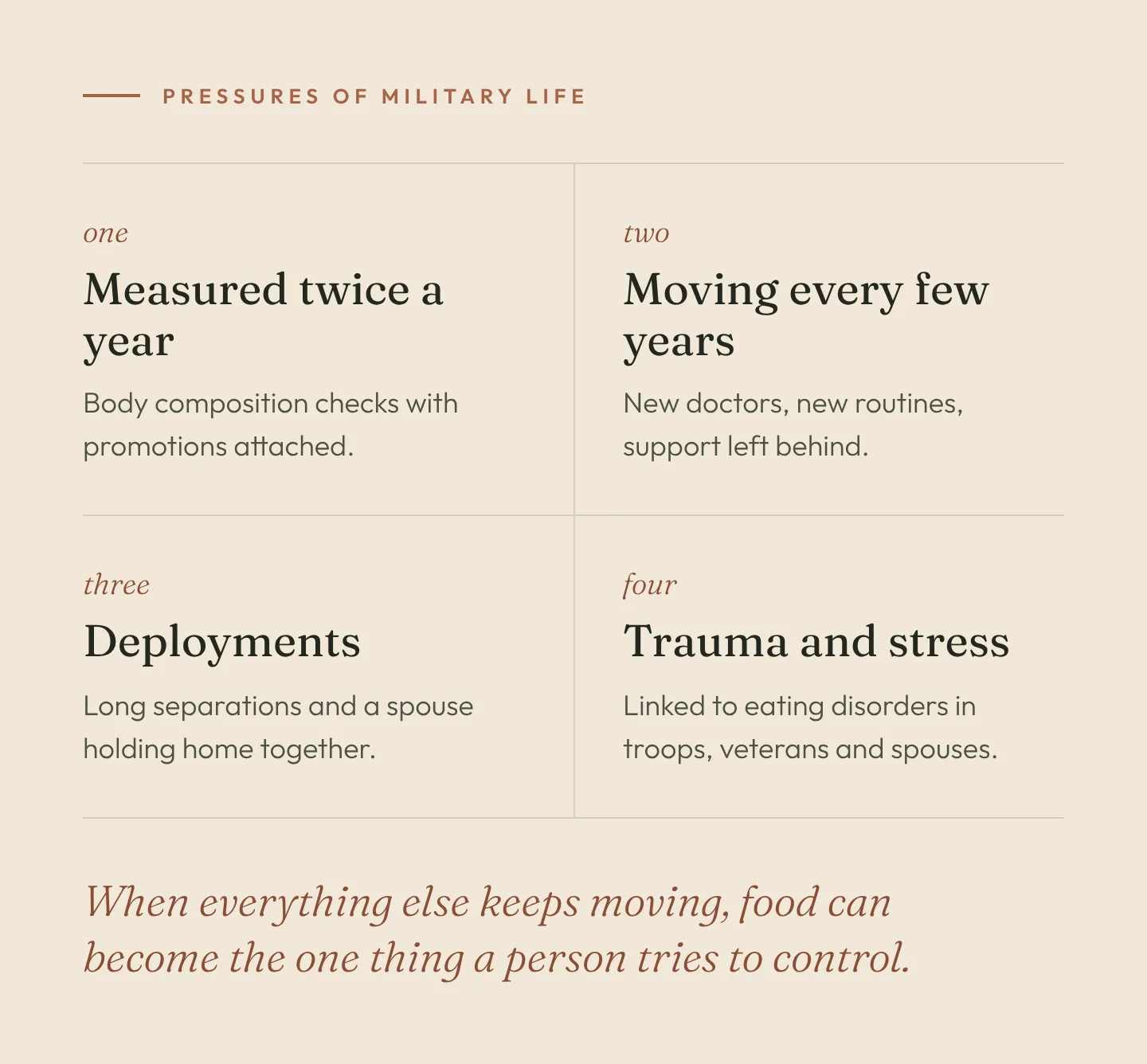
- Being measured. Regular body composition checks put weight and shape at the center of professional life, and the stakes are concrete.
- Moving. A permanent change of station means a new house, new doctors and a new routine. Any treatment that had started often stops, and the friends who noticed changes are now a time zone away.
- Deployment. Long separations change how a household eats. The service member eats on a mission schedule. The spouse at home may skip meals while holding everything together.
- Trauma and chronic stress. In all three groups above, eating disorders traveled with PTSD and other stress. Our page on eating disorders and trauma explains why the two so often appear together.
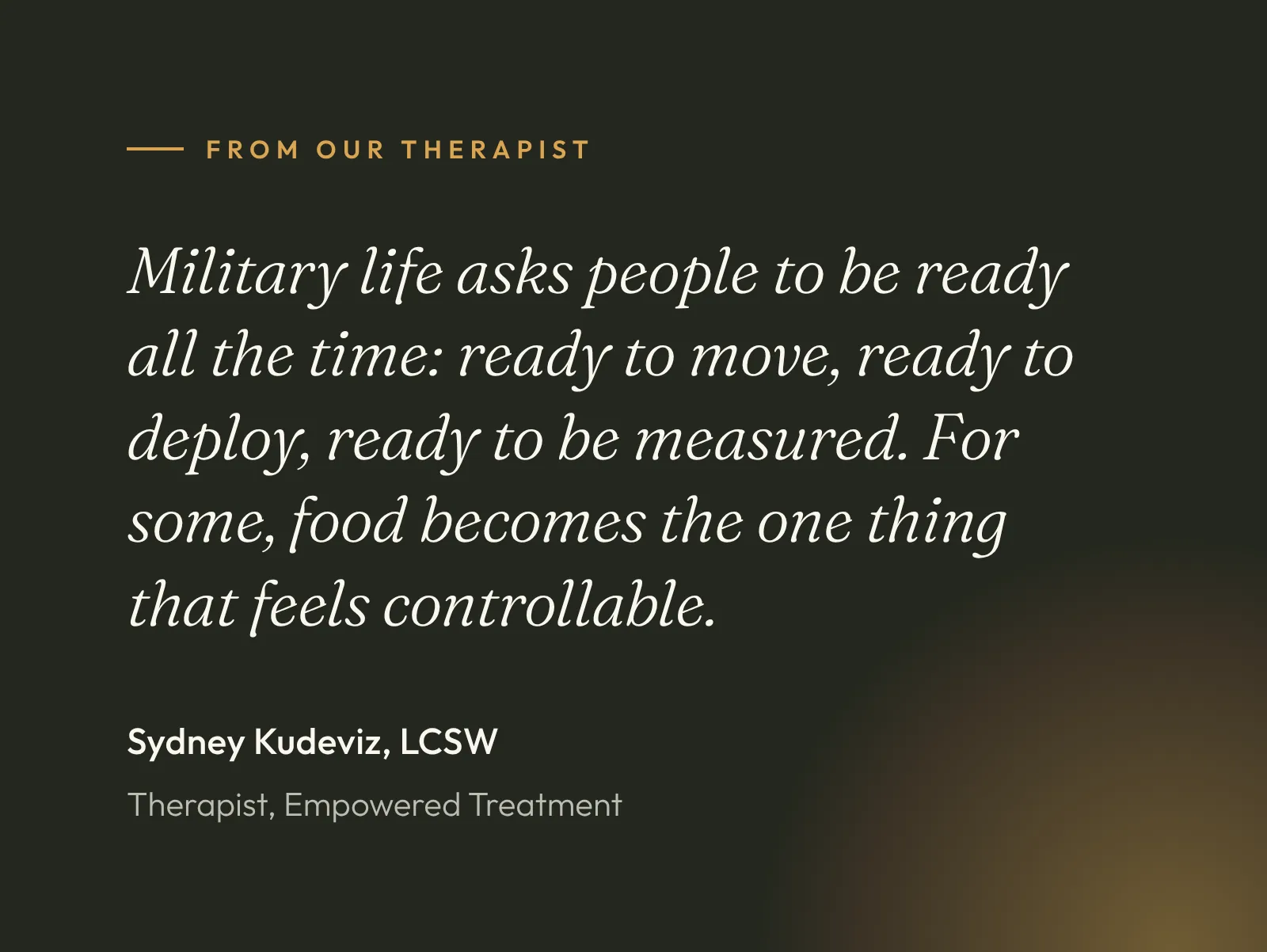
"We work on what that control is protecting before we ask anyone to let it go," says Sydney Kudeviz, LCSW, one of our therapists.
Signs worth paying attention to
In a military household, some of these can pass as discipline or dedication. That is exactly why they are worth a second look:
- Fasting, sweating it out or cutting food hard in the days before a weigh-in or tape test
- Eating large amounts quickly afterward, with a sense of losing control
- Exercise that continues through injury, illness or exhaustion, or that feels mandatory on rest days (our guide to telling healthy exercise from compulsive exercise can help)
- Vomiting, laxatives, diuretics or diet pills used to control weight
- Rigid food rules, eating alone, or anxiety when meals are not under your control
- A spouse who has quietly stopped eating with the family during a deployment
Weight is not a reliable signal. Many people with serious eating disorders sit in a normal or higher weight range, which is part of why conditions like atypical anorexia and binge eating disorder are often missed.
Emily Van Eck, MS, RDN, Dietitian, Empowered Treatment
How TRICARE and VA coverage usually works
Coverage questions are often the first real obstacle, so here is what the agencies themselves say. Rules change, so confirm your own situation with your plan.
TRICARE
- Eating disorder care is a covered benefit. TRICARE covers services needed to treat eating disorders when they are medically necessary and proven, and facilities must be certified.
- Programs must be TRICARE-authorized. In its January 2026 mental health briefing, TRICARE states that all institutional facilities, including partial hospitalization and intensive outpatient programs, must be TRICARE-authorized.
- Active duty members need a referral and pre-authorization for any civilian mental health services, according to the same briefing. TRICARE Prime beneficiaries need a referral for PHP and IOP.
- Pre-authorization rules vary by program. TRICARE's partial hospitalization page and intensive outpatient page list who qualifies and advise checking with your regional contractor.
VA health care
- VA treats eating disorders directly. The South Texas Veterans Health Care System lists eating disorders among the conditions its mental health service treats.
- Community care needs approval. VA's community care rules require approval from your VA health care team before you see an outside provider, and that provider must be in VA's community care network. For mental health, one eligibility standard is a 30-minute average drive time or a 20-day wait.
Whether a particular program, ours included, can be used with your TRICARE or VA benefits depends on your plan, your referral and the program's status. The quickest way to know is to ask. You can send us your insurance details or call (512) 882-4599, and our admissions team will tell you plainly what we find. Our guide to insurance coverage for eating disorder treatment explains the general terms.
Where to start close to home
- Veterans Crisis Line: dial 988 and press 1, or text 838255, any time. It serves veterans, service members, Guard and Reserve members, and the people who support them, whether or not they use VA care.
- South Texas VA mental health: enrolled veterans can call 210-617-5300 through primary care, or use brief walk-in appointments at the 1E clinic at Audie L. Murphy Memorial Veterans Hospital, weekdays from 8:30 a.m. to 4 p.m. New enrollment questions go to 210-949-3981.
- Military OneSource: free, confidential non-medical counseling for active duty, Guard and Reserve members and their immediate families, at 800-342-9647. Mental health conditions are referred to military medical care or TRICARE.
- ANAD Helpline: free eating disorder support and referrals at 1-888-375-7767, Monday through Friday, 9 a.m. to 9 p.m. Central.
Our San Antonio page lists more local support, and our guide on how to help someone with an eating disorder is a good place to start if you are worried about a spouse or a battle buddy.
When outpatient support makes sense
Reach out if weigh-in cycles keep repeating, if food or exercise is taking more of your attention than your work or family, or if a loved one's eating has changed since a move or deployment. You do not need to be certain something is wrong to ask.
Empowered Treatment is an adult eating disorder program in Northwest Austin, about 80 miles up I-35 from San Antonio. We offer an intensive outpatient program at 9 hours a week and a partial hospitalization program at 30 hours a week, with therapists, registered dietitians and psychiatric care on one team. For adults who live too far to commute, our transitional housing in Austin's Hyde Park neighborhood makes day treatment possible. We work with adults from across Texas.
Eating disorders in military families: FAQs
Do military weight standards cause eating disorders?
Weight standards do not cause eating disorders on their own. For people who are already vulnerable, the pressure to make weight can trigger restriction, bingeing or purging. Military health researchers have named "making weight" behaviors as one possible driver of rising diagnoses.
Does TRICARE cover eating disorder treatment?
TRICARE covers medically necessary eating disorder care at certified, TRICARE-authorized facilities. Active duty members need a referral and pre-authorization for civilian mental health care, and Prime beneficiaries need a referral for PHP and IOP. Check with your regional contractor for your plan's rules.
Can veterans use VA benefits for outside eating disorder treatment?
Sometimes. VA community care requires approval from your VA health care team and a provider in VA's community care network. Eligibility depends on standards such as drive time and wait time. Start with your VA primary care team.
Can military spouses get eating disorder treatment at Empowered?
Yes. We treat adults 18 and older of all genders, including spouses and adult family members. Our admissions team can review your benefits and help you understand your options before you commit to anything.
This article is for general education and is not medical advice. Empowered Treatment is not affiliated with the Department of Defense or the Department of Veterans Affairs. If you are in crisis, call or text 988; veterans and service members can press 1.
Sources
- Murray, Mabila, McQuistan. Trends in the incidence of eating disorders among active component service members, 2017 to 2021. Medical Surveillance Monthly Report 30(1). Armed Forces Health Surveillance Division, Defense Health Agency. January 2023.
- Yale School of Medicine. Yale, VA researchers investigate eating disorders in Iraq and Afghanistan war-era veterans. March 24, 2021. Reporting on Masheb RM et al., DSM-5 eating disorder prevalence, gender differences, and mental health associations in United States military veterans. International Journal of Eating Disorders. 2021. doi:10.1002/eat.23501.
- Ray TN, Esquivel AP, McMaster HS, Jacobson IG, Maguen S. Risk and protective factors of probable binge eating disorder in US military spouses: findings from the Millennium Cohort Family Study. American Journal of Epidemiology. 2025;194(6):1631-1641. Published online July 16, 2024.
- Noury T. Pentagon to start measuring troops' body fat by waist-to-height ratio. Military Times. January 13, 2026.
- U.S. Army Public Affairs. Army modifies Body Composition Program, adopts Waist-to-Height Ratio. Joint Base San Antonio. July 9, 2026.
- TRICARE. Eating Disorder Treatment; Partial Hospitalization; Intensive Outpatient Program. Accessed October 29, 2026.
- TRICARE. Mental health and substance use disorder services briefing. January 2026.
- U.S. Department of Veterans Affairs. Eligibility for community care outside VA. Updated September 11, 2025.
- South Texas Veterans Health Care System. Mental health care. Accessed October 29, 2026.
- Veterans Crisis Line. veteranscrisisline.net. Military OneSource. Free, confidential non-medical counseling. ANAD. Eating Disorders Helpline. Accessed October 29, 2026.
- City of San Antonio. Military installations.
Eating disorders are not a choice. Recovery can be.
One confidential conversation is all it takes to start. No pressure. We'll help you find the right next step, even if it isn't with us.