
The Binge-Restrict Cycle: Why Another Diet Won’t Cure Binge Eating
Stay EMPOWERED |
Stay Connected |
Stay EMPOWERED | Stay Connected |
For many people, the urge to start a new diet often appears right after a binge. It can feel like the logical solution. You may find yourself thinking, “If I just have enough willpower this time, I can finally stop bingeing.”
But what many people don’t realize is that dieting itself is often a large part of what keeps binge eating going. In fact, it’s extremely difficult to address binge eating without also addressing the restriction that contributes to it. This pattern is commonly known as the binge–restrict cycle, and it can keep people feeling stuck for years.
Understanding how this cycle works can be an important step toward healing your relationship with food.
What Is the Binge–Restrict Cycle?
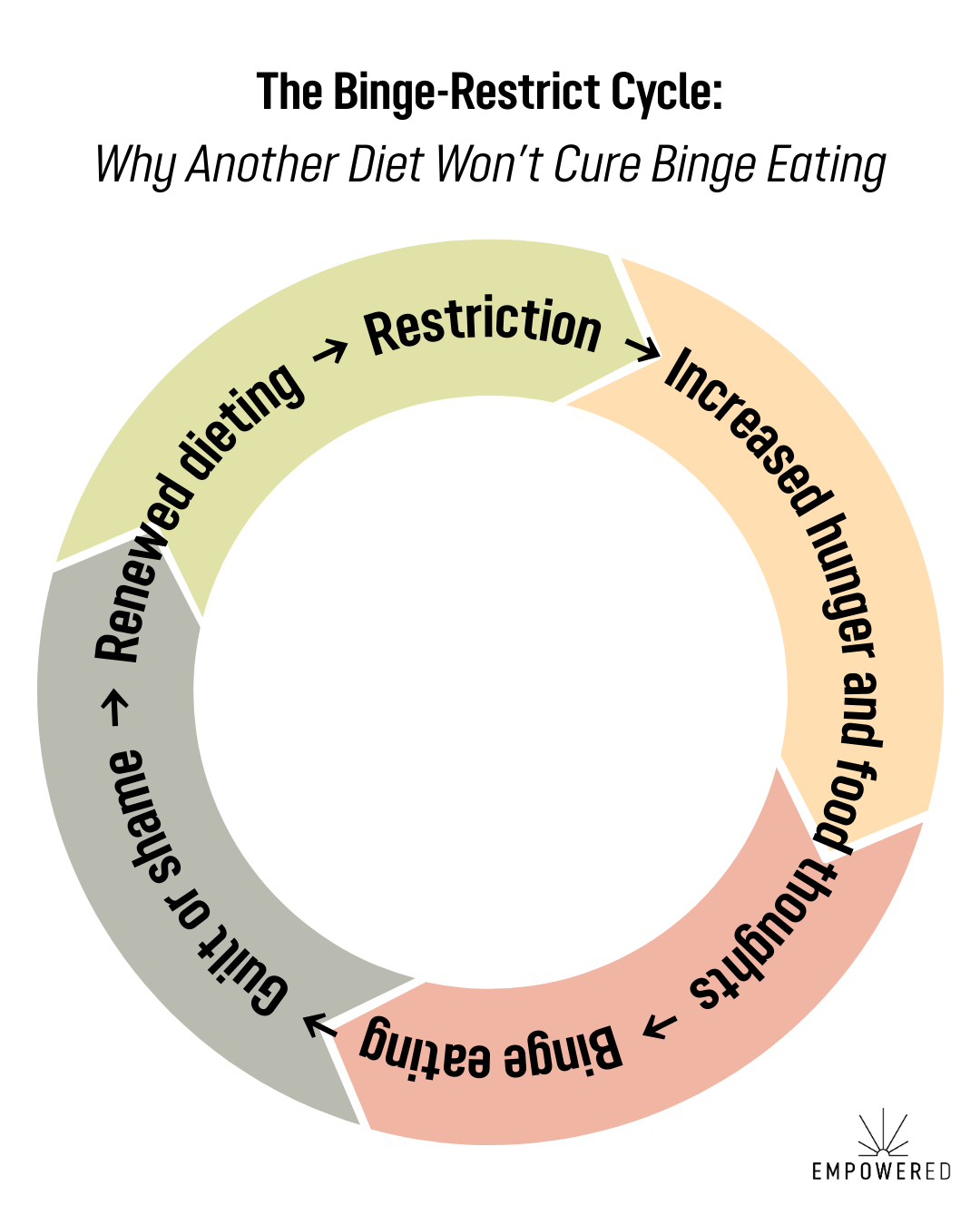
The binge–restrict cycle describes a pattern where periods of restriction lead to binge eating, followed by guilt and eventually another attempt to diet. I often compare diets to toxic relationships, where people find themselves getting hurt by the diet but always getting sucked back in thinking “it will be different this time.”
Many people recognize this pattern:
Restriction → increased hunger and food thoughts → binge eating → guilt or shame → renewed dieting → repeat.
Most of us have had the experience of telling ourselves, “The diet starts Monday.” By Tuesday, however, food may already feel more mentally enticing. You might notice more “food noise,” stronger cravings, or that you keep returning to the kitchen.
This can create an uncomfortable internal push and pull. On one hand, you feel hungry and dissatisfied. On the other hand, you may feel guilty for wanting more food. Some people begin to believe there is something wrong with them for feeling so hungry or so preoccupied with food. Some people even describe feeling “addicted” to food.
As restriction continues, the body and brain become increasingly focused on food. Eventually, you may eat one of your “forbidden” or “off-limits” foods. In that moment, many people experience a shift in thinking: “I already broke my diet, so I might as well eat everything now.”
This moment is called disinhibition, when rigid food rules go out the window and people experience a loss of control around food.
When we look at the cycle closely, it becomes clear that the binge itself is often not the starting point of the problem. The restriction leading up to it plays a significant role.
Restriction Isn’t Always Obvious
When people think about restriction, they often imagine strict dieting or dramatically reducing calories. However, restriction can also be psychological.
Mental restriction might include:
labeling foods as “good” or “bad”
having foods that are completely off-limits
feeling like certain foods must be earned
believing you must “make up for” eating certain foods later
Even when someone is eating enough calories, these mental rules can still create feelings of deprivation that fuel binge eating.
In my work with patients, I often explain that both physical restriction and psychological restriction need to be addressed when working to stop binge eating.
Why Restriction Leads to Binge Eating
The binge–restrict cycle is not simply about willpower. Biology plays an important role.
Our bodies are designed to maintain balance and protect us from starvation. When the brain senses that food intake is restricted, it increases hunger signals and heightens attention toward food. This is the body’s way of encouraging us to seek food to stay alive during times of scarcity.
From this perspective, binge eating can be understood as a natural response to deprivation, rather than a personal or moral failure.
Breaking the Binge–Restrict Cycle

A woman smiling indoors.
Now that we know dieting contributes to binge eating, the path forward may sound surprising.
Breaking the cycle often involves reducing restriction rather than increasing it.
This may include:
eating consistently throughout the day
challenging black-and-white thinking about food
moving away from labeling foods as “good” or “bad”
allowing a wider variety of foods without shame
When people gradually give themselves permission to eat a broader range of foods, the urgency and intensity around those foods often decrease. Over time, binge episodes may become less frequent and less intense.
This process can feel unfamiliar or even scary at first. But with the support of a dietitian and therapist at Empowered, many people can rebuild trust with their bodies and develop a more stable relationship with food.
How to Care for Yourself After a Binge

A man looking at himself in a mirror.
If a binge does occur, responding with care rather than punishment can help interrupt the cycle.
Some gentle ways to support your body afterward may include:
brushing your teeth or rinsing your mouth
taking a warm shower or bath
going for a gentle walk to support digestion
sipping warm ginger or herbal tea
practicing slow breathing to reduce physical discomfort
It can also be helpful to challenge shame-based thoughts. Instead of viewing the binge as a failure, try to approach it as neutral information. Ask yourself what may have contributed to the binge this time and what support might help in the future.
Most importantly, remember that binge eating is not a moral failure. There is nothing inherently wrong with you for struggling with this pattern.
Recovery Is Possible
For many people, binge eating originally develops as a way of coping with difficult emotions or stress. Dieting often enters the picture later as an attempt to fix the problem, but it can unintentionally make bingeing worse.
Healing involves addressing both the emotional and behavioral pieces of the cycle while ensuring the body does not feel deprived.
With time, patience, and the right support, it is possible to step out of the binge–restrict cycle and develop a more peaceful relationship with food. If you or a loved one are struggling with binge eating or restrictive eating patterns, professional support from eating disorder specialists can make a meaningful difference in recovery.