
Eating disorders in Latino and Hispanic families: what Houston families should know
Eating disorders show up in Latino families about as often as anywhere else. They are noticed less, named less and treated less. Here is what the research says, and what families in Houston can do with it.

Do eating disorders affect Latino families?
Yes. Latino and Hispanic adults develop eating disorders at rates similar to non-Latino white adults, and binge eating is especially common. They are far less likely to be asked about symptoms or to receive treatment. In one national study, only 17% to 35% of Latino adults with eating disorder symptoms had ever been treated for them.
- The illness is not rare here. National research finds bulimia, binge eating disorder and binge eating at rates in line with, or above, those of non-Latino white adults.
- The gap is in care, not in risk. Latino adults with eating disorders use mental health care less often, and clinicians have been shown to refer them less often.
- Family is a strength in recovery. In research with Latina adults, family support was one of the main reasons people stayed in treatment.
- Culture belongs in the plan. Good care keeps the foods, meals and traditions a family loves, and helps change the conversations that hurt.
A city where this conversation matters at scale
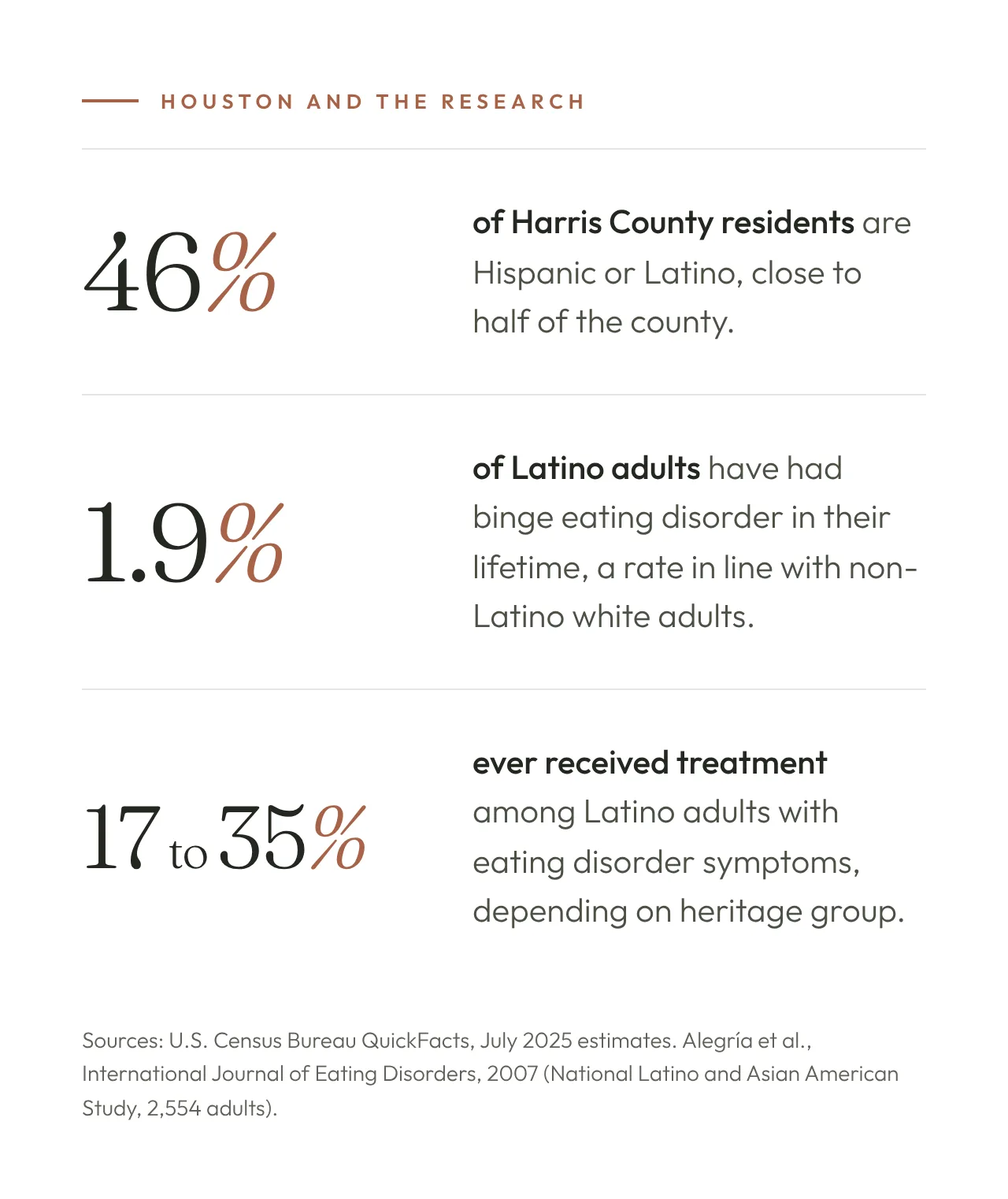
According to the U.S. Census Bureau, 46.1% of Harris County residents and 44.2% of people living in the city of Houston are Hispanic or Latino. About 45% of Harris County residents age 5 and older speak a language other than English at home.
Latino Houston is not one community. It includes families whose roots run back generations in Texas and families who arrived last year, Mexican, Salvadoran, Honduran, Colombian, Venezuelan, Cuban, Puerto Rican and many more, with different foods, faiths, languages and ideas about health. Nothing below describes every family. It describes patterns researchers have found and that clinicians hear about, offered so families can recognize what applies to them and leave what does not.
Common, under-recognized and under-treated
The largest national look at this question, the National Latino and Asian American Study, interviewed 2,554 Latino adults. Alegría and colleagues reported lifetime rates of 1.61% for bulimia nervosa, 1.92% for binge eating disorder and 5.61% for any binge eating, figures within the range seen in non-Latino white samples. Anorexia was rare in that sample, which does not mean it is absent; it means too few cases were found to estimate it well.
The more striking finding was about treatment. Among Latino adults who reported at least one eating disorder symptom, the share who had ever received treatment for it ranged from about 17% to 35%, depending on heritage group.
A later analysis of the same national data, published by Marques and colleagues in 2011, compared groups directly. Bulimia was more common among Latino respondents than among non-Latino white respondents, any binge eating was more common in every ethnic minority group studied, and lifetime use of mental health services was lower among minority respondents with an eating disorder.
Part of the gap sits with the health system. In a 2003 study of a national screening program, Latino participants were significantly less likely than white participants to be referred for further evaluation, even when their symptoms were just as severe, and ethnic minority participants with eating concerns were less likely to have been asked about them by a doctor. The authors pointed to clinician bias as a likely barrier. The stereotype of who gets an eating disorder still shapes who gets asked, a pattern we write about in why you cannot see an eating disorder.
Where culture can help, and where it can hurt
In in-depth interviews with Latina women who had lived with eating disorders, researchers heard about practical barriers, such as not knowing much about eating disorders and not finding bilingual treatment, alongside quieter ones: stigma, fear of not being understood, keeping family matters private and not feeling ready. The same study found that family support was a key reason people stayed in treatment once they started.
Food as love
In many homes, cooking for someone is how care gets expressed, and accepting a second plate is how it gets received. That generosity is a gift, and it can also make it hard for someone who is restricting to say no, or for someone who binges to say they are struggling. Families do not need to give up the meal. They may need to change the pressure around it.
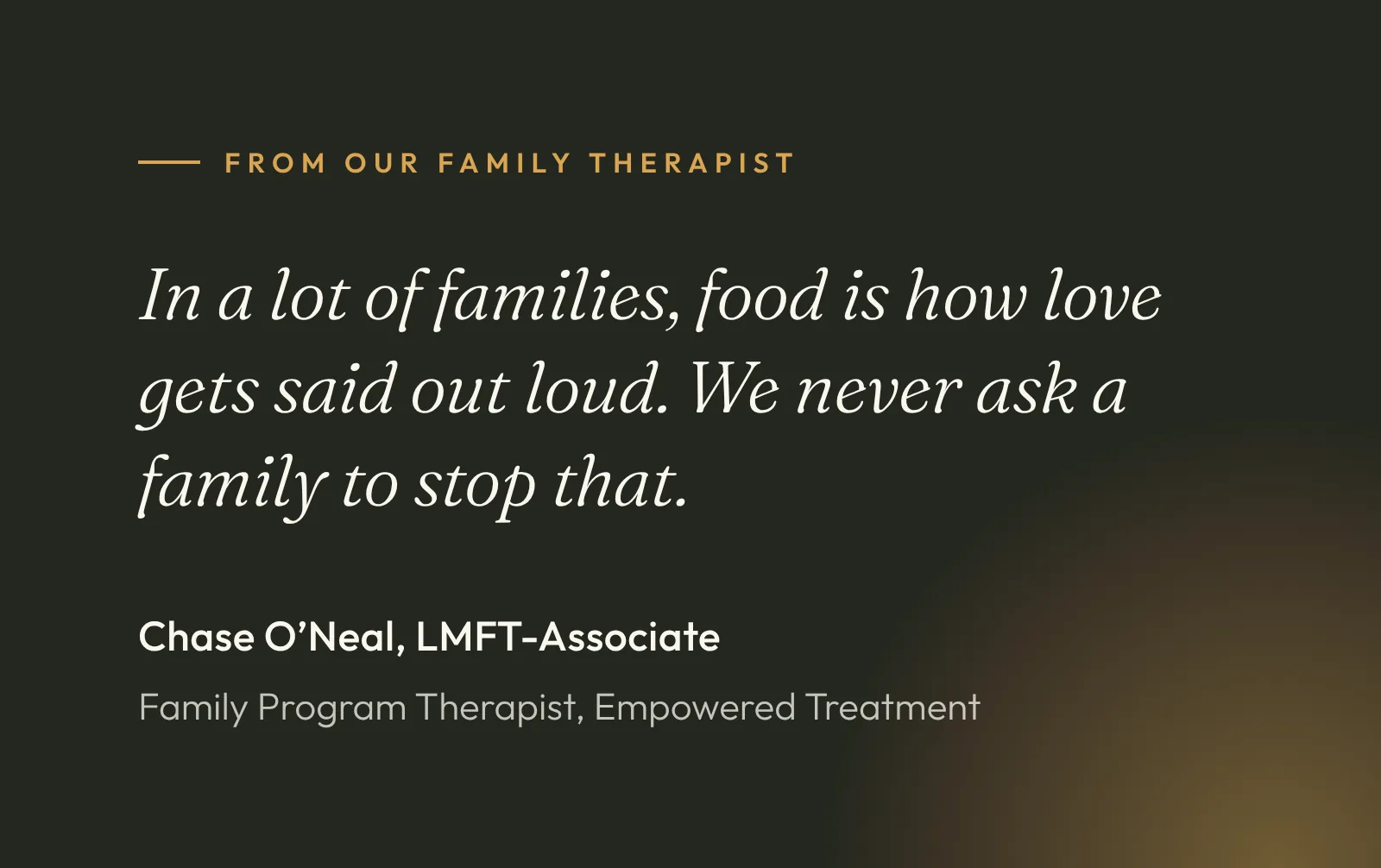
"We help them find ways to keep showing up at the table that also protect the person who is healing," adds Chase O'Neal, LMFT-Associate, our family program therapist.
Comments about bodies
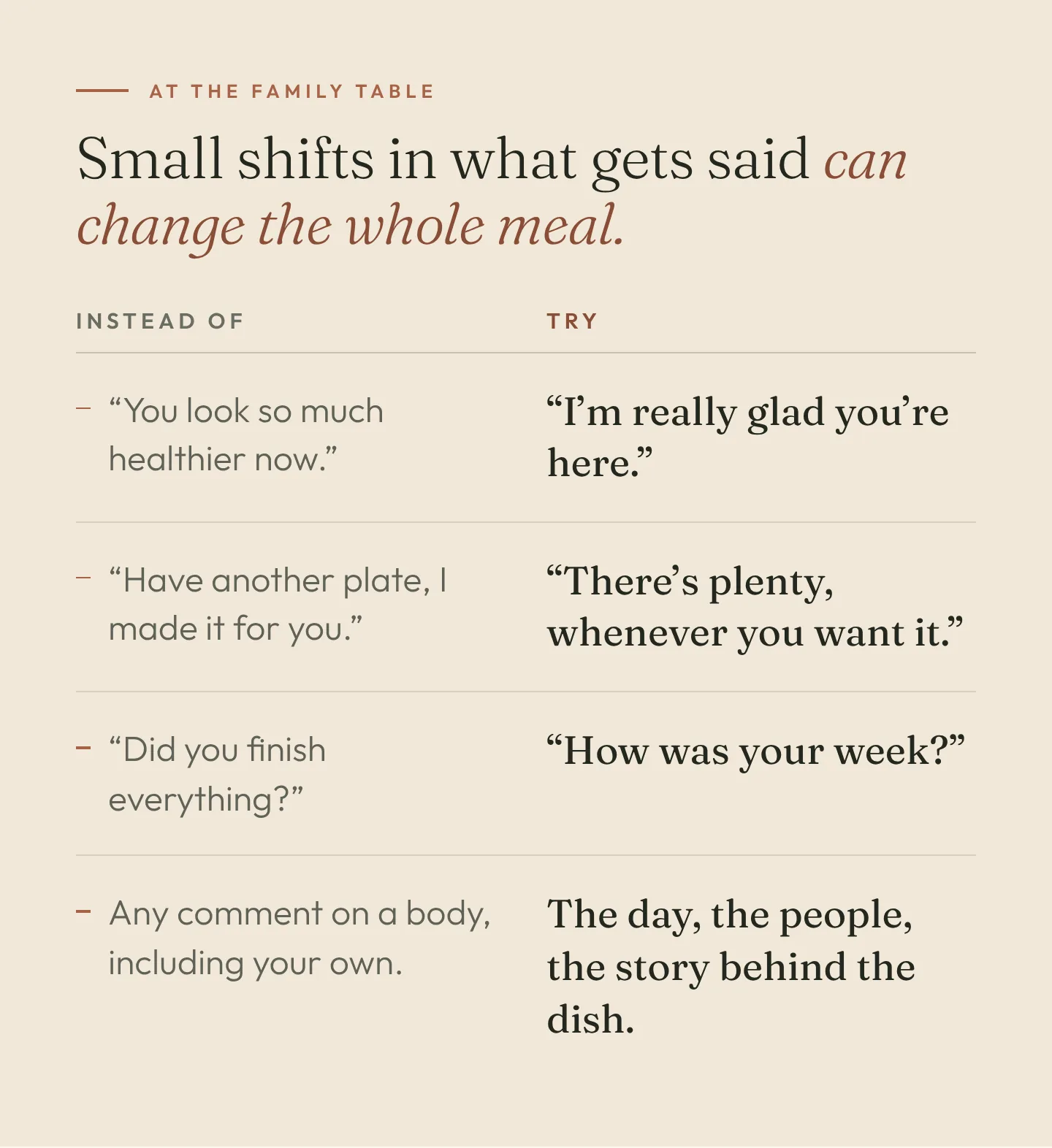
Remarks about weight are common in plenty of families, often meant kindly: you look healthier, you got so thin, are you sure you want seconds? For someone with an eating disorder, any comment about a body, praise included, can feed the illness. Our guide to handling comments about your weight offers scripts for the person in recovery; the card below is for everyone else at the table.
Stigma and privacy
Some families treat mental health as something to handle at home, or worry about what an eating disorder says about the family. Others assume eating disorders belong to someone else. Neither belief protects anyone. Eating disorders are medical and psychiatric illnesses with real physical risks, and they respond to treatment.
Signs worth noticing in an adult you love
Whether you are a parent of an adult child, a partner, a sibling or the person who is struggling, these patterns deserve a conversation with a specialist:
- Eating large amounts in a short time with a sense of losing control, often in secret
- Skipping family meals, always having eaten already, or eating very differently in front of others
- Vomiting, laxatives, fasting or hours of exercise after eating
- Rigid rules about food groups, including the dishes they grew up loving
- Strong shame about their body, or a body that is changing quickly in either direction
- Dizziness, fainting, dental problems or stomach trouble without a clear cause
Eating disorders affect people in every body size. Someone in a larger body who binges or restricts is not "just dieting," and their symptoms are as real as anyone's. Our binge eating disorder and bulimia pages explain how each is diagnosed and treated.
If you are worried about an adult child, our guide to talking with your adult child about their eating walks through how to open the conversation without blame.
Treatment that makes room for the whole family
Research suggests that bringing family into adult treatment can help Latino patients stay engaged. In the Promoviendo una Alimentación Saludable trial, adding family sessions to cognitive behavioral therapy for Latina adults was linked to better attendance and retention, though symptom outcomes were similar either way. Staying in treatment matters, and families can make it easier.
At Empowered, families of adult clients are invited into family education, and our dietitians build meal plans around the food people actually eat at home. Our guide to family meals during recovery covers how to make the table a calmer place.
Emily Van Eck, MS, RDN, Dietitian, Empowered Treatment
Questions worth asking any provider
- Have you treated adults from Latino or Hispanic families, and how do you include family?
- Can sessions, family meetings or written materials be offered in Spanish if a relative needs that?
- Will the meal plan include the foods my family cooks?
Help in Spanish and in Houston
- 988 Suicide and Crisis Lifeline. Call 988 and press 2 for a Spanish-speaking crisis counselor, or text 988 and type "Ayuda." Available any time.
- MedlinePlus en español. The National Library of Medicine's plain-language overview, Trastornos de la alimentación, covers types, symptoms and treatment.
- NIMH en español. The National Institute of Mental Health publishes Spanish-language booklets on eating disorders, free to read or download.
- Find a dietitian who speaks your language. The Academy of Nutrition and Dietetics directory, Find a Nutrition Expert, can be searched by location, specialty and language.
- Eating disorder helplines (English). ANAD's helpline at 1-888-375-7767 and the National Alliance for Eating Disorders at 866-662-1235 offer free support and referrals.
- Crisis care in Harris County. The Harris Center for Mental Health and IDD runs a 24/7 crisis and access line at 713-970-7000. In an emergency, call 911.
Specialized care, a short drive from Houston
Empowered Treatment is an adult eating disorder program in Northwest Austin with a partial hospitalization program of about 30 hours a week and an intensive outpatient program of about 9 hours a week. Adults from across Texas attend, and our transitional housing in Hyde Park gives people coming from Houston a place to stay during treatment. Our Houston page covers the drive, family visits and what coming to Austin involves.
You can check your insurance benefits online, or call (512) 882-4599 to talk it through with our team.
Latino families and eating disorders: FAQs
Are eating disorders common among Latino adults?
Yes. National research finds bulimia, binge eating disorder and binge eating among Latino adults at rates similar to or higher than those of non-Latino white adults. What differs is care: Latino adults with symptoms are much less likely to have been treated.
Why are eating disorders missed in Latino patients?
Stereotypes about who develops eating disorders, fewer questions from doctors, limited bilingual care and stigma all play a part. One study found Latino participants were less likely to be referred for evaluation even when symptoms were equally severe.
Can our family's foods be part of recovery?
Yes. A good meal plan is built around the food a person eats at home. Our dietitians include family dishes and traditions rather than replacing them.
How can parents help an adult child with an eating disorder?
Lead with care rather than comments about weight or food, keep body talk off the table, and encourage an assessment with an eating disorder specialist. Family education during treatment helps parents learn what supports recovery.
This article is for general education and is not medical advice. If you are in crisis, call or text 988.
Sources
- U.S. Census Bureau. QuickFacts: Harris County, Texas; Houston city, Texas. Population estimates, July 1, 2025.
- Alegría M, Woo M, Cao Z, Torres M, Meng XL, Striegel-Moore R. Prevalence and correlates of eating disorders in Latinos in the United States. International Journal of Eating Disorders. 2007;40(S3):S15-S21. doi:10.1002/eat.20406.
- Marques L, Alegría M, Becker AE, et al. Comparative prevalence, correlates of impairment, and service utilization for eating disorders across US ethnic groups. International Journal of Eating Disorders. 2011;44(5):412-420. doi:10.1002/eat.20787.
- Becker AE, Franko DL, Speck A, Herzog DB. Ethnicity and differential access to care for eating disorder symptoms. International Journal of Eating Disorders. 2003;33(2):205-212. doi:10.1002/eat.10129.
- Reyes-Rodríguez ML, Ramírez J, Davis K, et al. Exploring barriers and facilitators in eating disorders treatment among Latinas in the United States. Journal of Latina/o Psychology. 2013;1(2):112-131. doi:10.1037/a0032318.
- Reyes-Rodríguez ML, Watson HJ, Smith TW, Baucom DH, Bulik CM. Promoviendo una Alimentación Saludable (PAS) results: Engaging Latino families in eating disorder treatment. Eating Behaviors. 2021;42:101534. doi:10.1016/j.eatbeh.2021.101534.
- 988 Suicide and Crisis Lifeline. Is the 988 Lifeline available in other languages?
- MedlinePlus en español. Trastornos de la alimentación. U.S. National Library of Medicine.
Eating disorders are not a choice. Recovery can be.
One confidential conversation is all it takes to start. No pressure. We'll help you find the right next step, even if it isn't with us.