
Coming home to Houston after eating disorder treatment: how to build your aftercare team
Finishing a program in Austin is a real milestone. The weeks after it, back in your own kitchen and your own schedule, are where that progress gets protected. Here is how to set up the team that does the protecting.

What should eating disorder aftercare in Houston include?
A strong aftercare plan in Houston includes an outpatient therapist, a registered dietitian, a psychiatric provider if you take medication, and a primary care doctor for medical checks. Ideally each first appointment is booked before you leave treatment, with records shared, a written relapse plan and a clear path back to more support if needed.
- The first year matters most. Research on anorexia finds relapse risk is highest in the first year after treatment, which is why the handoff deserves real planning.
- Step down, do not drop off. Moving from PHP to IOP to weekly outpatient care lets structure come off gradually.
- Book before you leave. The safest aftercare has dates on the calendar, not a list of names to call later.
- Know your warning signs. A short, written list of early signs, shared with someone you trust, catches slips while they are small.
The handoff is part of the treatment
Treatment builds new habits inside a lot of structure: scheduled meals, daily groups, a team that sees you most days. Going home removes much of that at once, while work, family and Houston traffic come back all together.
The research is honest about this window. A 2017 systematic review in the Journal of Eating Disorders found reported relapse rates in anorexia ranging from 9% to 52%, depending on how relapse was defined and how long people were followed, and agreement that risk is especially high in the first year after treatment.
None of that is a prediction about you. It is the reason good programs plan the exit as carefully as the entrance. For the skills side of staying well, including how to tell a lapse from a relapse, read our practical guide to relapse prevention. This post is about the people and the logistics.
From PHP to IOP to outpatient care
Most people do not go from full days of treatment straight to one hour a week. At Empowered, the partial hospitalization program runs about 30 hours a week with supported meals, and the intensive outpatient program runs about 9 hours a week, built to fit around work or school. Many Houston clients stay in our transitional housing during PHP, then decide with their team whether to finish IOP in Austin or head home with a full outpatient team in place.
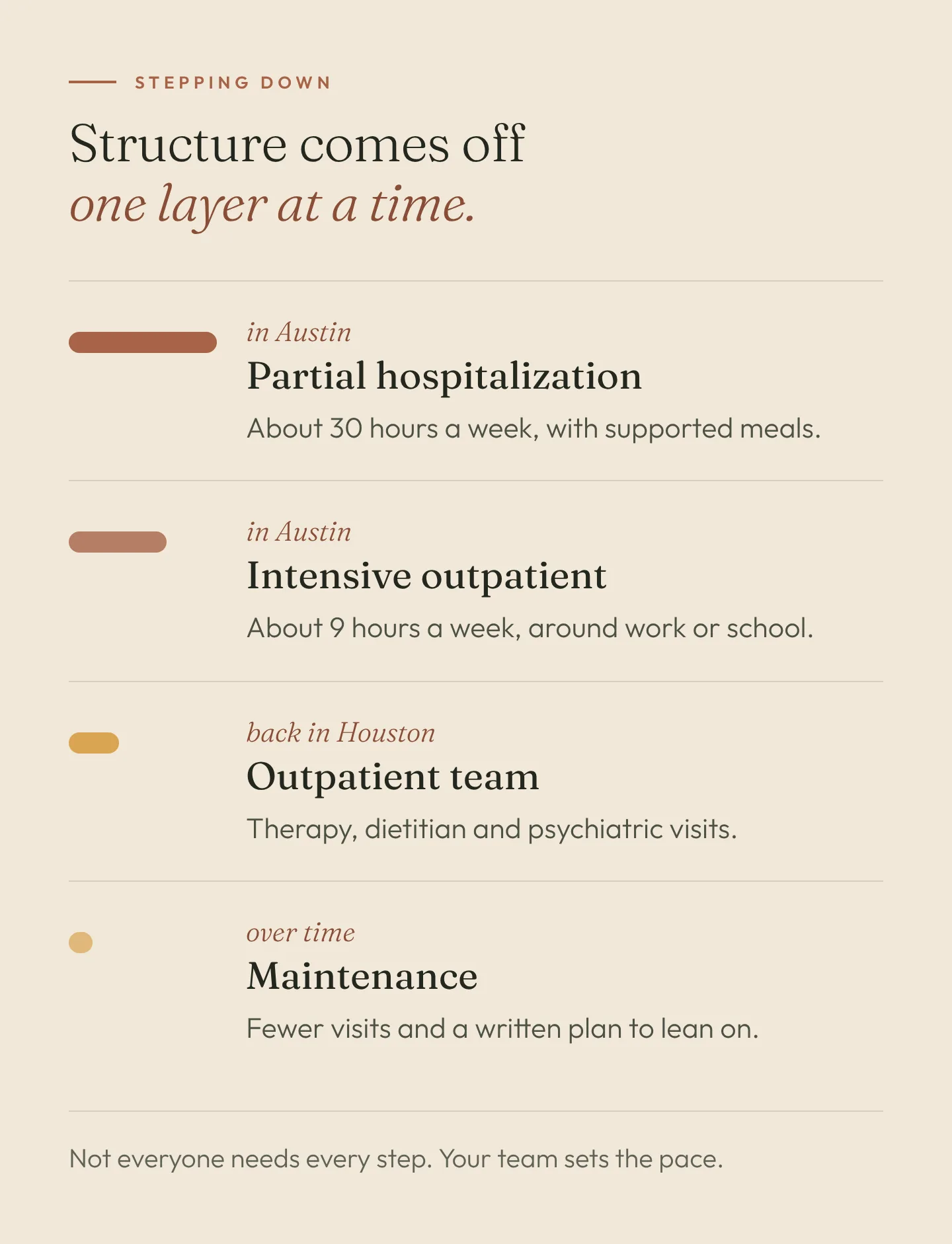
The order can also run the other way. Stepping back up to IOP for a few weeks during a hard season is a normal use of the system. Our page on levels of care explains how each level fits together.
Who belongs on your Houston aftercare team
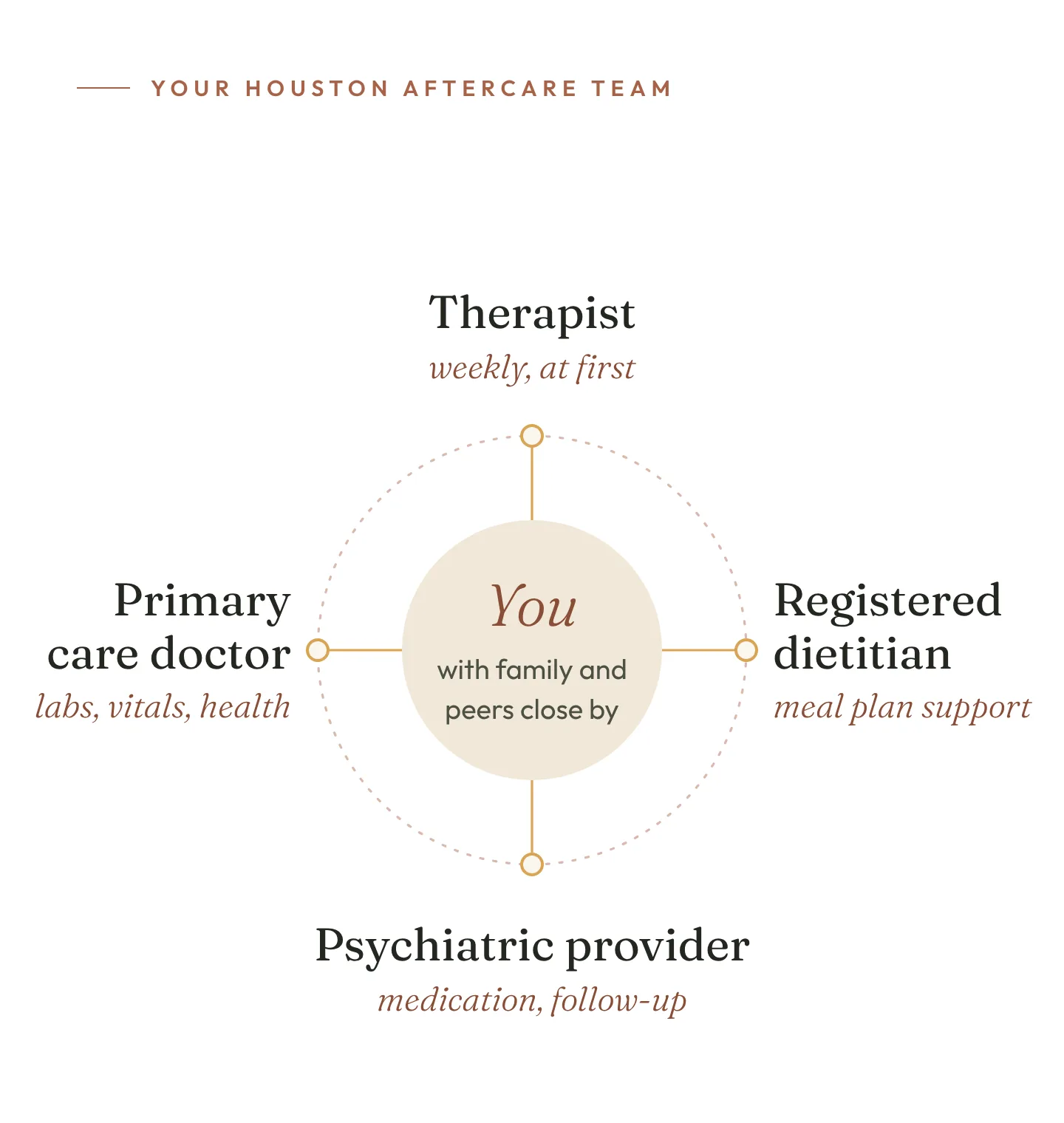
An outpatient therapist
Look for someone who treats eating disorders regularly, not occasionally. Ask how many eating disorder clients they see, which approaches they use, and whether they are comfortable coordinating with a dietitian and prescriber. Weekly sessions are typical at first. Texas counselors, social workers, marriage and family therapists and psychologists can all be checked through the Texas Behavioral Health Executive Council's license search.
A registered dietitian
A dietitian with eating disorder experience keeps the meal plan alive at home, adjusts it as life changes, and is often the first to notice drift. The Academy of Nutrition and Dietetics' Find a Nutrition Expert directory lets you search the Houston area by specialty, language and insurance. Ask directly whether they follow a non-diet, recovery-focused approach.
A psychiatric provider
If you take medication for depression, anxiety, sleep or another co-occurring condition, you need a prescriber in Houston before your current supply runs out.
Reggie Graves, MSN, PMHNP-BC, FNP-C, Psychiatric Nurse Practitioner, Empowered Treatment
A primary care doctor
Eating disorders affect the heart, bones, electrolytes and hormones. A primary care physician who knows your history can track vitals and lab work and spot medical warning signs early. Send them your treatment summary so they are not starting from scratch.
Peer and family support
Free, eating disorder specific groups add connection between appointments. The National Alliance for Eating Disorders runs free, therapist-led weekly groups, virtual and in person, and ANAD offers free peer support groups and a helpline at 1-888-375-7767. Families can keep learning through our family guide to IOP and meal support at home.
What Empowered coordinates before you leave
Aftercare planning at Empowered starts well before the last week. As you get closer to stepping down, your team works with you to:
- Identify a therapist, dietitian and psychiatric provider in the Houston area who fit your needs and insurance
- Share records and a treatment summary with your permission, so new providers understand what has worked
- Arrange clinician-to-clinician conversations where possible, which carry more than paperwork does
- Make a plan for medication management that bridges you to your first Houston appointment
- Write a relapse prevention plan with your warning signs, coping skills and the people you will call
- Invite family into a planning conversation, if you want them there

"The weeks right after someone steps down are when we want the plan to be the most concrete," says Maryam Mahmoud, LCSW, LCDC, who leads our transitional services.
How to find providers in the Houston area
- Start with your insurer. Call the member services number on your card and ask for in-network therapists and dietitians who treat eating disorders, plus your outpatient mental health benefits. You can also verify your benefits with us while you are still in care.
- Ask your current team. Clinicians in this field often know who is good, who has openings and who coordinates well.
- Check the commute. Houston is big. A provider 50 minutes away at rush hour is a provider you will cancel on. Telehealth visits can fill gaps if your plan covers them.
- Interview before you commit. A short call about experience, approach and availability is reasonable and expected.
- Keep crisis numbers handy. Call or text 988 any time. In Harris County, The Harris Center runs a 24/7 crisis and access line at 713-970-7000. In an emergency, call 911.
If you are a family member supporting someone through this, our post on eating disorders in Latino and Hispanic families covers how families can help at the table and where to find Spanish-language resources.
Early warning signs after you get home
Slips usually start quietly. Share a short list like this with your therapist and one person at home:
- Skipping snacks or meals with good-sounding reasons
- Food variety narrowing back to a few "safe" foods
- Canceling or pushing back appointments
- Body checking, weighing or exercise rules creeping back
- Pulling away from meals with others or from friends
- Sleep, mood or anxiety getting noticeably worse
Noticing a sign is not a failure. It is the moment to call your team, return to structured eating and tell someone. If things have already slipped further, our guide on relapse after treatment walks through next steps, and coming back to Empowered for a period of IOP is an option we are always glad to talk through.
Planning treatment from Houston
Empowered Treatment is an adult eating disorder program in Northwest Austin, about 165 miles from Houston, offering PHP, IOP and transitional housing. Adults come to us from across Texas, and aftercare planning for your return home is part of care from the start. Our Houston page covers the drive, family visits and housing. If you are still at the very beginning, our guide to finding eating disorder help in Houston walks through where to start. If you are moving in the other direction, our guide to continuing care after a move to Austin may help.
Call (512) 882-4599 or request information to talk with our team.
Aftercare in Houston: FAQs
When should I start planning aftercare?
Early in treatment, not in the final week. At Empowered, continued-care planning begins well before you step down, so providers in Houston can be found, records shared and first appointments booked before you leave.
How often should I see my therapist and dietitian after treatment?
Weekly is common at first, then less often as recovery steadies. Your treatment team will recommend a starting frequency based on your history and how the step-down has gone.
What if I cannot find an eating disorder specialist near me in Houston?
Ask your insurer and your current team for referrals, search professional directories by specialty, and consider telehealth for part of your care. A generalist who coordinates closely with a specialist can also work.
Can I go back to IOP if things get hard?
Yes. Stepping back up for a while is a normal part of recovery, not a failure. Call us at (512) 882-4599 and we will look at what level of care fits now.
This article is for general education and is not medical advice. If you are in crisis, call or text 988.
Sources
- Khalsa SS, Portnoff LC, McCurdy-McKinnon D, Feusner JD. What happens after treatment? A systematic review of relapse, remission, and recovery in anorexia nervosa. Journal of Eating Disorders. 2017;5:20. doi:10.1186/s40337-017-0145-3.
- Texas Behavioral Health Executive Council. Verify a License.
- Academy of Nutrition and Dietetics. Find a Nutrition Expert.
- National Alliance for Eating Disorders. Support Groups and Programs.
- ANAD. Eating Disorders Helpline.
- The Harris Center for Mental Health and IDD. Crisis and Access Line.
Eating disorders are not a choice. Recovery can be.
One confidential conversation is all it takes to start. No pressure. We'll help you find the right next step, even if it isn't with us.